
Moving to Japan from the US
We pack, ship and handle customs.
Guide to relocating from the US to Japan
Before the container leaves, your mover or forwarder files Electronic Export Information in the Census Bureau's Automated Export System. That filing is needed when your household goods are worth more than the Census Bureau's reporting threshold, and at any value for a car or anything that needs an export licence. The filing reference goes to the carrier 24 hours before loading.
Japan exempts used household effects from customs duty and consumption tax when you move there to stay at least a year. The conditions: you declare the separately shipped goods on Customs Form C-5360 on the day you arrive, and they clear Customs within six months of your entry.
We do not print a US to Japan sea-transit day count, because it changes with the carrier service, the US port and the routing. We confirm the scheduled sailing from the carrier when you request an estimate, and we leave slack for the Atlantic hurricane season on East Coast sailings.
US citizens can enter Japan without a visa for up to 90 days, but that is for short stays, and the Working Holiday visa is not open to Americans. To live there you need a Certificate of Eligibility and a visa, or one of the routes covered below: the six-month digital nomad status, Business Manager or Highly Skilled Professional.
Japan's supply is 100 V, below the 110-120 V in US homes, so read every appliance label. Tokyo waives both driving-licence checks for only seven US states, and dogs and cats from anywhere in the US except Hawaii and Guam must follow the full 180-day route.
A move from the US to Japan has two customs halves. In the US, your mover files the export record in the Automated Export System, and a car, firearms or protected-species items bring their own steps. In Japan, the duty relief for people moving house turns on what you do the day you land: you hand Customs a declaration for your separately shipped goods and keep the sealed copy until they clear.
We book the export filing, the sailing and the customs broker in Japan, and your dedicated specialist stays on your shipment until delivery. Two jobs stay with you because Japan's rules put them there: the declaration on arrival and your visa.
This page covers the US export steps, Japan's customs relief and Form C-5360, what is banned or restricted, US ports and sailings, the seasons at both ends, visas for US citizens, US tax and Social Security, driving, health cover, dogs and cats, and a checklist. For the destination as a whole, see our guide to relocating to Japan.
Customs for a US to Japan move
The US side is an export filing that your mover or forwarder makes, not a duty. The Japanese side is a relief. Under Customs Tariff Law Article 14, item 8, used household effects and professional equipment brought by a person who enters Japan to move their home there are exempt from customs duty, and Japan Customs describes household effects for a move as free of duty and tax. The conditions start on the day you land.
A licensed broker can clear the goods for you in Japan, but you make the declaration on arrival yourself and you must keep the sealed copy that Customs hands back. Customs says it cannot redo that step for any reason, and that includes a lost copy.
On the US side, three bodies matter. The Census Bureau sets the filing rules (the Foreign Trade Regulations) and the filing goes through the Automated Export System. CBP takes the vehicle details at the port if you ship a car. The Bureau of Industry and Security in the Commerce Department licenses controlled exports such as firearms. Your forwarder deals with all three, and you supply a power of attorney and an accurate inventory.
Japan exempts used household goods and professional equipment from customs duty, and from import consumption tax, for people who move their home to Japan. You qualify if you will stay in Japan for at least one year, shown by your passport or other official documents, or if you are returning after living abroad for at least one year. The goods must be things you and your family use personally, in a reasonable quantity. Cars, boats and aircraft follow a separate procedure.
- United States · at booking
Check whether an EEI is needed
Census Bureau guidance says household goods need an Electronic Export Information (EEI) filing when their total value is over $2,500, but the regulation on household goods (15 CFR 30.38) names no figure, so expect a filing and let your forwarder confirm. Some shipments need one at any value, because a mandatory filing category applies: a used car and anything that needs an export licence are two of them.
- United States · before the goods are loaded
You or your agent file the EEI
Give your mover accurate details and a power of attorney or written authorisation to file in the Automated Export System. The EEI must be filed, and the filing reference given to the carrier, 24 hours before loading by sea or 2 hours before departure by air; a used car's EEI is always filed before it departs. Protected-species items follow CITES rules, and cash or monetary instruments over $10,000 must be reported to CBP when you leave.
- Japan · before you ship
Mark the cargo as unaccompanied baggage
Write "unaccompanied baggage" (別送品) on the packages, the customs notice and the invoice, and name yourself as the addressee. Tell the freight company or broker beforehand that the cargo is unaccompanied baggage: some carriers do not handle it, and unmarked cargo can be cleared as ordinary trade cargo.
- Japan · on the day you arrive
Declare the shipment on Form C-5360
Submit the Declaration of Accompanied Articles and Unaccompanied Articles (Customs Form C No. 5360) in duplicate at the Customs counter where you arrive, by air or by sea, and tick Yes for unaccompanied articles. Customs seals one copy and gives it back; one declaration per family is enough. Separately shipped goods cannot be declared once you are in Japan, and a lost copy cannot be reissued.
- Japan · within six months of your entry
Get the goods cleared in time
The goods must be imported within six months after you enter Japan, and Customs counts clearance, not the day the ship docks. A later import is accepted only for an unavoidable special reason, such as a ship accident or a cargo-handling strike at the export or import port. No extension length is stated.
- Japan · when the shipment arrives
Clear it at the port
Once the airline or shipping line gives notice that the cargo has arrived, collect the delivery order. Take it, with the sealed form, your passport, the statement of contents and any receipts, to the unaccompanied-baggage section of the Customs office where the cargo landed. Plants and animals are checked at a quarantine station first; Customs then inspects the goods, you pay any tax assessed and the cargo is released. A licensed customs broker can handle this if you pass over the sealed form.
Documents to have ready
- Your passport, plus the visa or residence papers that show you are moving to Japan for at least a year
- Two copies of Customs Form C No. 5360, completed before you land; Customs seals one and gives it back
- The sealed copy, kept safe until the goods clear Customs, because Customs cannot reissue it
- The shipment's transport documents, including the delivery order that the carrier or its agent issues once the cargo has arrived
- A statement of contents that lists what is in the shipment, and receipts for the items you are importing
- For a car: the US title (the CBP port of export also takes it), the registration certificate, three copies of Customs Form T No. 1280 and proof that you are moving to Japan
- For plants: a phytosanitary certificate issued in the US, which your broker presents to the Plant Protection Station at inspection
Inspection, quarantine and possible delays
Once the carrier gives notice of arrival, the shipment moves from the customs warehouse to Customs' inspection area. Plants and animals that need quarantine are inspected first at the nearest plant or animal quarantine station. Japan Customs publishes no clearance time for household goods, so we do not give you one.
Most avoidable delays come from paperwork you control: a missing sealed declaration, packages not marked 'unaccompanied baggage', or a shipment that Customs decides is commercial. Customs says commercial cargo, or costly goods sent as unaccompanied articles, may have to follow the import procedures for general cargo.
Wooden crates and pallets fall under the Japanese wood packaging rules, which follow ISPM 15, the international standard for treated and marked wood packaging. Tell your specialist if your goods will travel in wooden crates.
What you can import to Japan

Personal belongings
Free of duty and tax when you move to Japan for a year or more, in reasonable amounts

Used clothing

Household appliances
Japan runs on 100 V; 220-240 V items need a transformer

Fragile items

High-value items
Declare any gold and cash over JPY 1 million on arrival

Large items & furniture

Excess luggage
Declare as unaccompanied baggage on arrival; clear within 6 months

Pets
Microchip and 40 days' notice; rabies tests and a 180-day wait except from Australia, New Zealand and a few other places

Vehicles
Form T-1280; no resale for 2 years; Japanese inspection and registration needed
What Japan restricts or bans

Drug Contraband
Adderall (amphetamine) banned even with a prescription

Prescription & non-prescription medicines
Over 1 month's prescription supply needs an import certificate; Vyvanse needs prior permission and cannot be shipped

Cannabis & CBD products
Cannabis banned; CBN products banned since 1 June 2026

E-cigarettes & vapes
Nicotine liquid counts as medicine; over 120 ml needs a certificate

Alcohol & tobacco products
No mover limit published; travellers get 3 bottles and 200 cigarettes

Weapons, firearms & controlled items
Pistols and their ammunition banned; hunting guns, air guns and swords need permits

Explosives

Hazardous
High-pressure gas, kerosene and agricultural chemicals are controlled by other laws

Counterfeit

Banned publications & media
Obscene or immoral material and child pornography

Ivory
CITES items need an export permit and a METI import licence

Plants, seeds & soil-related items
Soil banned; plants and seeds need a phytosanitary certificate

Food, supplements & consumables
Most fresh fruit and vegetables banned

Meat & dairy products
Meat, ham, sausage and jerky banned in principle
Japan Customs checks imports against other laws as well as its own, and the official pages carve out no exception for household moves. Pistols and their ammunition, narcotics, stimulants, cannabis, counterfeit goods and obscene material are prohibited outright, and that includes cannabis products sold legally in some US states. Customs' list of other-law checks adds swords over a 15 cm blade, high-pressure gas, kerosene, agricultural chemicals, plants and livestock products.
Firearms. Japan lets firearms and swords in only with the prefectural permit or registration its Customs page describes, plus import approval from the Minister of Economy, Trade and Industry (Customs FAQ 1809). On the US side, the Commerce Department's baggage exception lets a US citizen or permanent resident take up to three firearms and 1,000 rounds abroad on a trip, as baggage, but it says they must be returned to the United States, so it does not cover sending them abroad for good (15 CFR 740.14). Ask us before you pack any firearm or ammunition.
Medicines. You can bring up to one month's supply of prescription medicine without a certificate, and more needs an import confirmation certificate from the Regional Bureau of Health and Welfare. Amphetamine, and so Adderall, is banned even with a prescription. Codeine above 1%, pseudoephedrine above 10% and lisdexamfetamine (Vyvanse) need permission from the Narcotics Control Department at least 14 days before you travel, and you must carry them yourself: they cannot be sent.
Protected species. A household move gets a US exemption from CITES paperwork only if the items were legally acquired, you own them for personal use, no live wildlife or plants are included, none is an Appendix I specimen (with a narrow exception for worked African elephant ivory that comes back to the US), the shipment holds only items you acquired before you changed residence, the quantity is reasonable (the rule caps some species, four crocodile items for example) and you ship within one year of changing residence. The exemption does not apply where a country prohibits or restricts the item (50 CFR 23.15), and Japan Customs says CITES goods, ivory and crocodile leather among them, need the exporting country's export permit and a METI import licence (Customs FAQ 1808). Check each such item before you pack it.
Alcohol and tobacco. Customs publishes traveller allowances of three bottles of alcohol (about 760 ml each) and 200 cigarettes per adult, but no separate allowance for people moving house. Ask a Customs Counselor before you ship a wine collection or cartons of cigarettes.
How much you can ship
Customs publishes no minimum shipment size and no maximum. Its test is whether the household effects are reasonable for you and your family: ordinary household effects fit, while commercial quantities and costly goods may be handled like trade cargo.
A full container (FCL) suits a whole home and a shared container (LCL) a smaller load. Standard steel containers hold about 33 cubic metres (20 ft) and 67 cubic metres (40 ft) inside, according to Maersk's dry equipment specifications, which gives you a way to size your inventory. Customs applies the same unaccompanied-baggage procedure to air and sea shipments, so air freight is an option for essentials.
Whatever you choose, the six months run from the day you enter Japan, not from the day the goods sail. Book a sailing that leaves time for the container to arrive and clear.
Forms and official customs guidance
The arrival declaration is Form C No. 5360, the Declaration of Accompanied Articles and Unaccompanied Articles. Two Japan Customs FAQs cover the rest: FAQ 7103 on unaccompanied articles takes you through clearance step by step, and FAQ 7301 on household effects for home relocation sets out the relief and the car procedure. For a consultation about customs procedures, Customs points you to the nearest Customs Counselor.
Besides the declaration you make on arrival, you will probably need these forms and pages:
- The EEI filing in the Automated Export System, which your forwarder files for you once you sign a power of attorney
- FinCEN Form 105 if you carry more than $10,000 in cash or monetary instruments out of the US (CBP), and the declaration Japan Customs asks for if you bring more than 1 million yen into Japan
- Customs Form T No. 1280 if you ship a car: three copies, filed together with the import declaration
- The documents a transport office wants for a first vehicle registration in Japan, as listed by the Ministry of Land, Infrastructure, Transport and Tourism
Contact Japan Customs

Japan Customs is part of the Ministry of Finance. The Customs Counselors at its regional offices answer questions about household-move procedures.
Duty and tax on your belongings
Goods that qualify for the moving-house relief enter Japan without customs duty or consumption tax. The tax relief follows the duty relief: the law that collects consumption tax on imports exempts goods listed in Customs Tariff Law Article 14 items 6 to 11, which include this relief, and Japan Customs describes household effects for a move as free of duty and tax.
Goods outside the relief clear as ordinary imports. Consumption tax on imports is 10% (standard rate) or 8% (reduced rate), worked out on the customs value plus any duty payable and other excise taxes, according to Japan Customs' tariff summary (checked 7 November 2026).
Leaving the US and landing in Japan: personal tax
You still file a US tax return. US citizens are taxed on worldwide income wherever they live, and the benefits made for Americans abroad, such as the foreign earned income exclusion and the foreign tax credit, are available only if you file a US return (IRS guidance for Americans abroad). If you live outside the US and your main place of business or post of duty is outside it too on the due date, you get an automatic two-month extension, to 15 June for a calendar-year return, by attaching a statement to your return that says so (IRS Publication 54). Interest still runs from 15 April on tax you have not paid, and you can ask for more time, to 15 October, with Form 4868. Moving abroad does not end the filing duty. Check also whether your state still treats you as a resident.
Foreign earned income exclusion. For tax years beginning in 2026 the exclusion is up to $132,900 of foreign earned income (IRS Rev. Proc. 2025-32), claimed on Form 2555 once you meet the bona fide residence or physical presence test. The excluded amount reduces your income tax but does not reduce self-employment tax (IRS).
Foreign accounts. If your foreign financial accounts add up to more than $10,000 at any time in the year, you file an FBAR (FinCEN Form 114) electronically by 15 April, with an automatic extension to 15 October (IRS, page updated 30 July 2026). Form 8938 is a separate report with its own thresholds. For a single filer who counts as living abroad they are more than $200,000 on the last day of the year or $300,000 at any time, and $400,000 and $600,000 on a joint return. You count as living abroad if your tax home is in a foreign country and you are a bona fide resident there for the whole tax year, or if you are physically present abroad for at least 330 days in 12 consecutive months ending in the tax year. In the year you move, the lower US limits may apply instead: for a single filer, more than $50,000 on the last day of the year or $75,000 at any time (IRS, page updated 20 September 2026).
No exit tax for most movers. The IRS expatriation tax applies to US citizens who renounce their citizenship and to long-term residents who end their US resident status for tax purposes. A citizen who only moves abroad is not expatriating (IRS expatriation tax).
Japan's income tax turns on residency. You are a resident if you have a home in Japan or have lived there continuously for a year or more, and the tax agency presumes you have a home from the day you arrive when you come for work that normally means living in Japan for a year or more (National Tax Agency guide to residency). A resident who is not a Japanese national and has lived in Japan for five years or less in the last ten is a non-permanent resident, taxed on foreign-source income only when it is paid in Japan or remitted there (National Tax Agency FAQ), and other residents are taxed on worldwide income. The US and Japan have an income tax convention, signed on 6 November 2003 and in force since 30 March 2004, amended by a protocol signed on 24 January 2013 and in force since 30 August 2019 (Ministry of Finance list). Its first article keeps the US right to tax its own citizens, with exceptions the article lists (text of the convention), so expect to file in both countries and to use credits or the exclusion to limit double taxation. How they apply depends on your facts, so ask an adviser who works with both countries before you leave.
Who qualifies for the relief
The relief applies when all of these are true: (1) you enter Japan to move your home there, and your passport or other official documents show you will stay at least a year; (2) the goods are for the personal use of you and your family, or are professional equipment, in reasonable amounts; (3) you declare the separately shipped goods on Form C-5360 on the day you enter Japan; and (4) the goods clear Customs within six months of your entry.
If a shipment is late for a reason nobody could avoid, such as a ship accident or a cargo-handling strike at the port, Customs can accept it after the six months, and it sets no fixed extension (Customs Basic Circular 14-12). Customs' English FAQ says 'more than one year' where its circular says 'at least one year', so if your stay will be close to twelve months, ask a Customs Counselor before you ship. The official pages also do not say whether a fixed-term stay counts, so ask in that case too.
What the relief covers
The relief covers the household effects you and your family use, and the tools and equipment you need for your work. Customs publishes no item list and no quantity cap, and the pages we checked state no minimum period of earlier use. Its test is whether the amount is reasonable for your circumstances.
Outside the relief, goods clear as ordinary imports and pay duty and consumption tax. That covers commercial quantities, and costly goods sent as unaccompanied articles may be treated like general cargo. Customs publishes traveller allowances for alcohol and tobacco but does not say how they apply to movers, so ask before you ship either.
Cars, boats and other vehicles can also come in duty-free, but through a separate procedure with its own form and a two-year resale ban. The next section covers it.
Shipping your car to Japan
A car you have owned and used can come in duty-free, but the household-effects relief that covers your other goods does not apply to it. Customs grants a separate exemption instead: you file an import declaration as for general cargo and submit three copies of the 'Application Duty Exemption on Household Effect, removed on account of Removal of Residence such as Automobiles' (Customs Form T No. 1280), with proof that the car has been used, such as the registration certificate, and proof that you are moving to Japan. The exemption holds only on condition that you neither sell the car nor give it to another person within two years of the import permission (Customs FAQ 7301).
A used car also has its own export steps in the US. Its EEI must always be filed before departure, never after, and the Internal Transaction Number, the vehicle identification number and the title must reach the CBP port of export 72 hours before export (Census Bureau FAQ). The Census Bureau tells you to contact the port you will ship through for its requirements. In Japan, duty is only one step: to be driven on Japanese roads the car must also pass safety certification, inspection (shaken) and registration.
What you need for a car
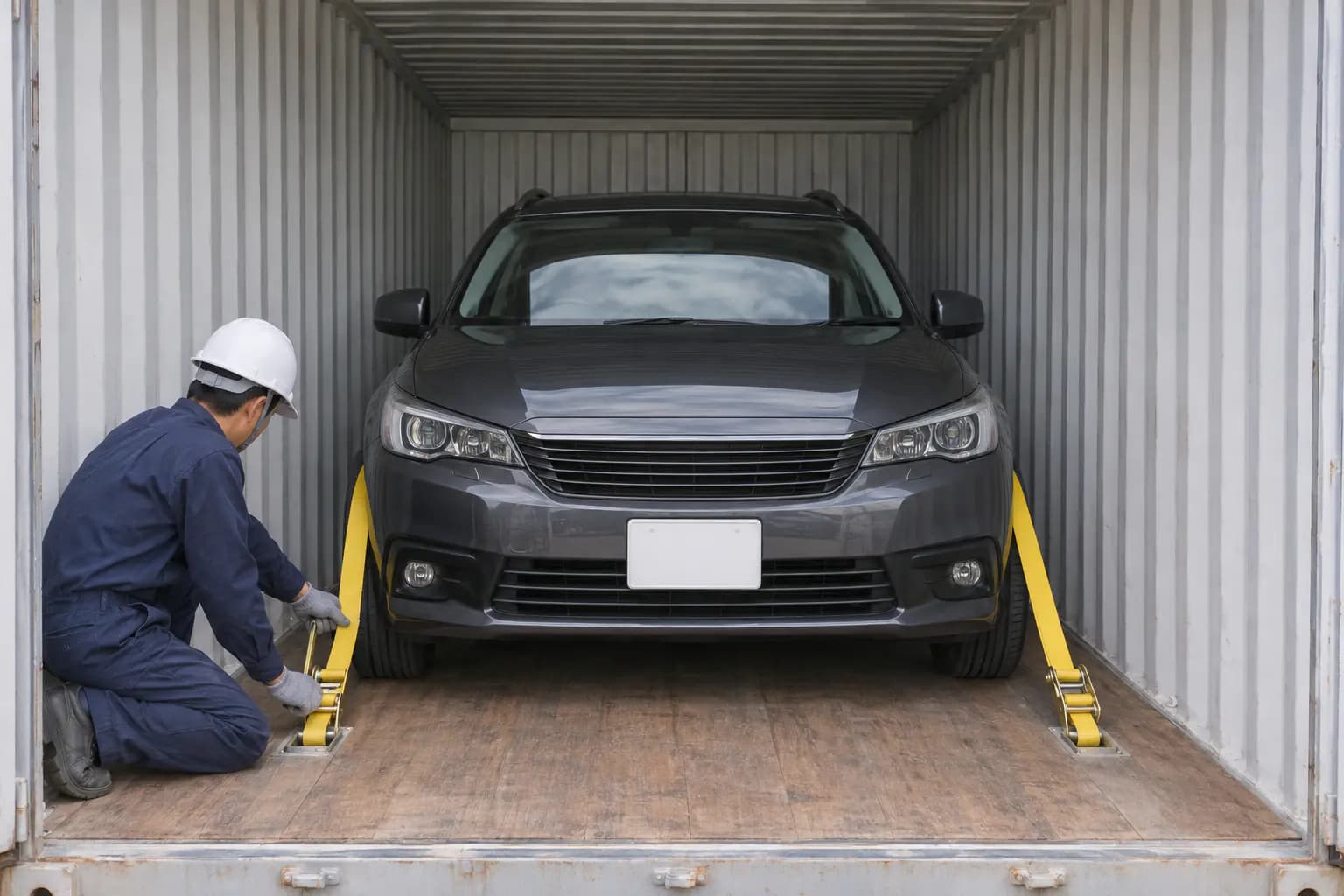
What you need for a car
- The US title and the registration certificate
- The car's EEI details (Internal Transaction Number and vehicle identification number), sent with the title to the CBP port of export 72 hours before export
- Proof that the car has been used, such as the registration certificate
- Proof that you are moving to Japan
- Three copies of Customs Form T No. 1280, filed with the import declaration
- For first registration in Japan, one of the import documents the transport office lists, such as the customs clearance certificate, an emission inspection completion certificate or an imported-vehicle special-handling notification
After the car clears Customs
A car that has cleared Customs is not yet road-legal. For its first registration the local transport office wants documents that the Ministry of Land, Infrastructure, Transport and Tourism lists, the customs clearance certificate among them, and the car then needs inspection and registration (MLIT Miyagi Transport Office).
The official pages we checked give no total cost for inspecting and registering an imported car, and they do not set out requirements for a left-hand-drive car, so we cannot give you a cost or a conversion list. Ask your specialist for the registration requirements for your model before you decide to ship it.
Bringing your dog or cat to Japan
Japan's Animal Quarantine Service inspects every dog and cat on arrival. In the US, only Hawaii and Guam are on Japan's list of designated rabies-free regions (with Iceland, Australia, New Zealand and Fiji), and pets from Hawaii and Guam follow a shorter route (Animal Quarantine Service). A pet from any other US state follows the full route set out in the procedure for non-designated regions: two rabies vaccinations, a titre test, a 180-day wait and 40 days' notice. USDA APHIS describes the same steps for US pets (APHIS page, last modified 30 July 2025). By our arithmetic (30 days between vaccinations plus the 180-day wait), allow about seven months at the least.
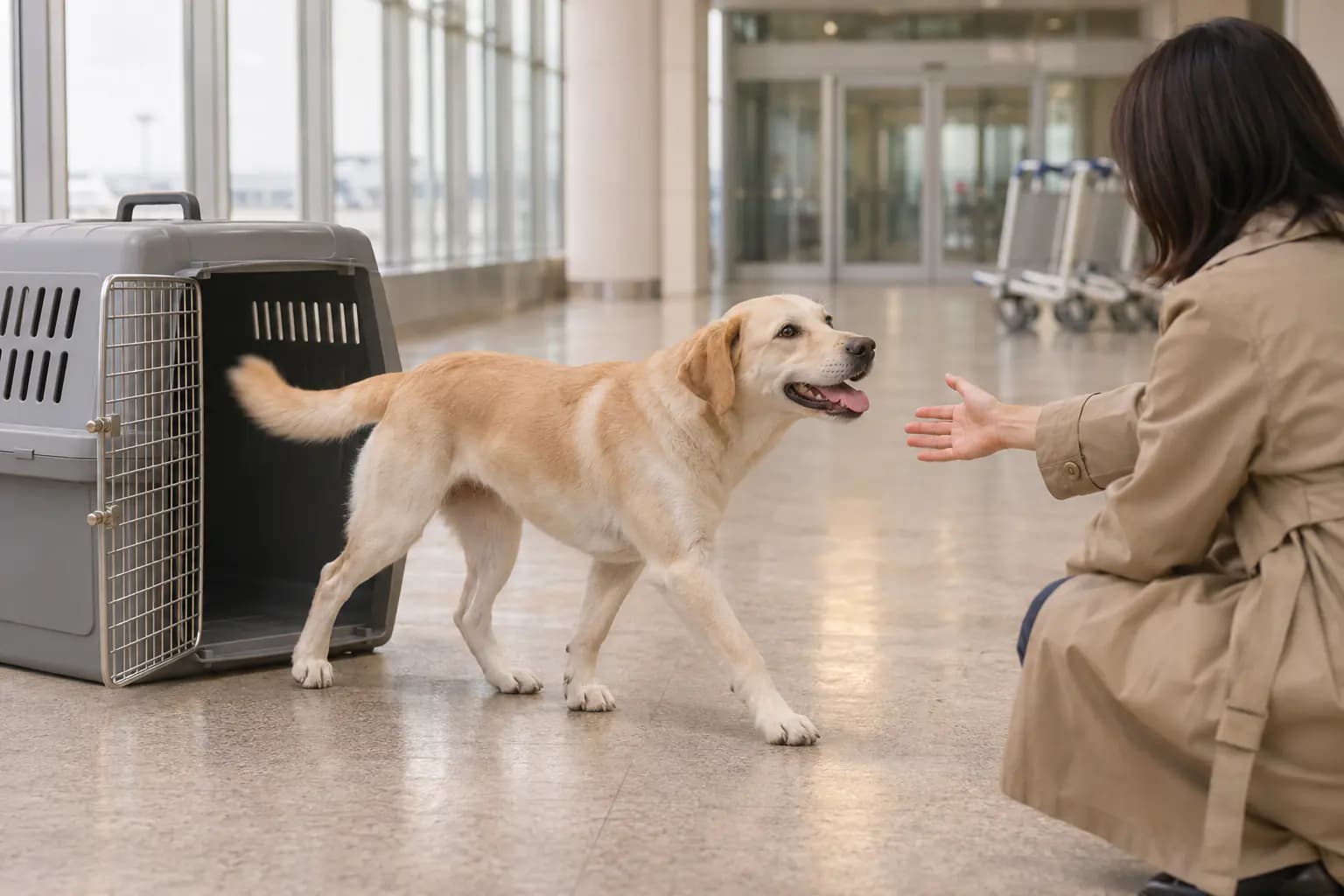
The route for a dog or cat from a US state
- An ISO microchip, implanted before the first rabies vaccination
- Two or more rabies vaccinations after the microchip: the first when the pet is at least 91 days old, the second 30 days or more after the first by Japan's count (APHIS words it as more than 30 days, so allow 31)
- A rabies antibody (titre) test of 0.5 IU/ml or more on a blood sample taken after the second vaccination. The sample goes to a laboratory on Japan's designated list. For the US that is the Kansas State University Rabies Laboratory in Manhattan, Kansas; the other US laboratory on the list takes samples from US forces personnel only (list as at 4 August 2026)
- A 180-day wait from the date of the blood sample before the pet arrives in Japan; a pet that arrives short is held in quarantine for the shortfall
- Notice to the Animal Quarantine Service at your arrival airport, given at least 40 days before you arrive
- A clinical inspection by a vet within 10 days before boarding, and a health certificate completed by a USDA-accredited vet (APHIS Form AC, or Forms A and C, or APHIS Form 7001 with Form A) and endorsed by APHIS. An endorsed paper copy must travel with the pet
Shipping from US ports to Japan
We book from the main US container ports on both coasts: Los Angeles and Long Beach, Oakland and Seattle and Tacoma on the West Coast, and New York and New Jersey and Savannah on the East Coast. The carrier service that suits your move and your collection address decide which port we use, not distance alone.
On the Japanese side, Yokohama is the nearer port for Tokyo and the Kanto region, and Osaka or Kobe for Osaka, Kyoto and the Kansai region. The goods clear Customs where they land: you present your sealed form at the Customs office for the port of arrival. Your delivery address decides the Japanese port, and your specialist confirms it when the estimate arrives.
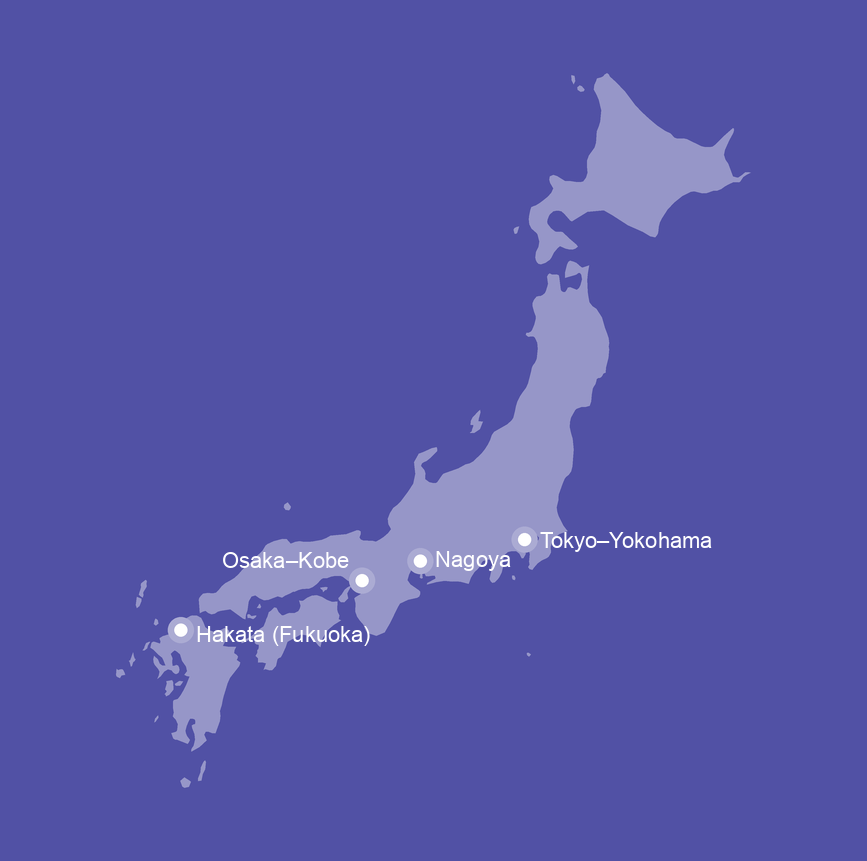
US ports, routing and timing
Four things set how your container travels:
Which US port
We check the live carrier schedules for your collection address and move date before we confirm the port, and we do not assume that one coast is always faster.
The export filing sets the deadline
The EEI has to be filed, and the filing reference handed to the carrier, 24 hours before the container is loaded on the vessel (15 CFR 30.4). Your inventory and power of attorney therefore have to be ready before the loading date, not on it.
Hurricane season on the East Coast
The Atlantic hurricane season runs from 1 June to 30 November (NOAA National Hurricane Center). For an East Coast sailing in those months we leave slack in the schedule.
No standard day count
We do not print a US to Japan sea time, because it changes with the carrier service, the US port, any transhipment and the routing. We take the scheduled sailing and arrival window from the carrier's live schedule when we prepare your estimate.
When to ship
Official sources date the pressure points in Japan more firmly than in the US. These are the ones that matter for a household shipment:
- June to November (US East Coast): the Atlantic hurricane season runs from 1 June to 30 November (NOAA National Hurricane Center). If your container sails from an East Coast port in those months, build slack into the schedule. No official source dates a US moving season for international shipments, so we do not give one.
- March and April (Japan): the Ministry of Land, Infrastructure, Transport and Tourism reports that moving requests concentrate in March and April, with March running at about twice a normal month (press release of 12 February 2025). If you can choose, ask for delivery outside those weeks.
- 29 April and 3-5 May 2027 (Japan): Showa Day and the Golden Week holidays (Cabinet Office holiday list). Customs offices are government offices, closed in principle on national holidays, so a clearance that lands on these days waits for the next working day.
- 29 December to 3 January (Japan): government offices are closed in principle on these days (Act on Holidays of Administrative Organs), Customs offices included, although an office can still open when it needs to. Customs offices publish year-end service notices, so check the one for your arrival port.
- July to October (Japan): typhoon season. On the Japan Meteorological Agency's 1991-2020 averages, 11.7 typhoons a year come within 300 km of a weather station, and August and September average 3.3 each. Put the slack into the schedule, not into the date you need the goods.
Whichever month you choose, the one deadline in the rules is Japan's six months from your entry date to Customs clearance. Work back from the day you land, not from the day the container sails.
Visas for US citizens moving to Japan
US citizens can enter Japan without a visa for short stays. The Ministry of Foreign Affairs lists the United States among the countries with a visa exemption arrangement and grants 90 days (MOFA, page of 1 September 2025), and the Immigration Services Agency caps a Temporary Visitor grant at 90 days for activities such as tourism, visiting relatives and business contacts. That is not a way to move. Japan plans an electronic travel authorisation (JESTA) for visa-exempt visitors, to start by 31 March 2029; no start date or fee is announced yet (Immigration Services Agency overview).
For anything longer, the usual route is a Certificate of Eligibility. You, your employer or another authorised agent files it with a Regional Immigration Services Bureau in Japan. The application is free, the standard processing time is one to three months, and the certificate stays valid for three months from the day it is issued. You then apply for the visa at a Japanese embassy or consulate. Settle the visa before you commit to a sailing, because the six-month customs window for your goods starts the day you enter Japan.
Main routes for US citizens
US citizens moving to Japan most often use one of these routes:
Visa-free stay (up to 90 days)
For tourism, family visits and business contacts only; you cannot work. Not a route for moving, because the Customs relief needs a stay of at least a year.
Employee routes: Engineer/Specialist and Intra-company Transferee
The Certificate of Eligibility route for employees of a Japanese organisation. Engineer/Specialist usually needs a relevant degree or ten years of experience (some roles need three), and pay at least equal to a Japanese national would get. Intra-company Transferee is for staff sent from an overseas office of a group that has a Japanese office.
Working Holiday (not open to US citizens)
Japan's Working Holiday programmes cover 33 countries and regions as at 1 November 2026, and the United States is not one of them, so Americans cannot apply for this visa. Plan on an employer-sponsored status, the digital nomad status or another status of residence instead.
Digital nomad (six months)
For remote workers earning at least JPY 10 million a year, with private medical cover of at least JPY 10 million. US nationals are on the eligible list. The stay is six months with no extension and no residence card, and you may not work for a Japanese organisation.
Business Manager
Tightened on 16 October 2025: JPY 30 million of capital or investment, at least one full-time employee who is Japanese or holds a settled status, Japanese at about B2 level (held by you or a full-time employee), a relevant master's, doctorate or professional degree or three years of management experience, and a business plan checked by a licensed professional. Current holders have until 16 October 2028 before the new criteria decide their renewals.
Highly Skilled Professional (70 points or more)
A points system for researchers, technical specialists and business managers; you need 70 points or more. Type 2 has no expiry date and is open to people who have held Type 1 for a period.
Note: Immigration decides every case, and these summaries are as at 7 November 2026. The Working Holiday facts come from the Ministry of Foreign Affairs' programme list, the digital nomad facts from the Immigration Services Agency and its chart of eligible nationalities, and the Business Manager rules from its guidance on the 2025 change. A fixed-term stay may not count as the year of residence the Customs relief asks for, so check with Customs before you ship.
If a Japanese authority asks for a US public document such as a birth or marriage certificate, the usual route is an apostille, because Japan and the United States are both parties to the Hague Apostille Convention. Ask the authority first which documents it wants legalised.
Frequently asked questions: moving from the US to Japan
Work in this order. Settle your visa route first, because a Certificate of Eligibility takes one to three months and the six-month customs window starts the day you enter Japan. Then book the shipment so your forwarder can file the export record, put your tax and health cover in order, and on the day you land declare your separately shipped goods on Form C-5360.
After you arrive, clear the goods through Customs within six months, register your address at the municipal office within 14 days and join Japan's health insurance and pension. Each step has its own section above, and the checklist at the foot of the page puts them in order. For the destination as a whole, see our guide to relocating to Japan.
This page does not print a price, because there is no single figure. The cost depends on the volume of your inventory, how it is packed, where in the US we collect, the port and the sailing, and your delivery address in Japan. A whole home usually travels as a full container and a smaller load as a shared one.
Qualifying household goods enter Japan free of duty and consumption tax, so duty is not what drives the cost for them. Request a free estimate with your inventory, both addresses and your entry date, and we price the move from those details.
We cannot give you one figure. The time depends on the carrier service, the US port, any transhipment and the routing, and we take the scheduled sailing and arrival window from the carrier's live schedule when we prepare your estimate. East Coast sailings between 1 June and 30 November fall in the Atlantic hurricane season, so we leave slack in them.
Two clocks matter more than the sea time: Japan's six months from your entry date to Customs clearance, and the one to three months a Certificate of Eligibility can take. The export filing adds one more deadline, because the EEI has to be filed 24 hours before the container is loaded.
Usually yes, for a move by sea. Census Bureau guidance says your mover or forwarder files Electronic Export Information (EEI) in the Automated Export System when the total value of your household goods is over $2,500, and at any value when a mandatory filing category applies, such as a used car or anything that needs an export licence. The regulation on household goods (15 CFR 30.38) names no value, so expect a filing and let your forwarder confirm. Household goods are reported with the export information code HH, and the Census Bureau says no commodity classification code is needed. For a ship, the filing and its reference go to the carrier 24 hours before loading. You give your agent accurate details and a power of attorney or written authorisation (Census Bureau FAQ, 15 CFR 30.4).
Separately, report more than $10,000 in cash or monetary instruments to CBP when you leave, on FinCEN Form 105. If you ship a car, its title and vehicle details go to the CBP port of export 72 hours before export. See CBP on reporting money.
Check the rating label. Japan's supply is 100 V AC everywhere, and US homes run on 110-120 V at 60 Hz. Dual-voltage items such as hair dryers, travel irons and shavers work anywhere in Japan, and an appliance marked 100-240 V is built for Japan's supply. One marked only for 120 V is built for a higher voltage than Japan supplies, so ask the maker before you ship it.
Frequency also differs inside Japan: 50 Hz in the east, including Tokyo, and 60 Hz in the west, including Nagoya, Kyoto and Osaka. Appliances labelled 50/60 Hz work nationwide. See the Japan National Tourism Organization's power guide and the US Department of Energy.
Usually not on used household effects, if you qualify. Japan exempts customs duty and consumption tax for people who enter Japan to make their home there, on goods for their own and their family's use in reasonable quantities. You have to show a stay of at least a year, declare the separately shipped goods on Form C-5360 when you enter Japan, and have them cleared by Customs within six months of entering.
Form C-5360 is the Declaration of Accompanied Articles and Unaccompanied Articles, filled in twice. Customs seals one copy and hands it back, and you show that sealed copy when the goods arrive. Separately shipped goods cannot be declared once you are in Japan, and a lost copy cannot be reissued. Customs' pages describe paper copies and do not say a Visit Japan Web declaration replaces the sealed copy for unaccompanied goods, so keep the paper one. See Customs FAQ 7103 and the passenger page.
Shipping after you arrive works if you made the declaration on entry and the goods clear within six months. If a shipment runs late for a reason nobody could avoid, such as a ship accident or a port strike, Customs can accept it case by case. Goods outside the relief, such as commercial quantities, clear as ordinary imports. Customs lists traveller allowances for alcohol and tobacco but none for movers, so ask a Customs Counselor before you ship a wine collection.
Yes, settle the visa route first. US citizens can enter without a visa for up to 90 days, but that is for short stays. To live in Japan you need a status of residence, normally through a Certificate of Eligibility (free, one to three months, valid three months) followed by a visa at a Japanese embassy or consulate.
No, there is no Working Holiday visa for Americans: the United States is not among the 33 countries and regions on the Ministry of Foreign Affairs list (1 November 2026). The routes most US movers use are Engineer/Specialist or Intra-company Transferee for employees, the six-month digital nomad status for remote workers earning at least JPY 10 million a year, Business Manager (tightened on 16 October 2025) and Highly Skilled Professional (70 points). Details are in the Immigration Services Agency's guidance.
For a while, yes. You can drive on an international driving permit issued under the Geneva Convention for the shorter of one year from the day you land and the permit's validity. To keep driving after that you convert your licence in person, with a Japanese translation, at the licence centre for your address.
Whether you also take the knowledge and skill checks depends on your state. Tokyo Metropolitan Police exempts licences from Ohio, Oregon, Colorado, Virginia, Hawaii, Maryland and Washington from both checks, and an Indiana licence from the skill check only. Every other state's licence means both checks. Other prefectures run their own centres. See Tokyo Metropolitan Police.
Yes, by the full route, which takes about seven months at the least, unless the pet comes from Hawaii or Guam. Only those two US places are designated rabies-free regions, so a pet from any other US state needs an ISO microchip, two rabies vaccinations, a titre test of 0.5 IU/ml or more at a designated laboratory (the Kansas State University Rabies Laboratory is the only US laboratory on the list that is not limited to US forces personnel), a 180-day wait from the blood sample and 40 days' notice to the Animal Quarantine Service. A USDA-accredited vet issues the health certificate and APHIS endorses it.
A pet that arrives short of the 180 days is held for the shortfall, and one that does not meet the rules can be held up to 180 days or sent back. See the APHIS page for Japan.
Your US tax filing continues: US citizens are taxed on worldwide income wherever they live, and moving abroad does not trigger the expatriation tax, which applies to people who renounce citizenship or end long-term residence. The foreign earned income exclusion is up to $132,900 for 2026, and an FBAR is due if your foreign accounts pass $10,000. See the IRS guidance for Americans abroad.
Medicare usually does not cover care outside the US, so you need cover for Japan. In Japan you must join public health insurance, normally through your employer or National Health Insurance, and you usually pay 30% of the bill (Medicare.gov).
The US-Japan agreement, in force since 1 October 2005, stops you paying Social Security into both systems and lets credits from both countries count toward a benefit, as long as you meet its minimums. Each country pays its own benefit. See the SSA guide to the agreement.
Pistols and their ammunition, narcotics, stimulants, cannabis, counterfeit goods and obscene material are prohibited, and that includes cannabis products bought legally in some US states. Amphetamine, so Adderall, is banned even with a prescription. Nicotine vaping liquid is treated as a medicine, and CBN products have been banned since 1 June 2026.
Other items need paperwork rather than a ban. You can bring up to one month's supply of prescription medicine without a certificate, and more needs an import confirmation certificate. Codeine above 1%, pseudoephedrine above 10% and lisdexamfetamine (Vyvanse) need advance permission from the Narcotics Control Department at least 14 days before you travel, and you must carry them yourself. Hunting guns, air guns and swords need permits. Items made from protected species, ivory included, need an export permit and a METI import licence. See the Narcotics Control Department's guidance and the personal import page.
Soil is banned and plants and seeds need a phytosanitary certificate; most fresh fruit and vegetables and meat products such as ham, sausage and jerky are banned (Plant Protection Station, and its Japanese page on meat and soil). A car can come in under a separate duty exemption (Form T-1280, with no resale for two years).
There is no single best month, but official sources show which weeks to avoid. In Japan, moving requests concentrate in March and April, with March moves running at about twice a normal month. Government offices, Customs included, are closed in principle on national holidays (29 April and 3-5 May in 2027) and from 29 December to 3 January, and typhoons approach Japan mainly from July to October, most often in August and September.
On the US side, no official source dates a moving season for international shipments, but the Atlantic hurricane season runs from 1 June to 30 November, which matters for East Coast sailings. Because the six months run from the day you enter Japan, choose your arrival date first and work back from it.
Before and after you land
6 months
between the day you enter Japan and Customs clearance of goods that travel separately
100 V
is the household supply in Japan, against 110-120 V in US homes
14 days
to register your new address at the municipal office after you decide where you live
Power and appliances
Japan's household supply is 100 V AC, uniformly. US homes run on 110-120 V at 60 Hz (US Department of Energy), so a US appliance is built for a higher voltage than Japan supplies. Dual-voltage items such as hair dryers, travel irons and shavers work anywhere in Japan. For everything else, read the rating label: an appliance marked 100-240 V is built for Japan's supply, and one marked only for 120 V is not, so ask the maker before you ship it. Conversion plugs and transformers are sold in Japanese cities.
Frequency also differs inside Japan: 50 Hz in the east and 60 Hz in the west, including Nagoya, Kyoto and Osaka. The line runs roughly along the Fuji River in Shizuoka and Itoigawa in Niigata (Chubu Electric), so Tokyo and Yokohama are on the 50 Hz side and Osaka and Kobe on the 60 Hz side. The US supply is 60 Hz, which matches western Japan. An appliance labelled 50/60 Hz works nationwide, and a 60 Hz-only one may not suit eastern Japan.
Driving: your US licence and car
You can drive on an international driving permit issued under the Geneva Convention for the shorter of one year from the day you land and the permit's validity. After that, or instead, you can convert your US licence at the prefectural police licence centre for your address, in person and with a Japanese translation of the licence (National Police Agency).
Japan treats US licences state by state. Tokyo Metropolitan Police exempts licences from seven US states from both the knowledge check and the skill check: Ohio, Oregon, Colorado, Virginia, Hawaii, Maryland and Washington. An Indiana licence is exempt from the skill check only. A licence from any other state means taking both checks, and since 1 October 2025 the knowledge check has 50 questions with 45 correct needed to pass and the skill check is stricter (Tokyo Metropolitan Police, page updated 7 September 2026, its notice of the changes). You must also have spent at least three months in the issuing country after getting the licence. That is Tokyo's list: other prefectures run their own centres, so check the one for your address. For a car, see 'Shipping your car to Japan' above.
Your first weeks: address, residence card and bank
Register your address at the municipal office within 14 days of deciding where you live. It is free, and you bring your residence card or a passport stamped to show a card is coming (Immigration Services Agency, in Japanese). Ten airports issue the residence card when you land: New Chitose, Sendai, Narita, Haneda, Chubu, Kansai, Kobe, Hiroshima, Fukuoka and Naha. At any other port of entry the card is posted after you register.
Once you are in the resident register you receive a My Number. Since 14 June 2026 you can also ask for a 'specific residence card' that works as both residence card and My Number Card; it is optional and you apply in person. Keep your passport or residence card on you whenever you go out, because the police can ask to see it.
Japan Post Bank opens accounts for new residents who show a residence card, but not when your stay ends within three months of the application.
Health cover: from US plans to Japan's insurance
Your US cover. A US health plan is not part of the Japanese system, and Medicare usually does not cover health care outside the US. Medicare counts the 50 states, the District of Columbia and five territories as the US and everywhere else as outside it, and a Medicare plan cannot cover drugs you buy outside the US (Medicare.gov). Ask your insurer in writing what, if anything, your plan pays for in Japan, and keep cover in place until your Japanese cover starts.
In Japan, anyone who lives there, whatever their nationality, has to join public health insurance. Employees are normally covered through their employer. Everyone else, foreign residents staying more than three months included, joins National Health Insurance at the municipal office. You usually pay 30% of the medical bill yourself, and premiums depend on last year's income and your household and vary by municipality (Ministry of Health, Labour and Welfare leaflet). If you leave an employer's insurance, you enrol at the municipality within 14 days. A worker sent to Japan by a US employer can stay out of Japan's health insurance only if the worker and any family living in Japan have private health insurance that covers the cost of care in Japan (Japan Pension Service notes).
If you take prescription medicine, read the medicine rules under restricted goods before you pack. Adderall is banned even with a prescription, Vyvanse needs permission in advance, and more than a month's supply of most prescriptions needs an import certificate.
Social Security and the US-Japan agreement
The agreement. The US-Japan totalization agreement has been in force since 1 October 2005 (SSA list of agreements). Each country pays its own benefit. If you do not have enough US credits for a US benefit, Japanese periods can be counted once you hold at least six US credits, roughly one and a half years of work, and US credits can count toward a Japanese benefit once you have at least one month of Japanese coverage (SSA guide to the agreement). One US credit counts as three months of Japanese coverage (Japan Pension Service notes).
Which country takes your contributions. US Social Security and Medicare tax generally does not apply to wages you earn as an employee outside the US, but there are exceptions, such as working for an American employer (IRS Publication 54), and US law covers self-employed US citizens even when they work abroad. The agreement settles which system applies. A worker sent to Japan by a US employer for five years or less stays under US rules, provided the worker was covered by US Social Security for at least six months immediately before the posting, with an extension possible in unforeseen cases. A worker sent for a long period, or hired in Japan, is covered only by the Japanese system and exempt from the US one, but needs a Certificate of Coverage from Japan to show to the employer or the IRS (Japan Pension Service notes). A self-employed person who moves a business to Japan for five years or less stays in the country they came from (SSA).
Japan's pension. Residents aged 20 to 59 must join the National Pension (Japan Pension Service). For self-employed people, students and the unemployed the contribution is JPY 17,920 a month in fiscal year 2026 (Japan Pension Service), and it changes every April. Employers enrol their employees. If you leave Japan, a non-Japanese national who paid in for at least six months may be able to claim a lump-sum withdrawal payment within two years of leaving, with conditions.
Door-to-door service from the US to Japan
Our door-to-door service covers every stage from your US address to your Japanese address. The stages run in this order:
- Estimate and survey:
Your dedicated specialist goes through your inventory (by video walkthrough or a home survey), both addresses and your entry date, then sends you a free estimate. - Packing at your US address:
We pack and inventory your goods for export. The inventory becomes the statement of contents you need at Customs in Japan. What causes shipping damage is worth reading before you decide what to pack yourself. - US export filing:
Once you give us a power of attorney, we file the EEI in the Automated Export System before your container is loaded. If you ship a car, its title and vehicle details go to the CBP port of export 72 hours before export. Firearms and other controlled items need their licences first. - Sea freight:
Your container is booked on a scheduled sailing from a US port. You receive the bill of lading with the vessel, the voyage and the estimated arrival at the Japanese port. - Your declaration in Japan:
You hand Customs your two-copy Form C-5360 on the day you land and keep the sealed copy. We cannot make the declaration for you, and Customs cannot issue the copy again. - Customs clearance in Japan:
A licensed customs broker clears the shipment against your sealed declaration, the transport documents, the statement of contents and your receipts, and deals with any inspection or quarantine request. Your specialist follows the container and keeps you posted at every step. - Delivery:
When the goods are released, the container travels to your Japanese address. We unpack, set items where you want them and take the packing materials away.
Checklist for your US to Japan move
Checklist for your US to Japan move
Check that you qualify for Japan's moving relief: a stay of at least a year, shown by your passport and official documents. Ask a Customs Counselor if your stay is close to twelve months or is on a fixed-term status.
Start the visa route first. A Certificate of Eligibility takes one to three months to process, and the six-month customs window for your goods opens the day you enter Japan. There is no Working Holiday visa for US citizens.
Request a free estimate with your inventory, collection address, Japanese delivery address and entry date. We confirm the US port, the routing and the sailing from the live carrier schedule.
Sign the power of attorney your forwarder needs to file the EEI, and report more than $10,000 in cash or monetary instruments to CBP when you leave. If you ship a car, gather the title and registration; firearms and other controlled items need licences first.
Complete two copies of Form C-5360 before you land, and keep the sealed copy that Customs hands back.
Write 'unaccompanied baggage' on every package with yourself as addressee, then check medicines, food, plants and appliance rating labels against the restricted goods and power sections.
Put your US tax filing, foreign account reporting and health cover in order. Within 14 days of deciding where you live, register your address at the municipal office, then join National Health Insurance and the National Pension unless your employer enrols you.
Get your US to Japan move plan
Send your US address, your Japanese address and your entry date. Your specialist replies with a free estimate.
Get your estimate