
International relocations to Japan
Request a free estimate in 60 seconds.
Complete guide to moving to Japan
This page covers used household goods and personal effects that you ship to Japan when you move there to live, including Japanese nationals who are coming home.
Japan exempts the used household goods and professional equipment of a person who moves their home to Japan from customs duty and from import consumption tax. You qualify if you will stay in Japan for at least one year, shown by your passport or other official documents, or if you are returning after living abroad for at least one year. The goods must be for you and your family and reasonable in quantity.
Declare separately shipped goods on the day you arrive, on Customs Form C-5360 in duplicate. Customs seals one copy and returns it. You cannot declare after you enter Japan, and Customs cannot reissue a lost copy. The goods must then clear customs within six months of your entry.
Cars and other vehicles follow a separate procedure and cannot be resold or given away for two years. Narcotics and stimulants (Adderall too, even with a prescription), pistols and their ammunition, counterfeit goods, soil and meat products are banned, and many fresh fruit and vegetables cannot be brought in. Customs publishes no separate alcohol or tobacco figure for movers, so ask Customs before you pack a wine collection.
We plan the sailing, pack and collect at your origin, prepare the clearance file and deliver to your door in Japan. Your specialist starts from your entry date so the arrival declaration and the six-month window are settled before the container is booked.
Moving from Australia, the United Kingdom, Canada or the United States? Australia to Japan, UK to Japan, Canada to Japan and USA to Japan add the export steps and routing for each origin. This page covers what every move to Japan has in common: the customs relief, the ports, the visas and the first weeks.
The relief is generous, but it rests on one document. Customs accepts your separately shipped goods as household effects only if you declared them on the day you entered Japan, and it cannot redo that step. Most of what follows is sequencing: the declaration first, then the sailing, then clearance inside six months.
Rules on this page rest on official Japanese government pages (Japan Customs, the Ministry of Finance, the Immigration Services Agency and others), checked on 6 November 2026. Where official guidance is silent, we say so.
Our import process
We start from your entry date: the arrival declaration, then the sailing, then clearance inside the six-month window, so the shipment is ready before it reaches a Japanese port.
Request an estimate
Tell us where you ship from, roughly what you are moving and the date you enter Japan.
Meet your specialist
One specialist plans the sailing, checks your goods against Customs' unaccompanied-baggage steps and flags anything that needs a permit.
Approve the plan
We pack, ship and clear the shipment, then deliver to your address in Japan.
Peak shipping months to Japan
Japan's own calendar matters as much as the shipping season. These are the periods that slow customs offices, delivery crews or vessels:
- March and April
MLIT, Japan's transport ministry, says domestic moving demand peaks in March and April, and March sees about twice as many moves as a normal month. Delivery crews can be hard to book in those weeks, so pick another delivery date if you can. - Golden Week (29 April and 3-5 May 2027)
All four days are national holidays, and Japan's government offices, including Customs offices, do not work on national holidays in principle. Plan clearance and delivery on either side of the block. - 11 August (Mountain Day) and Obon
Mountain Day is a national holiday. Obon in mid-August is not on the official holiday list, so confirm delivery-crew availability for that week with your specialist. - 29 December to 3 January
Customs and the rest of the government stay closed in principle from 29 December through 3 January, and Customs publishes a reduced-service notice each year-end. A container that arrives in the last days of December can wait for clearance until offices reopen. - July to October
Typhoon season. The Japan Meteorological Agency's 1991-2020 averages count 11.7 typhoons a year approaching Japan: 2.1 in July, 3.3 in each of August and September, and 1.7 in October. We found no official statement on port closures, so allow slack for a delayed vessel or delivery.
Understanding Japan customs
Japan Customs clears the belongings of a person who is moving there under a simplified procedure called customs clearance for traveller's baggage. Household effects are the personal effects and professional equipment of you and your family, whether they travel with you or follow as unaccompanied articles, and they enter free of duty and tax when the declaration, the timing and the quantities fit the rules below.
Japan exempts used household goods and professional equipment from customs duty, and from import consumption tax, for people who move their home to Japan. You qualify if you will stay in Japan for at least one year, shown by your passport or other official documents, or if you are returning after living abroad for at least one year. The goods must be things you and your family use personally, in a reasonable quantity. Cars, boats and aircraft follow a separate procedure.
- Japan · before you ship
Mark the cargo as unaccompanied baggage
Write "unaccompanied baggage" (別送品) on the packages, the customs notice and the invoice, and name yourself as the addressee. Tell the freight company or broker beforehand that the cargo is unaccompanied baggage: some carriers do not handle it, and unmarked cargo can be cleared as ordinary trade cargo.
- Japan · on the day you arrive
Declare the shipment on Form C-5360
Submit the Declaration of Accompanied Articles and Unaccompanied Articles (Customs Form C No. 5360) in duplicate at the Customs counter where you arrive, by air or by sea, and tick Yes for unaccompanied articles. Customs seals one copy and gives it back; one declaration per family is enough. Separately shipped goods cannot be declared once you are in Japan, and a lost copy cannot be reissued.
- Japan · within six months of your entry
Get the goods cleared in time
The goods must be imported within six months after you enter Japan, and Customs counts clearance, not the day the ship docks. A later import is accepted only for an unavoidable special reason, such as a ship accident or a cargo-handling strike at the export or import port. No extension length is stated.
- Japan · when the shipment arrives
Clear it at the port
Once the airline or shipping line gives notice that the cargo has arrived, collect the delivery order. Take it, with the sealed form, your passport, the statement of contents and any receipts, to the unaccompanied-baggage section of the Customs office where the cargo landed. Plants and animals are checked at a quarantine station first; Customs then inspects the goods, you pay any tax assessed and the cargo is released. A licensed customs broker can handle this if you pass over the sealed form.
Documents to clear household goods in Japan
Customs' unaccompanied-baggage steps ask for these at clearance:
- Sealed copy of Form C-5360, the declaration Customs returned to you on arrival
- Passport
- Transport documents, meaning the delivery order the airline or shipping line issues after its arrival notice
- Statement of contents, a plain-language inventory of what is in each package
- Receipts for the goods
- Personal seal (inkan) if your Customs district asks for it; Tokyo Customs lists one in its own checklist
- For a vehicle: Form T-1280 in three copies, a registration certificate or similar proof of prior use, and a document showing you are moving to Japan
Quarantine and items that need extra checks
The categories most likely to need extra checks on the way into Japan are:
- Plants and seeds: they need a phytosanitary certificate from the exporting country and an inspection by the Plant Protection Station, and importing them without both can carry up to 3 years' imprisonment or a fine of up to 3 million yen. Plants can travel as unaccompanied baggage if your broker presents the certificate at inspection.
- Soil and used agricultural machinery: Japan's plant quarantine authority says soil may not be brought in, and used agricultural machinery is inspected. Clean boots, tools and outdoor gear before they are packed.
- Fresh fruit, vegetables, meat and meat products: strictly restricted, and many items cannot be brought in. Meat products such as ham, sausage and jerky are banned in principle, including items with a small amount of meat in them.
- Rice: up to 100 kg a year is free of duty when you submit a Report for the Import of Rice to the Local Food Office and show a copy to Customs.
- Wood and furniture: Customs' plant-protection guidance says treated lumber, woodwork and furniture do not need plant inspection, and Japan regulates imported wooden packaging in line with the international standard ISPM 15.
Timing your shipment against the six-month window
Customs counts the six months from your entry date to the date your goods clear, so a late sailing eats into the window. If you ship after you arrive, the window still runs from your arrival, and the declaration you made at the airport still carries the relief. Ask your specialist for the sailing date and the expected clearance date before you book.
What you can import to Japan

Personal belongings
Free of duty and tax when you move to Japan for a year or more, in reasonable amounts

Used clothing

Household appliances
Japan runs on 100 V; 220-240 V items need a transformer

Fragile items

High-value items
Declare any gold and cash over JPY 1 million on arrival

Large items & furniture

Excess luggage
Declare as unaccompanied baggage on arrival; clear within 6 months

Pets
Microchip and 40 days' notice; rabies tests and a 180-day wait except from Australia, New Zealand and a few other places

Vehicles
Form T-1280; no resale for 2 years; Japanese inspection and registration needed
Products subject to restrictions in Japan

Drug Contraband
Adderall (amphetamine) banned even with a prescription

Medicines beyond the personal-import limit and controlled medicines
Over 1 month's prescription supply needs an import certificate; Vyvanse needs prior permission and cannot be shipped

Cannabis & CBD products
Cannabis banned; CBN products banned since 1 June 2026

E-cigarettes & vapes
Nicotine liquid counts as medicine; over 120 ml needs a certificate

Alcohol & tobacco products
No mover limit published; travellers get 3 bottles and 200 cigarettes

Firearms, swords and ammunition
Pistols and their ammunition banned; hunting guns, air guns and swords need permits

Explosives

Hazardous
High-pressure gas, kerosene and agricultural chemicals are controlled by other laws

Counterfeit

Banned publications & media
Obscene or immoral material and child pornography

Ivory
CITES items need an export permit and a METI import licence

Plants, seeds and soil
Soil banned; plants and seeds need a phytosanitary certificate

Fresh fruit, vegetables and rice
Most fresh fruit and vegetables banned

Meat & dairy products
Meat, ham, sausage and jerky banned in principle
Official customs guidance
- Japan Customs: procedures for household effects when you move to Japan (FAQ 7301)
- Japan Customs: how to declare unaccompanied articles (FAQ 7103)
- Japan Customs: the arrival declaration and Visit Japan Web
- Customs Form C-5360-B: Declaration of Accompanied Articles and Unaccompanied Articles (English, PDF)
- Japan Customs: summary of passenger clearance, allowances and prohibited articles
- Japan Customs: goods with prohibitions, controls and restrictions
Useful contacts
Taxes and duties when importing to Japan
A move to Japan is low-tax when the paperwork fits the household-effects relief and expensive when it does not. Three things decide it: whether you declared on arrival, whether the goods clear within six months, and whether Customs sees them as personal use in reasonable quantity.
General rules for goods entering Japan
- The relief covers customs duty and import consumption tax. The Customs Tariff Law (Art. 14, item 8) exempts the personal-use goods and professional equipment that you or your family import when you move your home to Japan, and the law on consumption taxes on imports extends the exemption to consumption tax.
- Goods must be for personal use and reasonable in quantity. Customs' test is use by you or your family and a quantity that fits your circumstances. The pages we read publish no item list, no minimum period of prior use and no numeric cap. Commercial cargo or costly goods sent as unaccompanied articles may need the same procedures as general cargo.
- Where tax is due, the standard consumption tax rate is 10% (8% for the reduced rate), charged on the customs value plus duty and excise, according to Japan Customs.
Tax exemptions
- Household effects that you and your family already use, such as furniture, clothing and books, qualify when the quantity is reasonable.
- Professional equipment you need for your work qualifies alongside your household effects.
- Goods shipped after you arrive still qualify if you made the arrival declaration and clear them within six months of your arrival.
What falls outside the relief
These goods do not follow the household-effects route, or sit in a grey area:
- Cars, boats and other vehicles: a separate procedure with its own form, covered further down.
- Goods you did not declare on arrival, or whose sealed copy is lost: they need ordinary import procedures, like trade cargo.
- Goods cleared after the six-month window, unless Customs accepts an unavoidable special reason.
- Commercial cargo and costly goods, which Customs may treat as general cargo.
- Alcohol and tobacco: Customs' allowances of 3 bottles of about 760 ml and 200 cigarettes are written for visitors and returning travellers. Official pages do not say whether the wine or tobacco in a household move follows that cap or the reasonable-quantity test, so ask a Customs counselor before you pack a cellar.
Cash, cheques and securities worth more than 1 million yen must be declared to Customs on arrival, and any gold, in any amount, must be declared by answering Yes on the arrival declaration. Both sit outside your household goods and apply to everyone entering Japan.
Customs counselors answer questions about your own case before you ship. Ask them about anything the published guidance leaves open, and keep the answer with your papers.
Insuring your shipment
A policy for a move to Japan should be written for the whole door-to-door move and checked against two local risks: typhoons and earthquakes.
Why insure a move to Japan
Four things make cargo cover worth having on this route:
- Typhoons approach Japan most often from July to October. The Japan Meteorological Agency averages 11.7 a year, 3.3 of them in each of August and September.
- Japan's Earthquake Research Committee revised its Nankai Trough assessment on 26 September 2025. Its two calculation methods give 60 to 90 percent or more and 20 to 50 percent for a major earthquake within 30 years, both in its highest class (values as at 1 January 2025), and it asks people to plan on the higher range.
- Your goods change hands at ports, terminals and warehouses at both ends, and each handover is a chance for loss or breakage.
- Customs can open and inspect your packages, and plant or animal items go to quarantine first.
What is covered
Coverage depends on the insurer and the policy. Check these points in the wording:
- Standard "all risks" cargo wording, the Institute Cargo Clauses (A), covers loss of or damage to the goods during transport, subject to exclusions.
- The exclusions normally include delay, inherent vice, and insufficient packing, including container stowage done by you or before cover starts.
- War, strikes and terrorism are excluded from the standard clauses and are usually bought back separately. The clause text does not single out earthquake or typhoon, so ask the insurer in writing how the policy treats natural perils.
Read the limits, exclusions and declared-value conditions with your broker or insurer before you finalise cover. How cargo damage claims get paid shows how packing and the delivery receipt decide a claim.
How to arrange cover
You can arrange cargo insurance for a shipment to Japan through:
- A general insurer that offers marine cargo insurance
- A broker that specialises in cargo or relocation insurance
- Your bank or financial institution, where it offers cover
- Us: we can arrange cargo cover with the move, and your specialist explains the declared value and the cost of cover with your estimate.
Visa requirements for moving to Japan
Customs looks for a stay of at least one year, and Japan's immigration rules decide how you get one. Visa-exempt entry as a Temporary Visitor lasts up to 90 days and is for short stays. A long stay needs a status of residence, usually applied for through a Certificate of Eligibility filed with the Immigration Services Agency (ISA).
Main routes to a long stay
These are the routes most movers use. Rules and fees change, so confirm each one on the ISA page before you plan around it.

Visa-exempt visit
Visa-exempt entry grants a Temporary Visitor stay of 90 days at most, for tourism, family visits or business contacts. That is shorter than Customs' one-year test for household effects.
Engineer/Specialist and Intra-company Transferee
Both work for a Japanese organisation under a contract. Engineer/Specialist needs a relevant degree or 10 years' experience (3 years for work that draws on foreign culture, such as translation) and pay equal to or above a Japanese national's. Intra-company Transferee covers a fixed-period transfer from an overseas office of the same organisation. Stays are granted for 5 years, 3 years, 1 year or 3 months.
Business Manager
Since 16 October 2025 the business needs 30 million yen in assets and at least one full-time employee who is Japanese or in a settled status, and Japanese at about B2 level (the applicant's or an employee's). A licensed professional checks the business plan, and a home is generally not accepted as the office.
Highly Skilled, J-Skip and J-Find
Highly Skilled Professional is points-based and needs 70 points. J-Skip suits a master's degree or 10 years' experience with 20 million yen a year, with permanent residence after 1 year. J-Find gives recent graduates of listed universities up to 2 years to job-hunt or start a business.
Digital nomad
Up to 6 months, no extension and no residence card, for remote work for a foreign employer or clients. It needs income of 10 million yen a year and private medical cover of 10 million yen. Australia, Canada and the United Kingdom are eligible, but six months is shorter than Customs' one-year test.
Working Holiday
For young citizens of partner countries including Australia, Canada and the United Kingdom, usually travelling without dependants. Age limits, annual caps and where to apply differ by country, so read your Japanese embassy or consulate's page before you rely on it.
Family members
A spouse or child of a worker, student or highly skilled professional usually applies for Dependent status, granted for a period set individually of up to 5 years. Certificates issued in Japan must be dated within 3 months, and foreign-language documents need a Japanese translation.
The long-stay route: you or your employer file a Certificate of Eligibility in Japan (free, standard processing of 1 to 3 months, valid for 3 months), and you then present it at a Japanese embassy or consulate to get the visa.
Dates to watch: fees for residence procedures rose on 1 October 2026, and permanent residence went from 10,000 to 200,000 yen. Next come the revised permanent-residence guideline, for applications filed from 1 April 2027, and JESTA, the entry authorisation for visa-exempt visitors, due by 31 March 2029.
Top import hubs in Japan
On the weekly container service we checked for this page, one carrier's Australia to Japan schedule printed on 6 November 2026, vessels call directly at Yokohama and Osaka, and cargo for Tokyo, Kobe, Nagoya and Hakata reaches those ports by truck or by feeder ship. Other carriers and other origins route differently, so your specialist confirms the port with your estimate.
Customs operates through nine regional districts (Hakodate, Tokyo, Yokohama, Nagoya, Osaka, Kobe, Moji, Nagasaki and Okinawa). Clearance happens at the office where the cargo arrives, so the port you choose decides where your sealed form is handed in.
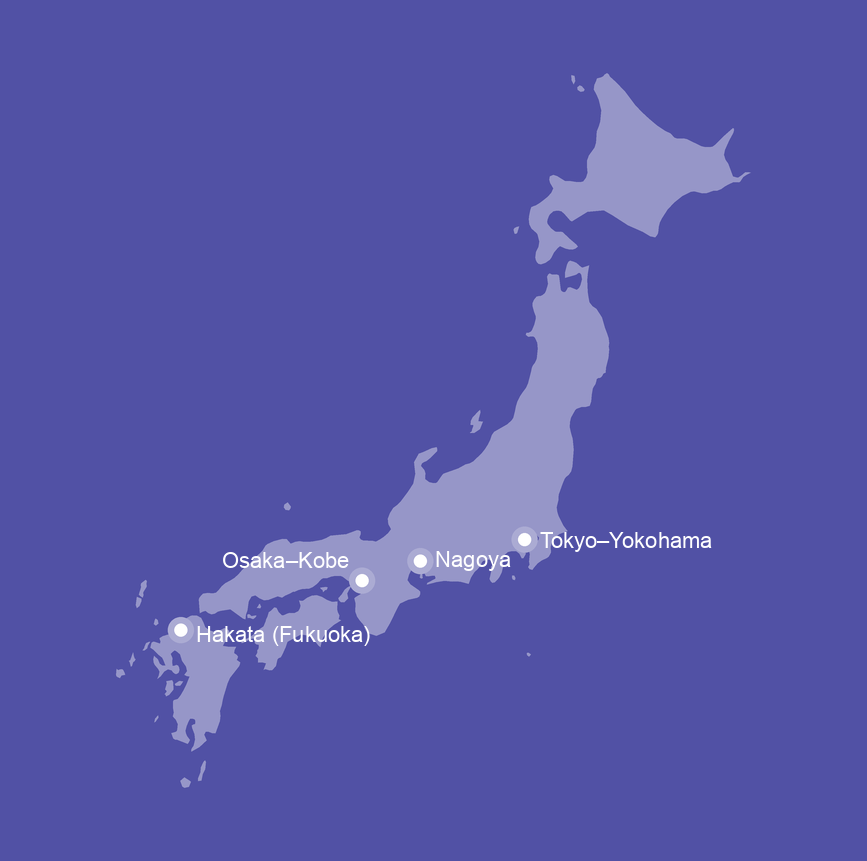
How cargo reaches each port
| Port | Region | Routing on one carrier's Australia service |
|---|---|---|
| Yokohama | Kanto | Direct call |
| Tokyo | Kanto | Trucked from Yokohama |
| Osaka | Kansai | Direct call |
| Kobe | Kansai | Trucked from Osaka |
| Nagoya | Chubu | Fed via Busan |
| Hakata (Fukuoka) | Kyushu | Fed via Busan |
Door-to-door relocation to Japan
We run a Japan move in the order Japan Customs sets it: the arrival declaration first, then the sailing, then clearance inside six months. The five stages below are the same whichever origin you ship from.
1. Packing for the sea leg
We pack for the sea leg and for Customs, so every package can be matched to your statement of contents:
- Packing boxes
For books, clothing, kitchenware and standard home contents. - Bubble wrap and cushioning
For fragile pieces, electronics and glassware. - Crates
For artwork, valuable furniture and anything that needs extra protection on a long sea leg. Ask your specialist about treated, marked timber for wooden crates.
Full packing service: prefer not to pack yourself? We can also pack furniture and oversized items. Say so on the estimate form and your specialist will arrange it.
2. Pickup at your origin
We collect from your home, check the inventory against what is actually loaded and mark every package as unaccompanied baggage, as Japan Customs asks.
3. Shipping and Japanese customs clearance
We route the shipment by sea or air, tell the carrier it is unaccompanied baggage and prepare the clearance file for the Japanese port. You make the declaration on Form C-5360 when you arrive; once the cargo lands and you pass us your sealed copy, we clear it.
4. Delivery to your new home
When Customs releases the shipment we schedule delivery and unloading at your Japanese address. Ask your building manager or landlord about move-in times and lift use before you set the date.
5. Unpacking and setup, if you want it
For full-service moves we can place furniture and remove packing material, so the gap between release and normal family life stays short.
Your move specialist
You work with one specialist from your first message to delivery. That person plans the sailing, prepares the clearance file and answers your questions, so you never repeat your situation to someone new.
Your specialist checks your entry date against the six-month window, tells you which of your goods need paperwork and flags problems before they reach the Japanese port.
You get an update at each stage: pickup, sailing, arrival, clearance and delivery. When you write, the person who replies already knows your shipment.
Talk to an agent now
Importing vehicles to Japan
A car you owned and used before you moved can come to Japan under its own exemption, but it does not follow the household-effects route. It is cleared like general cargo with a separate application, and it must pass Japanese inspection and registration before it can be driven on public roads.
Car import essentials
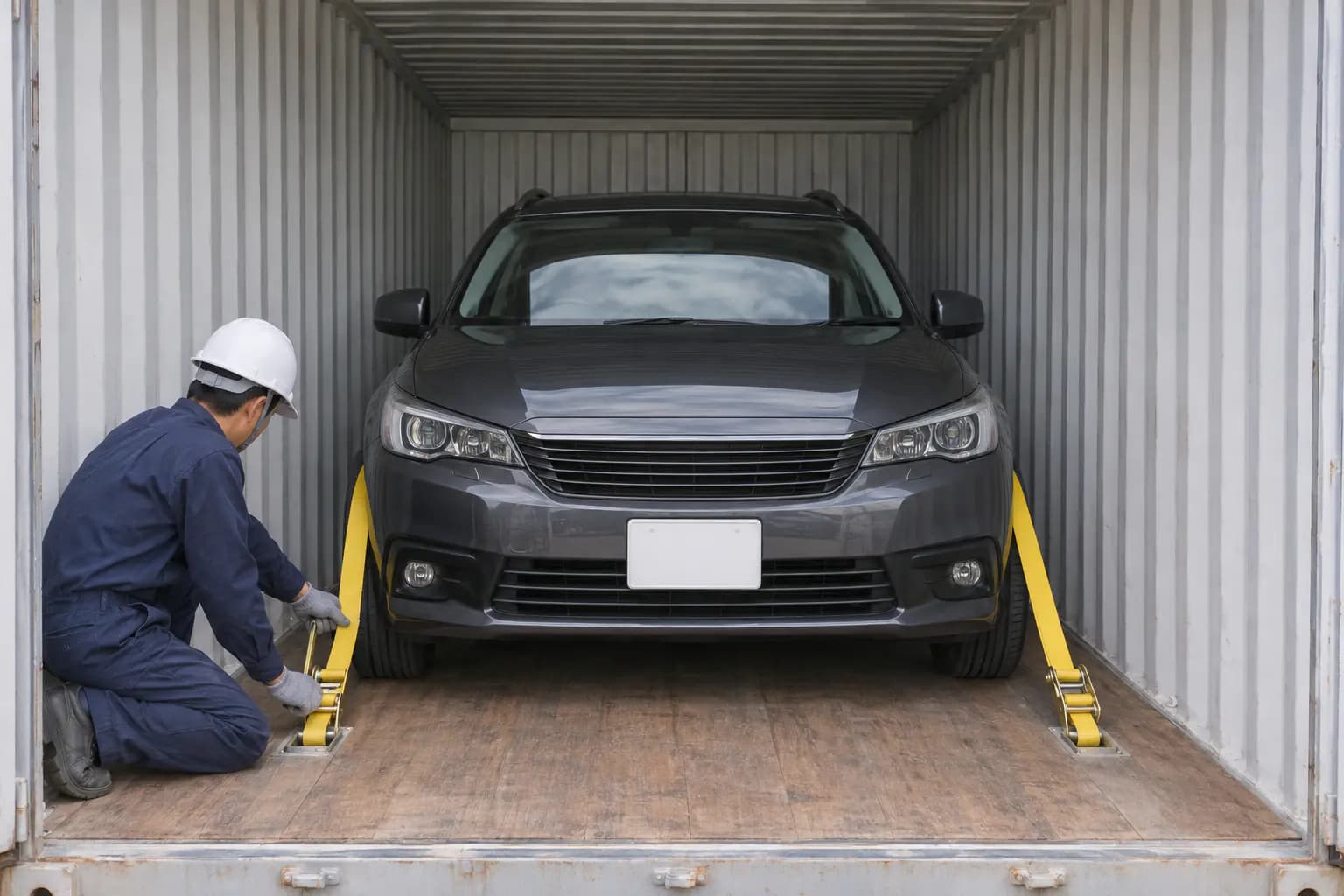
Car import essentials
- Customs application
Form T-1280, "Duty Exemption on Household Effects such as Automobiles", in three copies, filed with the import declaration. - Proof of prior use
A registration certificate or similar document showing the vehicle was used before you entered Japan, plus a document showing you are moving to Japan. A boat must have been in use for more than one year before it arrives. - Road registration
A vehicle registered in Japan for the first time needs safety-standards certification, inspection (shaken) and registration. The transport ministry's list of documents includes the customs clearance certificate (or an alternative such as an emissions inspection certificate) and an inspection record: a preliminary inspection certificate, a safety-standards conformity certificate, or an inspection with the vehicle presented.
Conditions and costs
- The duty exemption has a condition
The car must be neither resold nor given to another person within 2 years of the import permit. - Registration is a separate cost
The official pages we read give no total for inspection and registration, and none say whether a particular car meets Japanese standards.
A car is a separate go or no-go decision for most movers. We can plan the freight and the customs paperwork, but ask your regional transport bureau whether your car can be registered before you pay to ship it.
Moving to Japan with your pets
Japan quarantines every dog and cat on entry, and the Animal Quarantine Service (AQS) sets the route by origin. Pets from Iceland, Australia, New Zealand, Fiji, Hawaii and Guam follow a simplified route. Pets from other origins, the United Kingdom and Canada included, follow a longer route: microchip, two or more rabies vaccinations, an antibody test and then a 180-day wait.
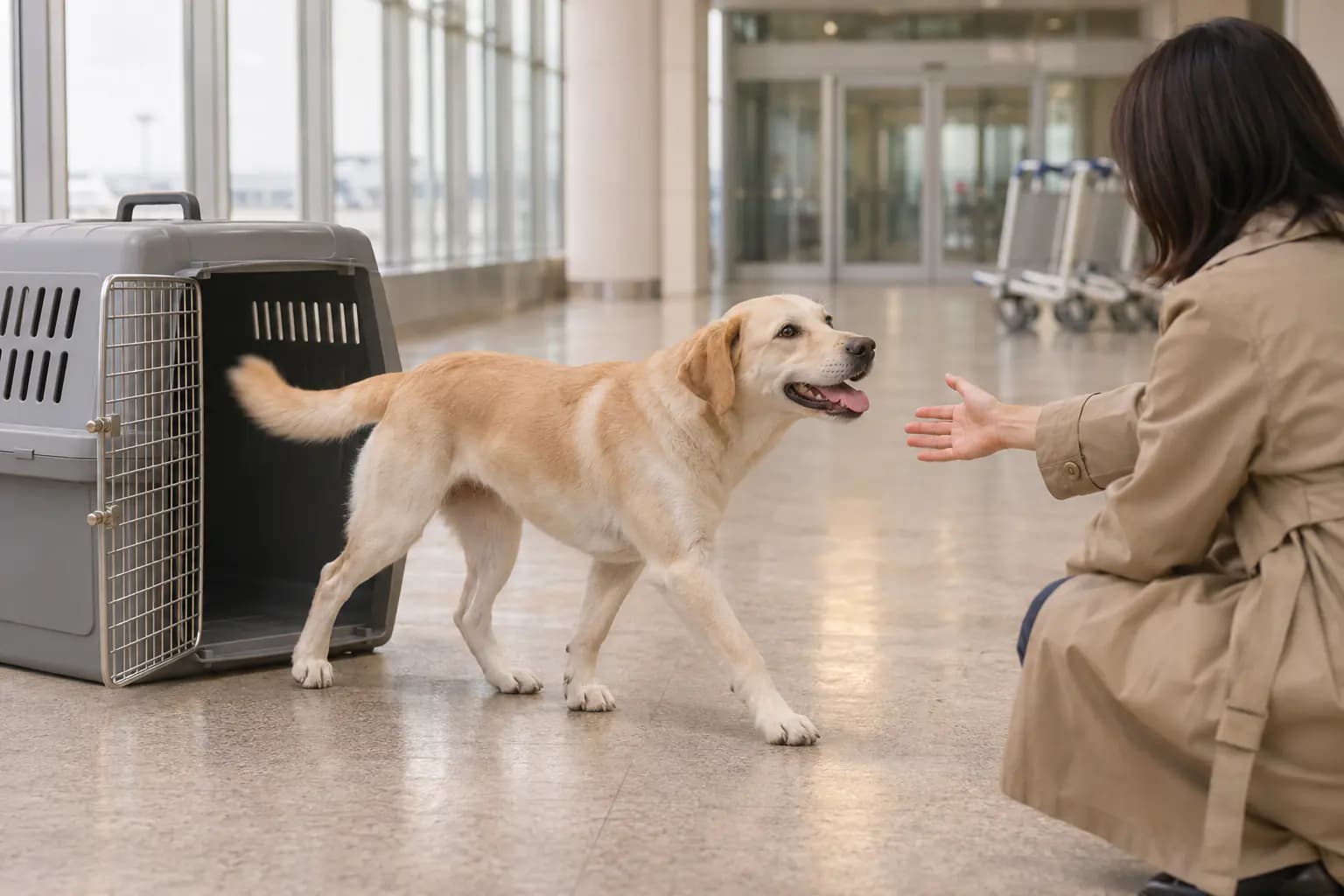
Key requirements for importing pets to Japan
- Microchip
An ISO 11784/11785 microchip, implanted before the first rabies vaccination, whose number matches every certificate. - Rabies vaccination and antibody test
Pets from non-designated regions need at least two rabies vaccinations and an antibody test at a laboratory designated by MAFF, then a 180-day wait from the blood sample. - Advance notification
Notify the AQS at least 40 days before the pet arrives. - Government health certificate
Issued or endorsed by the exporting country's government veterinary authority, after a clinical check within 10 days before boarding. A pet that does not comply can be detained for up to 180 days at your cost or returned.
Living in Japan
Moving to Japan is mostly a paperwork sequence. The first fortnight has a legal deadline, and the first month goes on health insurance, pension and a bank account.
In your first weeks:
- Register your address within 14 days. New residents notify the municipal office within 14 days of deciding where to live. It is free, and you bring your residence card or passport.
- Carry your ID. Foreign residents must carry their passport or residence card whenever they go out, according to the Tokyo Metropolitan Police.
- Join public health insurance. Enrolment is compulsory for anyone living in Japan. National Health Insurance takes residents who have no employer scheme, and patients usually pay 30% of the bill.
- Join the National Pension. It covers all residents aged 20 to 59; employees are enrolled through their employer.
- Drive on the right papers. An International Driving Permit lets you drive for up to a year after landing, or until it expires if sooner. To convert a licence in Tokyo you need at least 3 months' stay in the country that issued it, and Australian, Canadian and UK licences are on the list that skips the knowledge and skill checks. Other prefectures run their own centres.
This section summarises official guidance. Your employer or sponsor and your municipal office confirm what applies to your status.
6 months
Customs clearance window after you enter Japan
1 year+
Stay in Japan, or time abroad, that the household-effects relief rests on
2 copies
Form C-5360 copies you hand in on arrival, one returned with Customs' seal
Understanding Japan's cost of living
In 2025 the Statistics Bureau recorded average monthly consumption spending of 314,001 yen for households of two or more people, up 4.6% in nominal terms, with food at 28.6% of it. Workers' households averaged 653,901 yen of income and 346,297 yen of spending a month. These are national averages across all households, home-owners included, so they are not a budget for a newly arrived renter.
Rent is where newcomers feel it most. The transport ministry's apartment guidebook describes common (not mandatory) terms: move-in payments of roughly 4 to 7 months' rent, a deposit of about 2 months, non-refundable key money of 1 or 2 months that is often asked for in the Kanto region, and a guarantor or rent-guarantee company. Contracts normally run 2 years.
Security and disaster preparedness
Security and disaster preparedness
Call 110 for the police in an emergency, crime or accident, and a police interpreter joins the call if you do not speak Japanese. Call 119 for fire, illness or injury. The police general advisory line is #9110.
The Japan Meteorological Agency has run an Earthquake Early Warning service since 1 October 2007. It issues alerts as an earthquake starts, through TV, radio and other media, to give you seconds to react.
Earthquake and typhoon exposure applies to your home as well as your cargo. The peak-month and insurance sections above give the official figures.
Infrastructure and services
Power: the supply is 100 V across Japan. The east runs at 50 Hz and the west at 60 Hz, with the boundary roughly along the Fuji River in Shizuoka and Itoigawa in Niigata (Chubu Electric Power). Devices marked 100-240 V suit it, while 220-240 V appliances need a step-down transformer.
Waste: rules differ by municipality. Yokohama wants burnable waste in a transparent or semi-transparent bag and sorts several other categories, while Kyoto uses fee-based designated bags. Collect the local guide from your municipal office when you register your address.
Money, banking and tax
Japan Post Bank wants to see your residence card, plus another document (a copy of your resident record, for example) when the card carries no photo. It declines applications from people whose stay ends within 3 months, and the account may not open the same day, so budget your first weeks around cash or an overseas card.
Income tax: Japan treats you as a resident if you keep a home there or have lived there without a break for twelve months or longer. Non-Japanese residents in their first five years (five years or less out of the previous ten) are non-permanent residents: Japanese income is taxable, and foreign income only once it is paid in or remitted to Japan. Every other resident is taxed on worldwide income. Speak to a tax adviser about your own case.
Japan has social security agreements with Australia and Canada that include totalisation of pension periods, and one with the United Kingdom that covers contributions only.
Climate and weather
The Japan Meteorological Agency describes a country of wide contrasts. Temperatures as low as -20 C are frequent in inland Hokkaido in winter, Okinawa has mild winters, the rainy season begins in early May in Okinawa, and western Japan sometimes reaches 35 C or above in the second half of summer.
If your goods follow you by sea, keep clothing for the season you land in with you instead of packing it in the container.
Frequently asked questions
Visa first, shipping second. A long stay needs a status of residence, usually through a Certificate of Eligibility (free, standard processing of 1 to 3 months, valid for 3 months) and then a visa from a Japanese embassy or consulate. Once your entry date is set, mark the goods as unaccompanied baggage, ship them, declare them on Customs Form C-5360 when you arrive and clear them within six months.
Register your address at the municipal office within 14 days of arriving, then join health insurance and the pension scheme. The sections above cover each step.
Usually not. Japan exempts the used household goods and professional equipment of a person who moves their home to Japan from customs duty and from import consumption tax. You need to stay in Japan for at least one year, or be returning after at least a year abroad, and the goods must be for you and your family in a reasonable quantity.
A Temporary Visitor stay (90 days at most) and the digital nomad status (6 months, no extension) are shorter than that. Official guidance does not say whether a one-year working holiday or a student stay qualifies, so ask a Customs counselor before you ship.
On the day you enter Japan, at the Customs counter at your arrival airport or port. Fill in Customs Form C-5360 in duplicate, tick Yes for unaccompanied articles and give both copies to the officer; one comes back with Customs' seal. Once you are in Japan you cannot declare separately shipped goods, and a lost copy cannot be reissued.
Customs recommends Visit Japan Web for most declarations, but its pages for unaccompanied goods still describe two paper copies and a seal. Official guidance does not say that Visit Japan Web alone replaces the sealed copy, so carry the paper form.
Six months after you enter Japan. The Cabinet Order counts the import, so plan for customs release before the deadline and not only for the ship's arrival. People who move to Japan can ship after they arrive and still use the relief, as long as they made the declaration on arrival and clear the goods inside the six months.
Customs can accept a later import for an unavoidable special reason, such as a ship accident or a cargo-handling strike at the export or import port. It does not state how long an extension lasts, so ask a Customs counselor as soon as a delay looks likely.
The cost depends on your move, so you get a free estimate for your own inventory. The main drivers are the volume of your goods, your origin port and the sailing route, how much packing and crating you want, your Japanese delivery address and whether you add cargo insurance.
Qualifying household effects pay no Japanese customs duty or consumption tax, so the estimate is freight, handling, clearance and delivery. Ask your specialist which port or storage charges apply to your sailing.
It depends on your origin port, the carrier's service and the Japanese port, and published schedules change week to week. We give you the current sailing schedule for your origin with your estimate instead of a generic number of days. Customs release and delivery add time after the vessel arrives.
On the weekly Australia to Japan service we checked, vessels call directly at Yokohama and Osaka, Tokyo and Kobe cargo is trucked from those ports, and Nagoya and Hakata cargo is fed via Busan. Your specialist chooses the port with your delivery address in mind.
Possibly. A car you used before moving has its own exemption: Customs treats it like general cargo and asks for Form T-1280 (three copies), proof of prior use abroad and proof of your move. The duty exemption carries a condition, no sale or transfer within two years of the import permit, and the car must still pass Japanese inspection and registration before it goes on public roads.
Ask your regional transport bureau whether your car can be registered before you pay to ship it.
Yes, through quarantine. Japan inspects every dog and cat on entry. Pets from Iceland, Australia, New Zealand, Fiji, Hawaii and Guam follow a simplified route, and pets from anywhere else, including the United Kingdom and Canada, need a microchip, at least two rabies vaccinations, an antibody test and a 180-day wait, with notification at least 40 days before arrival.
Banned: narcotics, stimulants and cannabis, pistols and their ammunition, explosives, counterfeit goods, obscene material, soil, and meat products in principle. Many fresh fruit and vegetables cannot be brought in either. Needing a permit or certificate: swords and hunting guns, ivory and other CITES-listed items, plants and seeds, and medicines beyond one month's supply.
Nicotine vaping liquid is treated as a medicine, so only small personal amounts clear without a certificate.
A month's worth of prescription medicine is the most that clears without a certificate; a larger quantity needs an import confirmation certificate from the Ministry of Health, Labour and Welfare. Vyvanse and other medicines made from narcotic or stimulant raw materials need advance approval from the Narcotics Control Department, requested at least 14 days before travel, and the patient must carry them personally.
Adderall (amphetamine) is banned even on prescription.
Japan's household supply is 100 V everywhere. A device marked 100-240 V suits it, but a 220-240 V appliance from Australia or the United Kingdom needs a step-down transformer. The frequency is 50 Hz in eastern Japan and 60 Hz in western Japan, so a single-frequency appliance may not work across the line.
Check the label on each appliance before you pack it.
Customs publishes allowances of 3 bottles of about 760 ml and 200 cigarettes for adult visitors and returning travellers. Its pages do not say whether the wine or tobacco in a household move follows those caps or the reasonable-quantity test for household effects, so we do not give you a mover figure.
Ask a Japan Customs counselor before you pack a wine collection, and keep their answer with your papers.
Checklist for your Japan relocation
Checklist for your Japan relocation
Confirm your visa route and your entry date. Customs' relief rests on a stay of at least one year.
List what you are shipping and separate anything that needs a permit: medicines, plants, firearms, swords or CITES items.
Give us your origin and your Japanese address so we can choose the sailing and the port.
Mark every package as unaccompanied baggage before it ships.
On arrival, hand in two copies of Form C-5360 and keep the sealed copy safe.
When the arrival notice comes, pass the sealed copy and your passport to your specialist so the goods clear inside six months.
Plan your Japan move around your entry date
Tell us where you ship from and when you arrive. We fit the sailing, the clearance file and the delivery inside your six-month window.
Get your estimate