
Moving to Japan from Australia
We pack, ship and handle customs.
Guide to relocating from Australia to Japan
Core rules for shipping used household goods and personal effects from Australia to Japan, as read on official pages on 6 November 2026.
Japan exempts the household effects of a person moving their home there from duty and consumption tax if you show a stay of at least a year, declare the shipment on Customs Form C-5360 when you enter Japan, and clear the goods within six months after that entry.
Australia needs no Export Declaration for personal effects, but the Border Force still takes a report, and firearms, protected cultural objects and items made from native or CITES-listed wildlife, wood included, can need export permits.
ANL's weekly A3N service, on a schedule printed 6 November 2026, takes 13 days from Brisbane, 15 to 16 from Sydney and 19 from Melbourne to Yokohama, port to port, on sailings from December 2026 to February 2027. Earlier sailings on the same sheet run 10 to 28 days, and pickup, clearance and delivery come on top.
Australians can enter Japan without a visa for up to 90 days, but living there needs a status of residence, usually through a Certificate of Eligibility.
A move from Australia to Japan runs on two clocks. Australia sets the packing and export side. Japan's clock starts the day you enter the country, because that is when you declare the shipment, and the six months you have to clear it are counted from the same date.
Most problems come from the order of events, not from the goods. Japan Customs says unaccompanied articles cannot be declared after you have entered Japan, and a shipment that was never declared, or whose sealed declaration copy is lost, goes through the ordinary import procedure used for trade cargo.
This guide follows the order in which things happen: what leaves Australia, the paperwork around your Australian accounts, what Japan Customs asks for, how long the sailing takes, then visas and licences.
Your specialist builds the Australian export file and the Japanese clearance file together, so the inventory, the consignee and the form details match at both ends.
Customs for an Australia to Japan move
Two customs systems touch this shipment. Australia reports every export to the Border Force. Japan treats separately shipped household goods as unaccompanied articles tied to your own arrival. The steps below run in the order they happen, Australia first and then Japan.
Japan exempts used household goods and professional equipment from customs duty, and from import consumption tax, for people who move their home to Japan. You qualify if you will stay in Japan for at least one year, shown by your passport or other official documents, or if you are returning after living abroad for at least one year. The goods must be things you and your family use personally, in a reasonable quantity. Cars, boats and aircraft follow a separate procedure.
- Australia · before packing
Check for controlled items
Firearms, ivory and other CITES-listed wildlife products, Australian native wildlife and objects on the cultural heritage control list generally need an export permit. The Office for the Arts says a cultural heritage permit can take many months, and some Aboriginal and Torres Strait Islander objects cannot be exported at all. The environment department counts wood as wildlife, so check timber items on its permit page. Report A$10,000 or more in cash or other money to AUSTRAC before it leaves Australia, including inside freight.
- Australia · before loading
Report the goods to the Border Force
Personal effects are exempt from an Export Declaration, but every export must still be reported to the Australian Border Force, and personal effects are reported under an exemption code. Anything that needs an export permit goes on an Export Declaration whatever its value. There is no export duty, and exports are generally free of GST if conditions are met.
- Japan · before you ship
Mark the cargo as unaccompanied baggage
Write "unaccompanied baggage" (別送品) on the packages, the customs notice and the invoice, and name yourself as the addressee. Tell the freight company or broker beforehand that the cargo is unaccompanied baggage: some carriers do not handle it, and unmarked cargo can be cleared as ordinary trade cargo.
- Japan · on the day you arrive
Declare the shipment on Form C-5360
Submit the Declaration of Accompanied Articles and Unaccompanied Articles (Customs Form C No. 5360) in duplicate at the Customs counter where you arrive, by air or by sea, and tick Yes for unaccompanied articles. Customs seals one copy and gives it back; one declaration per family is enough. Separately shipped goods cannot be declared once you are in Japan, and a lost copy cannot be reissued.
- Japan · within six months of your entry
Get the goods cleared in time
The goods must be imported within six months after you enter Japan, and Customs counts clearance, not the day the ship docks. A later import is accepted only for an unavoidable special reason, such as a ship accident or a cargo-handling strike at the export or import port. No extension length is stated.
- Japan · when the shipment arrives
Clear it at the port
Once the airline or shipping line gives notice that the cargo has arrived, collect the delivery order. Take it, with the sealed form, your passport, the statement of contents and any receipts, to the unaccompanied-baggage section of the Customs office where the cargo landed. Plants and animals are checked at a quarantine station first; Customs then inspects the goods, you pay any tax assessed and the cargo is released. A licensed customs broker can handle this if you pass over the sealed form.
Documents you need for household goods entering Japan
Most avoidable delays start with missing or inconsistent paperwork. Japan Customs lists the form, transport documents, statement of contents, passport and receipts for clearing unaccompanied baggage by sea or air. Australian permits add to them where they apply, and the delivery details are for our booking.
- Customs Form C-5360 with the Customs confirmation seal, returned to you when you entered Japan
- Passport, plus the official documents that show you will live in Japan for at least a year when you claim the relief
- Transport documents, such as the delivery order you collect from the shipping line after its arrival notice
- Statement of contents: a plain-language inventory that matches what is packed
- Receipts for the goods, where you have them
- Australian export permits for any controlled item, such as firearms, protected cultural objects or native and CITES-listed wildlife items
- Phytosanitary certificate from the exporting country for any plants, which your broker presents to the Plant Protection Station at inspection
- Delivery address and building access details in Japan, which we need to book the final leg
Inspection and quarantine in Japan
Japan's quarantine rules apply to household goods as they do to trade cargo. These are the categories most likely to stop a shipment:
- Soil, plants and used agricultural machinery
MAFF says soil cannot be brought into Japan. Plants can travel as unaccompanied baggage with a phytosanitary certificate from the exporting country, which your broker presents to the Plant Protection Station at inspection, and used agricultural machinery is inspected too. Importing plants without the certificate or inspection can mean up to 3 years in prison or a fine of up to JPY 3 million. - Food
Most fresh fruit and vegetables are banned, and meat and meat products are banned in principle, even when cooked or vacuum-packed. Check pantry items before they go in the container. - Wood: furniture versus packaging
Customs says processed wood such as furniture, woodwork and treated timber does not need plant inspection. Wood packaging is different: Japan regulates it consistent with ISPM 15, so crates, pallets and dunnage need treatment and the mark. Plywood, particle board, veneer and timber no thicker than 6 mm are not regulated as wood packaging. Australia's Department of Agriculture lists Japan as enforcing ISPM 15 since 1 April 2007 and leaves compliance to the exporter. - Medicines
Up to one month of prescription medicine clears without a certificate. Medicines containing narcotics or stimulant raw materials, such as lisdexamfetamine (Vyvanse), need advance permission (apply at least 14 days before you travel) and you must carry them yourself; they cannot be shipped. Amphetamine is banned even with a prescription.
Appliances and power
Mains voltage is 100 V AC throughout Japan, at 50 Hz in the east and 60 Hz in the west, which includes Nagoya, Kyoto and Osaka. Japan's national tourism organisation says dual-voltage items such as hair dryers and shavers work anywhere, and that other appliances need a step-down transformer.
Check the rating label on each appliance before it goes in the container. Conversion plugs are easy to find in Japan; the voltage and frequency are the part to settle before you pack.
What you can import to Japan

Personal belongings
Free of duty and tax when you move to Japan for a year or more, in reasonable amounts

Used clothing

Household appliances
Japan runs on 100 V; 220-240 V items need a transformer

Fragile items

High-value items
Declare any gold and cash over JPY 1 million on arrival

Large items & furniture

Excess luggage
Declare as unaccompanied baggage on arrival; clear within 6 months

Pets
Microchip and 40 days' notice; rabies tests and a 180-day wait except from Australia, New Zealand and a few other places

Vehicles
Form T-1280; no resale for 2 years; Japanese inspection and registration needed
Products subject to restrictions in Japan

Drug Contraband
Adderall (amphetamine) banned even with a prescription

Prescription & non-prescription medicines
Over 1 month's prescription supply needs an import certificate; Vyvanse needs prior permission and cannot be shipped

Cannabis & CBD products
Cannabis banned; CBN products banned since 1 June 2026

E-cigarettes & vapes
Nicotine liquid counts as medicine; over 120 ml needs a certificate

Alcohol & tobacco products
No mover limit published; travellers get 3 bottles and 200 cigarettes

Weapons, firearms & controlled items
Pistols and their ammunition banned; hunting guns, air guns and swords need permits

Explosives

Hazardous
High-pressure gas, kerosene and agricultural chemicals are controlled by other laws

Counterfeit

Banned publications & media
Obscene or immoral material and child pornography

Ivory
CITES items need an export permit and a METI import licence

Plants, seeds & soil-related items
Soil banned; plants and seeds need a phytosanitary certificate

Food, supplements & consumables
Most fresh fruit and vegetables banned

Meat & dairy products
Meat, ham, sausage and jerky banned in principle
Useful customs links
Useful contacts

Official Japan Customs guidance on household effects and unaccompanied baggage. For questions about your own case, such as a visa type, ask a Customs Counselor at your port of entry.
Leaving Australia: tax, Medicare and super
None of this changes the customs file, but it decides your tax position and your health cover in the first year. Each point comes from the official pages named in the Sources section at the foot of the page.
Tax residency
Leaving Australia does not by itself end Australian tax residency. The ATO's own example is a teacher on a one-year contract in Japan who stays an Australian resident under the domicile test, while its example of a family that moves for three years, sets up a home overseas and rents out its Australian house is a foreign resident. If your status changes during the year, the ATO says to answer yes to the residency question on that year's return.
Capital gains and your home
If you stop being an Australian resident, the ATO treats some of your assets, generally those that are not taxable Australian property, as sold at market value, and you can choose to disregard that. Selling your Australian home after you become a foreign resident can also lose the main residence exemption unless certain requirements are met.
Medicare and private health cover
Services Australia says Medicare does not cover you while you are overseas and that you may need to enrol again when you return, depending on how long you were away. Arrange your own health cover for the first weeks. If you stay an Australian tax resident and cancel private hospital cover, the Medicare levy surcharge can apply; a foreign resident does not pay the Medicare levy.
Super
Leaving Australia does not give you access to your super. The ATO says citizens and permanent residents leaving temporarily or permanently stay under the same rules, so you cannot access it until you reach preservation age and retire or meet another condition of release. The Departing Australia Superannuation Payment is for people who worked on a temporary visa; Australian citizens and permanent residents are not eligible.
Study loans
A HELP, VET Student Loan or Australian Apprenticeship Support Loan stays repayable. Update your contact details before you leave or within 7 days of leaving, and submit an overseas travel notification if you intend to stay away for at least 183 days.
Pensions and the Japan agreement
Australia and Japan have a social security agreement. For an employee posted to Japan by an Australian employer it avoids double pension coverage for up to five years, and it lets periods in either country count towards the Japanese old-age pension and the Australian Age Pension. It does not cover superannuation payouts.
Documents for Japanese offices
Japan and Australia are both parties to the Hague Apostille Convention. If a Japanese authority asks for an apostille on a birth or marriage certificate, Australia's Department of Foreign Affairs and Trade applies it. Ask the Japanese office which documents it needs and which must be legalised before you request any apostilles.
Japanese duty and tax on household goods
Customs describes household effects brought in by a person moving to Japan as free of duty and tax. A shipment that does not qualify is assessed as ordinary cargo: customs duty, then consumption tax at 10% (8% for reduced-rate goods) on the customs value plus duty and any excise, using the rates in force on 6 November 2026.
What the relief covers
- Household effects for your own or your family's use, and professional equipment, brought in when you enter or shipped separately.
- A stay of at least one year shown by your passport or other official documents, or a year or more lived abroad if you are a returning resident.
- Separate shipments cleared within six months after the date you entered Japan.
What falls outside it
- Cars, boats and aircraft are not covered by the household-effects rule. See the vehicles section.
- Customs says that commercial cargo or costly goods sent as unaccompanied articles may need the same import procedures as general cargo.
- Customs publishes no minimum period of prior use and no volume cap. Its test is that the goods are reasonable for your circumstances.
Shipping before or after you land
- You can ship before you travel or after you arrive. Either way, declare the shipment on entry, and make sure clearance falls inside the six months after that date.
- The form says only one written declaration per family is required, so one sealed copy covers the household.
Alcohol, tobacco, cash and gold
Customs' traveller allowances are three bottles of alcohol and 200 cigarettes per adult. Its pages do not say whether a mover's shipment follows those caps or the household-effects rule, so ask a Customs Counselor before you pack a wine collection or cartons of cigarettes.
On arrival you must declare cash, cheques and securities above JPY 1,000,000 (or the equivalent), and any gold whatever the amount, new or used.
Shipping a car to Japan
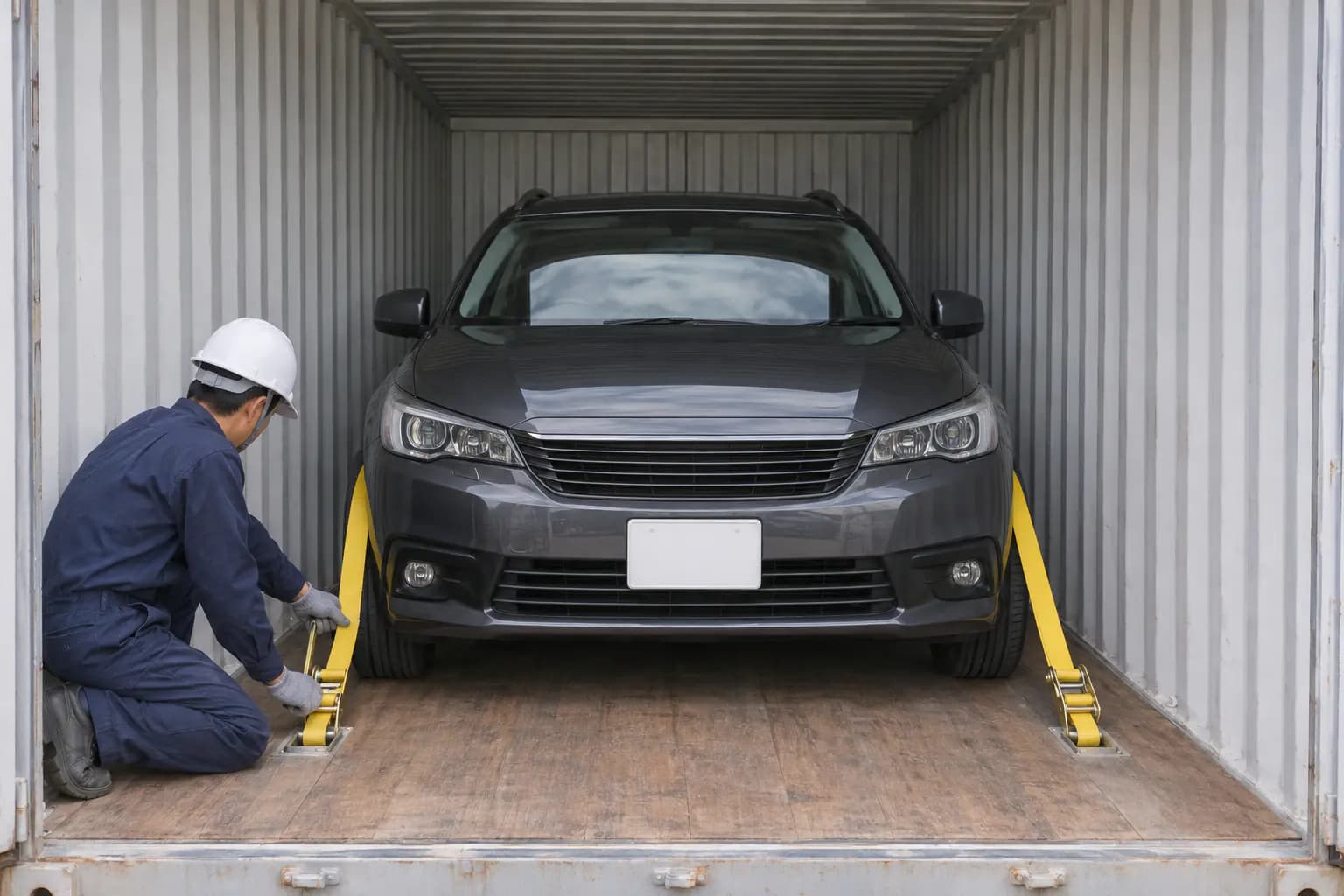
A car you have used abroad is not covered by the household-effects relief. Japan Customs handles it under a separate exemption: a general-cargo import declaration, an application for duty exemption on household effects such as automobiles (Form T-1280, three copies) and a registration or ownership certificate that proves the car was in use before you entered Japan. The exemption comes with a condition: you cannot sell or transfer the car within two years of the import permission.
Before you book
Before you book
- Ask Customs first
Customs approves the T-1280 application, so ask the customs office at your port of entry about your car before you book space. - Plan for inspection and registration
A car imported and registered for the first time needs Japanese safety certification, inspection (shaken) and registration before it can go on public roads. The transport ministry lists the customs clearance certificate among the documents. - Check the cost before you commit
Neither Customs nor the transport ministry publishes a total cost for importing and registering a used car, so ask for the steps for your model before you pay for shipping.
Conditions that come with the exemption
- Two-year rule: no resale or transfer of the car within two years of the import permission.
- Proof of use: a registration or ownership certificate from the foreign registry; Customs' circular also lists the insurance policy, purchase receipt or tax certificate.
- Boats and aircraft: you or your family must have used them for at least a year before entering Japan.
If you think your car qualifies: your specialist can point you to the right Customs office before you commit to anything.
Moving to Japan with pets
Japan quarantines every dog and cat on entry. Australia is one of six places on Japan's list of designated rabies-free regions, with Iceland, New Zealand, Fiji, Hawaii and Guam, which gives Australian animals a shorter route than most countries get.
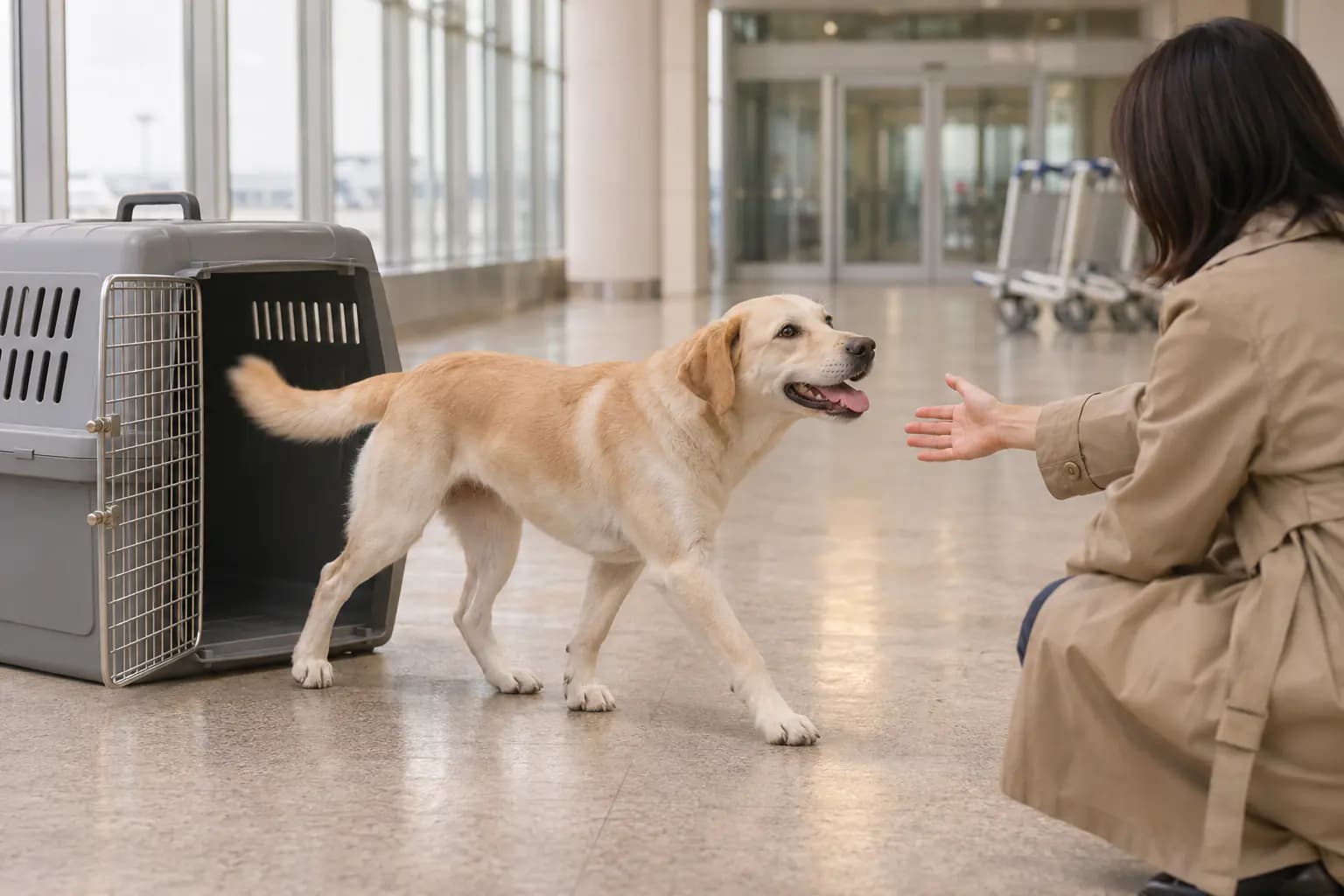
Japan's route for pets from Australia
- Microchip and residence
An ISO microchip, and your pet must have lived in Australia since birth or for at least 180 days immediately before export. - Advance notification
Notify the Animal Quarantine Service at your port of arrival not less than 40 days before arrival, online through NACCS. Dogs can enter Japan only through designated airports and seaports. - Vet check and certificate
A clinical inspection by a vet within 10 days before boarding, and a certificate issued by the exporting country's government. - No titre test on this route
The steps the Animal Quarantine Service lists for designated regions include no rabies antibody test and no 180-day wait; those belong to the route for other countries.
Japanese ports for freight from Australia
On the one published schedule we could read (ANL A3N, printed 6 November 2026), a weekly Australia to Japan service calls at Yokohama and Osaka directly. Tokyo cargo is trucked from Yokohama, Kobe cargo from Osaka, and Nagoya and Hakata cargo is fed through Busan in Korea. Another carrier or sailing can call elsewhere, so your specialist confirms the port against the live schedule. Door to door adds pickup, export reporting, Japanese clearance and delivery to the times below.
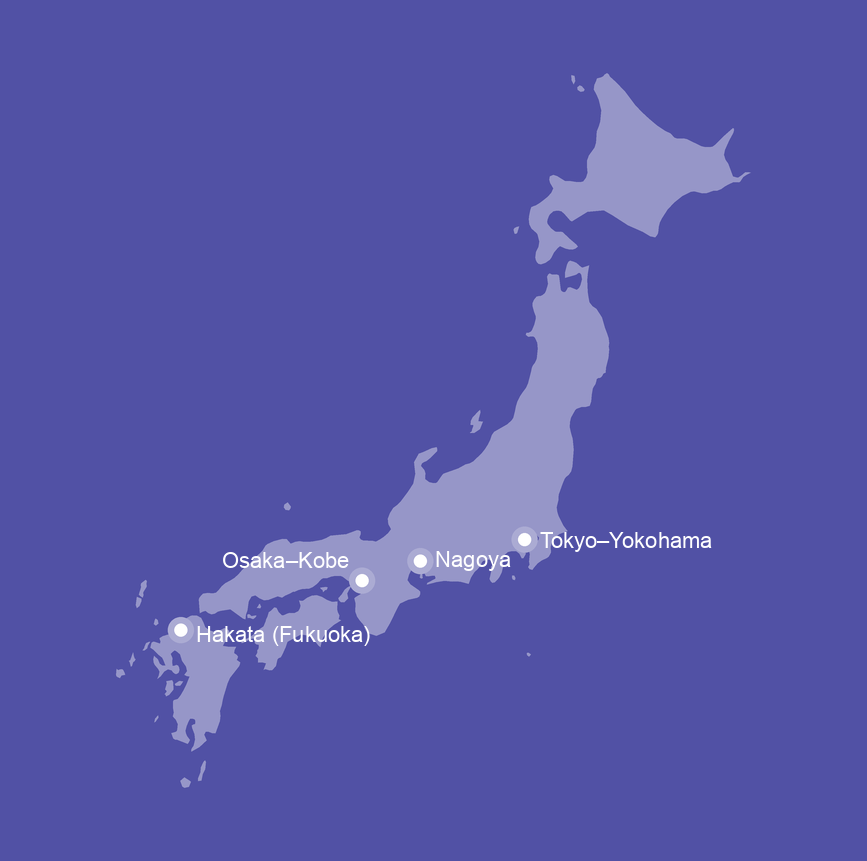
Ports on this route
Yokohama
Direct call and the reference point for the times in this guide
Tokyo
Trucked from Yokohama, three days after the Yokohama date in the schedule
Osaka
Direct call, two days after Yokohama
Kobe
Trucked from Osaka, five days after Yokohama
Nagoya
Fed through Busan, 14 days after Yokohama
Hakata (Fukuoka)
Fed through Busan, 17 days after Yokohama
Fremantle (Perth)
Not on this service. We found no published Fremantle to Japan sailing time, so your specialist gives you a figure from a live schedule.
ANL A3N scheduled sailing times, sailings from December 2026 to February 2027 (printed 6 November 2026)
| From | To | Scheduled days, port to port |
|---|---|---|
| Brisbane, Australia | Yokohama, Japan | 13 days |
| Sydney, Australia | Yokohama, Japan | 15-16 days |
| Melbourne, Australia | Yokohama, Japan | 19 days |
| Yokohama arrival date | Tokyo (trucked) | +3 days |
| Yokohama arrival date | Osaka | +2 days |
| Yokohama arrival date | Kobe (trucked from Osaka) | +5 days |
| Yokohama arrival date | Nagoya (via Busan) | +14 days |
| Yokohama arrival date | Hakata (via Busan) | +17 days |
| Fremantle (Perth), Australia | Any Japanese port | Not on this service |
Peak and quiet months for an Australia to Japan move
Only the Japanese side of the calendar is published by official bodies:
- March and April (Japan)
Japan's transport ministry says moving businesses receive requests concentrated in March and April every year. If you arrive then, book delivery crews and building access early. - Late April to early May (Japan)
Golden Week brings national holidays on 29 April and 3 to 5 May in 2027. Government offices are closed on national holidays in principle, so allow extra time if clearance falls on them. - 29 December to 3 January (Japan)
Government offices are closed in principle between these dates, and Customs publishes a reduced-service table each year. Avoid planning clearance inside this window. - July to October (typhoon season)
The Japan Meteorological Agency counts an average of 11.7 typhoons a year approaching Japan, with the most in August and September (3.3 each). We found no port-authority statement on their effect on sailings, so build slack into delivery dates. - November to June (fewer typhoons)
The same agency averages under one approach a month from November to June, and none were recorded in January to March (1991-2020). - Australia
No Australian government source publishes a moving-season peak for exports, so we do not state one. Your specialist checks vessel space and the export cut-off against your pickup date.
Visas for Australians moving to Japan
Australia is on Japan's list of visa-exempt countries, and the exemption gives a stay of up to 90 days. It covers short stays such as tourism, visiting relatives, meetings and business contact, and extensions are granted only for unavoidable humanitarian or similar reasons. Living in Japan needs a status of residence.
For most long stays the route is a Certificate of Eligibility, filed in Japan by you or by the organisation receiving you. It costs nothing, the standard processing period is one to three months and the certificate is valid for three months. You then apply for the visa at a Japanese embassy or consulate.
For the shipment, Customs looks for official documents showing a stay of at least one year. Its pages do not say whether a particular status, such as a working holiday visa, meets that test, so ask a Customs Counselor before you rely on it.
Routes Australians use
The routes below come from the Immigration Services Agency (ISA) and the Ministry of Foreign Affairs (MOFA):
Visa-free short stay
Up to 90 days for tourism, visiting relatives, meetings and business contact. JESTA, an electronic travel authorisation for visa-exempt visitors, must start by 31 March 2029; no start date is announced.
Work and transfer statuses
Engineer/Specialist in Humanities/International Services needs a relevant degree or 10 years of experience and pay at least equal to a Japanese national's. Intra-company Transferee covers a fixed-period transfer within a group. Highly Skilled Professional is a points system that needs 70 points.
Working Holiday
MOFA lists no annual cap on Working Holiday visas for Australians. The Sydney consulate gives the age range as 18 to 30 and says there is no dependant visa; MOFA words it as 18 to 25 unless extended to 30, so check the consulate before you apply.
Digital nomad
Six months, no extension and no residence card. It needs annual income of at least 10 million yen and private medical insurance of at least 10 million yen, and it allows remote work for a foreign employer but not under a contract with a Japanese organisation. Australia is on the eligible list.
Business Manager
Since 16 October 2025 it needs business assets or paid-in capital of at least 30 million yen, one full-time employee who is Japanese or holds a settled status, Japanese at about CEFR B2 (you or an employee), a business plan confirmed by a Japanese-licensed professional and, in general, an office that is not your home.
Family
The spouse or child of a holder of a listed status can apply for Dependent status, set for up to five years. A digital nomad's spouse and children get their own six-month status.
Note: a visa-free entry is for short stays, so it is the wrong base for a household shipment: Customs looks for a stay of at least a year.
Check the ISA and MOFA pages before you commit to sailing dates. Fees for residence procedures such as extensions and changes of status rose on 1 October 2026.
Frequently asked questions
Usually not, if you are moving your home to Japan.
Japan waives customs duty and consumption tax on household effects for the personal use of a person who is moving to live there and shows a stay of at least one year. You must declare the shipment when you enter Japan and clear it within six months after your entry date. Cars are handled separately, and Customs publishes no mover-specific limit for alcohol and tobacco.
You declare it on the day you enter Japan, and it cannot be done afterwards.
Fill in Customs Form C-5360 in duplicate at your arrival airport or port. Customs returns one copy with its seal, and you need that copy to clear the goods. Without it, the goods go through ordinary import procedures like trade cargo. Customs recommends declaring through Visit Japan Web, but its unaccompanied-articles guidance describes two paper copies and does not say that a Visit Japan Web declaration replaces them.
Six months from your entry date, counted to customs clearance.
Customs words the limit as goods clearable within six months from your entry. If a ship accident or a cargo-handling strike at the export or import port delays the cargo, the Director-General of Customs can accept a late import for an unavoidable reason, with no standard extension. You can ship after you arrive and still qualify, as long as you declared on entry and clearance falls inside the six months.
One carrier's schedule shows 13 to 19 days port to port to Yokohama.
In the schedule for ANL's weekly Australia to Japan service, printed on 6 November 2026, sailings from December to February run 13 days from Brisbane, 15 to 16 from Sydney and 19 from Melbourne to Yokohama. Tokyo cargo is trucked from Yokohama and arrives three days after the Yokohama date, Osaka two days, Kobe five, and Nagoya and Hakata 14 and 17 days via Busan. Sailings printed for October and November in the same schedule show anything from 10 to 28 days depending on the origin port, and the carrier says dates are subject to change.
Fremantle is not on this service and we found no published figure. Door to door adds pickup, export reporting, Japanese clearance and delivery.
No, personal effects are exempt from an Export Declaration.
The Border Force still requires every export to be reported, using an Export Declaration or an exemption code, and anything that needs an export permit goes on an Export Declaration whatever its value. There is no export duty, and exports are generally free of GST if conditions are met. Report A$10,000 or more in cash or other money to AUSTRAC before it leaves, including inside freight.
Firearms, drugs, plants and meat are the usual stoppers, and some items need permits at both ends.
From Australia, firearms, protected cultural objects and items made from native or CITES-listed wildlife, wood included, can need export permits. The Restricted Goods Permit does not cover firearms sent as freight; those fall under Defence Export Controls. Japan bans pistols, pistol parts and their ammunition, amphetamine (Adderall) even with a prescription, soil, most fresh fruit and vegetables, and meat and meat products in principle. Hunting guns, air guns and swords need a possession permit or registration plus import approval, and plants need a phytosanitary certificate. The goods lists above show the full set.
Check the rating label first, because Japan runs on 100 V.
Voltage is 100 V AC throughout Japan, at 50 Hz in the east and 60 Hz in the west. Japan's national tourism organisation says dual-voltage items such as hair dryers and shavers work anywhere, and that other appliances need a step-down transformer. Conversion plugs are easy to find in Japan.
Possibly, under a separate exemption with conditions.
Customs requires a general-cargo import declaration, the T-1280 application and proof the car was used abroad, and you cannot sell or transfer it within two years of the import permission. It must then pass Japanese inspection and registration before it can be used on public roads. Ask Customs before you book space.
Yes, with the right status, because visa-free entry covers only 90 days.
Most long stays start with a Certificate of Eligibility filed in Japan by you or your employer: no fee, standard processing of one to three months, valid for three months. You then take it to a Japanese embassy or consulate for the visa. Working holiday, digital nomad and Business Manager are separate routes; the visa section above sets out the sourced requirements.
You can ship, but Customs' pages do not say that a working holiday visa meets its one-year test.
Japan's household-effects relief rests on official documents showing a stay of at least one year. The Sydney consulate says working holiday visas are valid for one year, with an initial stay of six months that Japanese immigration can extend at its discretion. MOFA lists no annual cap for Australians, and there is no dependant visa. Ask a Customs Counselor about your case before you rely on the relief.
Yes, and in Tokyo you can convert it without the knowledge and skill checks.
Tokyo Metropolitan Police list Australia among 29 countries and regions exempt from those checks, if you stayed in Australia at least three months in total after getting the licence and your address is in Tokyo. Until you convert, you can drive on an International Driving Permit for the shorter of one year from landing or the permit's validity.
Yes, and Australia has a shorter route than most countries.
Australia is one of six designated rabies-free regions in Japan's quarantine rules. The route needs an ISO microchip, 180 days of residence in Australia (or birth there), notification at least 40 days before arrival, a vet check within 10 days before boarding and a government certificate.
Settling in Japan
Once the goods are on their way, the rest of the move is paperwork in Japan with fixed clocks. The first is 14 days: a new resident must notify the municipal office of their address within 14 days of deciding where to live, bringing the residence card or a passport that says a card will be issued later.
Residence cards are issued at landing at ten airports: New Chitose, Sendai, Narita, Haneda, Chubu, Kansai, Kobe, Hiroshima, Fukuoka and Naha. Elsewhere the card arrives by post after the address notification. For the wider picture of ports, regions and customs rules, see our relocation guide to Japan.
13-19 days
Scheduled port-to-port sailing from Brisbane, Sydney and Melbourne to Yokohama on one carrier (6 November 2026)
6 months
Time after you enter Japan to clear the shipment under the household-effects relief
100 V
Mains voltage throughout Japan, at 50 Hz in the east and 60 Hz in the west
Renting: what to expect up front
Japan's transport ministry (MLIT) describes typical rental practice in its English apartment guidebook. It is market practice, not law, and it varies by region.
- A guarantor or a rental guarantee company is often required, and a rule of thumb for move-in payments is the equivalent of 4 to 7 months' rent.
- A security deposit of about two months' rent is typical, and key money of one or two months' rent is often required in the Kanto region and is not returned.
- The agency fee is capped at one month's rent, and contracts normally run for two years.
- Allow one to two weeks from application to move-in.
Emergencies and carrying ID
Emergencies and carrying ID
Call 110 for police in an emergency, crime or accident; an interpreter joins the call if you do not speak Japanese. Call 119 for fire, illness or injury.
Foreign residents must carry their passport or residence card whenever they go out, and show it when the police ask, according to the Tokyo Metropolitan Police living guide.
Japanese tax for new residents
For income tax, Japan treats you as a resident if you have a domicile in Japan or have had a residence there continuously for one year or more. Until then a person with no domicile on arrival is treated as a non-resident, taxed on Japan-source income only.
A non-permanent resident is a non-Japanese who has had a domicile or residence in Japan for five years or less in the last ten. They are taxed on income other than foreign-source income, plus foreign-source income that is paid in Japan or remitted to Japan. Other residents are taxed on worldwide income.
Australia and Japan have had an income tax convention in force since 3 December 2008. Talk to a tax adviser about how it applies to you alongside the Australian residency rules above.
Health insurance and pension
Public health insurance is compulsory for anyone who lives in Japan. National Health Insurance covers the self-employed, students, the unemployed and foreign residents staying more than three months who are not in an employer's scheme. The usual patient share is 30%, and premiums depend on income and vary by municipality.
The National Pension covers all residents aged 20 to 59 regardless of nationality; employers enrol their employees. A non-Japanese who leaves Japan for good can claim a lump-sum withdrawal payment if they paid in for at least six months, but must claim within two years of ceasing to have an address in Japan.
Opening a bank account
Japan Post Bank asks for your residence card. It will not open an account if your stay expires within three months of the application, and the account may not open the same day.
Driving: converting your Australian licence
Tokyo Metropolitan Police list Australia among 29 countries and regions whose licence holders skip the knowledge and skill checks when converting to a Japanese licence. You must have stayed in Australia for at least three months in total after getting the licence, and your address must be in Tokyo. You bring the original licence with a certified Japanese translation and the other documents the police list.
Conversion is done in person, with no proxy, at the prefectural police licence centre for your address in Japan; the list above is Tokyo's. Until you convert, you can drive on an International Driving Permit issued under the Geneva Convention for the shorter of one year from landing or the permit's validity.
Door-to-door shipping from Australia to Japan
We manage the route from your Australian pickup address through Japanese customs to your front door, with one file built around the real shipment.
1. Packing and file review
Before export, we match the packing plan to the customs file and the risk profile of the goods. That usually includes:
- Export-grade cartons and wrapping
For ordinary household goods that still have to survive several handling points. - Protection for fragile items
For glass, electronics, artwork and anything that costs a lot to repack badly. - Crating where needed
For oversized, fragile or high-value items, with crates and pallets checked against Japan's wood packaging rule.
For the usual causes of damage and a prevention checklist, see this guide to why shipments get damaged in transit.
Full packing service: if you would rather not pack, your specialist can pack everything, including furniture and oversized items. Fill in the contact form and a consultant will get in touch to organise it.
2. Pickup at your Australian address
Collection is scheduled against packing completion, the export cut-off and the sailing you are booked on.
3. Sailing and Japanese customs
We move the shipment by sea, arrange the Australian export report, and prepare the Japanese clearance around the sealed Form C-5360 you carry from the airport.
4. Delivery to your Japanese address
After release, we book delivery around the building's access rules and your receiving window.
5. Unloading and placement
We also offer unpacking. Your specialist places your goods where you want them, so you can use your home from day one.
Checklist for your Australia to Japan move
Checklist for your Australia to Japan move
Enter your move details.
Confirm your Japanese entry plan: the status you will use and the date you land.
Check the Australian export items: permits for controlled goods and cash reporting.
Choose the sailing and port, and mark the cargo as unaccompanied baggage.
Declare the shipment on Form C-5360 when you arrive in Japan and keep the sealed copy.
Track the shipment, then clear it with Customs within six months of your entry date.
Confirm the delivery address, building access and timing in Japan.
Get your Australia to Japan move plan
See the customs steps, the sailing options and the timing for your move before you commit the shipment.
Get your estimate