
Moving to Thailand from Singapore, from S$1,956
Request a free estimate in 60 seconds.
Guide to relocating from Singapore to Thailand
Sea freight from Singapore's Pasir Panjang Terminal to Bangkok takes 5–7 days, making this one of Southeast Asia's shortest international shipping lanes. Air freight from Changi Airport arrives in 1–2 days.
Thai customs allows duty-free import of used personal effects for residents relocating from abroad, provided the goods were owned and used abroad (Customs sets no published minimum period of use, but newly bought items are at risk of duty).
For household goods, Thai Customs looks for a one-year basis to stay: if you are working in Thailand, a one-year non-immigrant visa or, until it is granted, an Immigration letter confirming an annual stay or a work permit of at least a year (some foreigners qualify through a quota shown in their passport). Its Thai-language guidance says Non-Immigrant O entries for retirement or to follow a Thai wife fall outside that quota route, so check your category with Customs before you ship. Items that do not qualify are charged duty like normal goods.
Thailand has prohibited importing used cars, vans, buses and trucks since 10 December 2019 (Ministry of Commerce notification B.E. 2562), with only a few licensed exceptions, so most Singaporeans sell their vehicle at home and buy in Thailand.
Starting price for a full household container from Singapore to Bangkok is S$1,956. Volume, packing services, and final delivery distance all affect the final figure.
Moving from Singapore to Thailand involves coordinating Singapore Customs export documentation, a short sea freight transit via the Malacca Strait, and Thai customs clearance on arrival. The short distance between the two countries is an advantage, but two failure points cause most delays: shipments that miss Thai Customs' timing window (from one month before to six months after the owner arrives), and undeclared or incorrectly valued items flagged at Thai customs.
Swift Cargo Solutions manages the full chain: packing and export wrapping in Singapore, sea freight booking with confirmed vessel schedules, customs documentation preparation, Thai customs clearance at Laem Chabang or Bangkok Port, and delivery to your door. A dedicated Move Manager stays on your case from first quote to final delivery.
Below: Thai customs rules for Singapore-origin shipments, transit times from Pasir Panjang, visa requirements, restricted items, and a cost-of-living comparison framed in Singapore dollars.
Hidden costs on Singapore-to-Thailand moves are usually the charges that surface between the initial quote and the final invoice.
Thai customs for Singaporeans moving to Thailand
Thailand's customs authority (Thai Customs Department) allows returning residents and foreigners changing residence to Thailand to import personal effects and household goods duty-free under specific conditions. Eligibility for the duty exemption depends on your immigration status and the shipment meeting the exemption rules, not on Singaporean nationality. The exemption covers used items that were owned and used abroad. Customs' published guidance sets no minimum period of use; some movers report that Customs expects about six months, so ask before you pack newly bought items.
Customs' published guidance sets no limit on the number of shipments, but it does fix the timing window (one month before to six months after you arrive) and allows one unit of each kind of appliance per person (two per family). Most movers use one sea shipment for the bulk of their belongings and an air shipment only for what they need sooner; ask your specialist before splitting a move. All items must be declared with an Application for Duty Exemption and the import declaration (normally Customs Form กศก. 99/1), and customs officers may conduct physical inspection of containers at Laem Chabang Port.
High-value electronics (laptops, cameras, audio equipment) are scrutinised carefully. If serial numbers can be matched to purchase records and items show visible use, the claim under the duty exemption for people changing residence is typically upheld. New, unopened electronics are treated as commercial imports and subject to VAT and import duty.
Thailand exempts used personal and household effects, in reasonable quantities, for people changing residence there. A foreigner needs an immigration quota shown in their passport or, if working in Thailand, a one-year non-immigrant visa (or, until it is granted, an Immigration letter confirming an annual stay or a work permit of at least a year); experts, government-contract staff and spouses accompanying workers have their own routes. Customs' Thai-language guidance adds that Non-Immigrant O entries for retirement or to follow a Thai wife do not meet the first of these, so check your visa category with Customs before you ship. Thai nationals qualify if they worked abroad for at least a year.
Goods must have been owned and used abroad and arrive between 1 month before and 6 months after you do. The allowance is one unit of each kind of household item per person, or two per family, and extras pay duty. Cars, firearms, provisions, musical instruments and sports equipment stay dutiable. A stay of less than one year gets the exemption for personal effects only.
- Singapore · before export
Check for controlled items
Controlled goods need authorisation from the competent authority before they can be exported, for example a CITES permit from NParks for personal ivory effects.
- Singapore · before the goods leave
A Declaring Agent can file the export permit
Household goods shipped as manifested cargo need a Customs export permit through TradeNet, one per container, filed before export and ideally before the cargo is lodged at the port. A permit is typically valid for 9 working days. There is no export duty or GST.
- Thailand · to claim the exemption
File the Application for Duty Exemption
You or your agent submit it, with your passport, proof of your stay or work permit and the bill of lading or air waybill, to Customs' duty exemption office at Bangkok Port or your port of entry. Customs examines the documents, and items that do not qualify are charged duty like normal goods. Get any permit for restricted goods from the relevant agency first.
- Thailand · once Customs returns your documents
Submit the import declaration
You or your agent submit the import declaration (normally Customs Form กศก. 99/1) and pay any duty and tax due.
- Thailand · at clearance
Green Line or Red Line
As with any import, Customs profiles the declaration: a Green Line shipment is released without inspection and a Red Line shipment is opened and checked first. Goods left in customs custody for more than 30 days without a declaration, duty payment or guarantee, and not dealt with within 15 days of a written notice to the carrier, can be auctioned or destroyed.
Documents you need for importing personal goods from Singapore
- Passport (valid, with relevant entry stamps)
- Proof of permission to stay for at least a year: a one-year non-immigrant visa, an Immigration letter confirming an annual stay, or a work permit of at least a year (experts and government-contract staff: a letter from their agency); a stay of less than a year gets the exemption for personal effects only
- Application for Duty Exemption (household effects) and the import declaration (normally Customs Form กศก. 99/1), filed by you or your agent
- Packing list with item descriptions, quantities, and estimated values (SGD or USD)
- Bill of Lading or Air Waybill from your freight forwarder
- Proof of overseas residence (Singapore lease agreement, utility bills, or employment contract)
- Work permit or Immigration letter confirming an annual stay, if applicable
- Original purchase receipts or valuations for high-value items
- Singapore Customs export permit, filed through TradeNet by your Declaring Agent (required for household goods shipped as manifested cargo, apart from non-controlled, non-dutiable air freight worth S$1,000 or less)
Inspections and delays
Thai customs officers at Laem Chabang and Bangkok Port (Klong Toey) may conduct full or partial physical inspections of inbound containers. Physical inspections add working days to the customs clearance timeline. Thai Customs publishes no standard figure, and we plan for roughly 3–7 working days. Containers flagged for inspection are moved to an examination bay at port and itemised against the declared packing list.
The most common triggers for inspection are: inconsistencies between the declared packing list and observed contents, high-value electronics without supporting purchase documentation, and restricted food or plant products.
The Swift Cargo Solutions Thailand customs team monitors container status through the Thai Customs e-Declaration system and flags potential inspection triggers during the documentation review stage, before goods reach port.
What you can import to Thailand

Personal belongings

Used clothing

Household appliances

Fragile items

High-value items

Large items & furniture

Excess luggage

Pets
Import permit and health certificate required
Restricted and prohibited goods

Plants, seeds and soil-related items

Food, supplements and consumables

Alcohol and tobacco products

Prescription and non-prescription medicines

Weapons, firearms and controlled items

Vehicles
Banned in most cases; exceptions are very costly

E-cigarettes & vapes
Minimum shipment size for Thailand
There is no formal minimum volume for personal effects shipments to Thailand. However, a full sea freight container (20ft or 40ft) usually makes the most economic sense when you are moving the contents of a complete home. For smaller volumes, such as a single room or studio apartment, a shared container (LCL, Less than Container Load) groupage service is more cost-effective.
Swift Cargo Solutions offers both FCL (Full Container Load) and LCL options on the Singapore–Thailand route. LCL shipments from Pasir Panjang consolidate weekly. Transit times for LCL add 3–5 days to FCL estimates due to consolidation and deconsolidation handling.
Air freight is available for high-priority or time-sensitive items. Air cargo from Singapore Changi Airport to Bangkok Suvarnabhumi (BKK) typically takes 1–2 days door-to-door including customs clearance.
Thai Customs forms and guidance
To claim the exemption, you or your agent file an Application for Duty Exemption with your supporting documents, then submit the import declaration (normally Customs Form กศก. 99/1). The steps and required documents are set out in the Thai Customs Department's household-effects guidance. For Singapore-side export documentation, visit Singapore Customs at customs.gov.sg.
Contact Thai Customs

Taxes and duties on imported household goods
Personal effects and household goods imported duty-free under the duty exemption for people changing residence are not subject to Thai import duty or VAT, provided the conditions are met. If any items fail the exemption criteria (for example, new goods, commercial quantities, or items without proof of prior ownership), they are assessed for duty and VAT individually. How Thai customs decides what counts as used, as opposed to new and therefore dutiable, depends on documentation, serial numbers, and visible evidence of prior ownership and wear.
Thai import duty on household goods that do not qualify for the exemption depends on the HS code of each item, and the rate varies widely by category; Thai Customs' tariff database gives the rate for each code. VAT of 7% applies on top of the CIF value (cost + insurance + freight) plus any applicable duty.
General tax rules
Thailand imposes a personal income tax on Thai-source income for all residents, regardless of nationality. For Singaporeans living and working in Thailand on a work permit, Thai personal income tax rates are progressive: 0% on the first 150,000 THB, 5% on 150,001–300,000 THB, scaling up to 35% on income above 5,000,000 THB.
Singapore taxes income arising in Singapore, and IRAS says overseas income received in Singapore is generally not taxable. If you are not a Singapore Citizen, your employer usually has to seek tax clearance (Form IR21) at least one month before you stop work, start an overseas posting or leave Singapore for more than three months, and must withhold the money due to you until IRAS issues its clearance. Consult a tax adviser familiar with both Singapore and Thailand tax rules before relocating.
Duty exemption for people changing residence
The exemption from Thai customs duty for used household goods and personal effects applies when: (1) you meet one of Thai Customs' criteria for changing residence: if you are working in Thailand, a one-year non-immigrant visa or, until it is granted, an Immigration letter confirming an annual stay or a work permit of at least a year (some foreigners qualify through a quota shown in their passport, but Customs' Thai-language guidance says Non-Immigrant O entries for retirement or to follow a Thai wife fall outside that quota route, so confirm a retirement visa with Customs first), (2) the goods were owned and used by you personally abroad (Customs' published guidance sets no minimum period of use; some movers report that Customs expects about six months, so ask before you pack newly bought items), (3) the goods are for your personal use and not for sale, and (4) the shipment arrives between one month before and six months after you do.
If your employer is promoted by the Board of Investment (BOI), ask it whether it arranges import privileges for staff of its own. Thai Customs' household-effects guidance names no BOI route, so do not plan around one. Your Move Manager will confirm which Customs route fits your relocation.
Duty-free status for qualifying relocations
Under the duty exemption for people changing residence, the following categories are typically cleared duty-free: clothing and personal items, household furniture and furnishings (used), kitchen equipment and appliances (used), books and personal documents, hobby equipment in personal quantities, personal computers and peripherals (used, with documentation).
Items that do not qualify for the duty exemption for people changing residence and will be assessed for duty include: new goods (still in original packaging), commercial quantities of any item, alcohol and tobacco (Customs' passenger allowance does not extend to shipments), and motor vehicles (used ones are prohibited outright).
If your shipment contains a mix of qualifying and non-qualifying items, Thai customs will separate the assessment. Duty is applied only to the non-qualifying portion. Accurate, itemised packing lists reduce the risk of over-assessment and delays.
Import your vehicle
Thailand has banned imports of used cars, vans, buses and trucks since December 2019, so for most people moving from Singapore shipping a vehicle is not an option. The Ministry of Commerce notification leaves room for a few licensed exceptions; if you think one applies, ask the Department of Foreign Trade before anything is booked.
A new vehicle is a separate import: customs duty, excise tax and VAT can apply, and Thai Customs' guidance keeps motor vehicles dutiable even for people changing residence. Ask for the current figures before you plan around one.
What to do instead

What to do instead
- Check before you assume
If a licensed exception may apply, ask Thailand's Department of Foreign Trade first. Do not ship a vehicle first and hope the paperwork catches up later. - Sell at home, buy locally
Most people sell the vehicle before leaving and buy or lease one in Thailand after arrival. - Plan the first weeks without it
Taxis, Grab and the metro cover most daily trips in the large cities while the replacement is arranged.
Why we advise against it
The rule: used cars, vans, buses and trucks are prohibited imports under a Ministry of Commerce notification (B.E. 2562) in force since 10 December 2019.
Exceptions: a short list of licensed cases exists; the Department of Foreign Trade decides whether one applies to you.
New vehicles: a new vehicle is a separate import that attracts customs duty, excise tax and 7% VAT. Ask your specialist for the current rates before you plan around one.
Import your pets
Thailand allows dogs and cats to enter from Singapore with an import permit, the required vaccinations and an export health certificate. Thai officials inspect every pet on arrival at an Animal Quarantine Station. Compliant pets are normally released the same day, but Thailand's published documents are not consistent on quarantine (an older Department of Livestock Development sheet on the Foreign Ministry site lists 30 days at approved premises) and an officer can detain a pet, so get written confirmation from the station at your arrival airport before you book.
Apply for the import permit before you travel. If you fly with the pet and carry every original document, Thai embassy instructions allow an application on arrival, but some airlines will not board a pet without the permit, so do not plan around it.

Key requirements for pet import to Thailand
- Import permit (Form R1/1): email the Animal Quarantine Station at your arrival airport with a passport copy, a face photo of the pet, your flight itinerary, English-language vaccination records and the microchip certificate. Suvarnabhumi's station asks for the application at least 7 working days before arrival and answers within 7 working days (the Thai Foreign Ministry pet guide also says not less than 7 working days), while the Thai agriculture office in Washington words it as at least 7 days and no more than 60 days before departure and recommends 30. Follow the longer timing. The permit is valid for 60 days.
- Microchip: the number must appear on every record and on the certificate that goes with the permit application. Thai sources name no chip standard, so a 15-digit ISO microchip is the practical choice.
- Vaccinations: dogs need rabies, distemper, hepatitis, parvovirus and leptospirosis vaccines (or a negative leptospirosis test within 30 days of departure); cats need rabies and feline panleukopenia. A first rabies vaccine needs a pet at least 12 weeks old. After any first vaccination you wait 21 days before applying for the permit; boosters carry no wait.
- Singapore export licence: the Animal and Veterinary Service (AVS) requires an export licence for every pet leaving Singapore, applied for through the GoBusiness Licensing Portal within 90 days of leaving; the licence is valid for 90 days from issue (AVS: exporting dogs and cats).
- Veterinary health certificate: a licensed private veterinarian in Singapore examines the pet and issues it. AVS says its wording and validity period follow the importing country's requirements, and AVS can endorse the importing country's template if an official endorsement is required. The Thai embassy sheet for the USA gives its certificate a 10-day life from government endorsement, so ask the Thai arrival station which window applies to a Singapore certificate.
- Rabies titre test: Thai embassy instructions list no titre test for entry. If your pet has lived outside Singapore, ask the arrival station before you book.
- Airline-compliant travel crate meeting IATA standards
- Arrival: Animal Quarantine Stations operate at Suvarnabhumi, Don Mueang, Chiang Mai, Phuket, Samui and Krabi airports. At Suvarnabhumi the station for hand-carried pets is beside baggage carousel 8 and open around the clock; pets that arrive as air cargo can be collected only Monday to Friday, 08:30 to 16:30. The station issues Forms R-6 and R-7 for THB 500 per animal, paid in cash (Thai Foreign Ministry pet guide, as at November 2026).
Shipping ports and routes
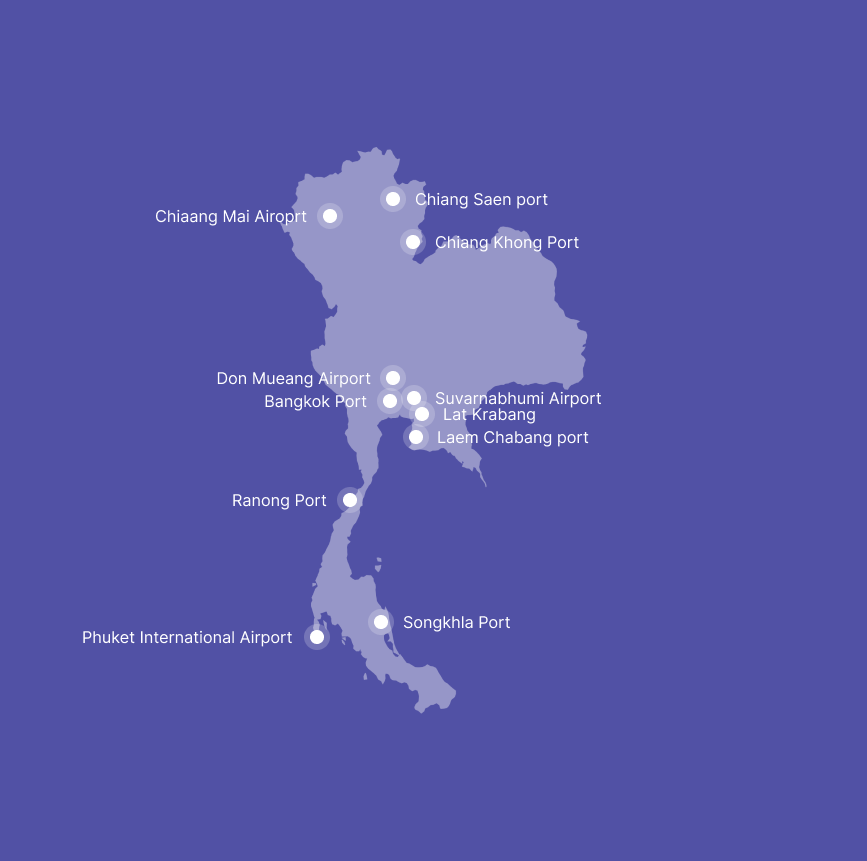
Singapore's primary container terminal for household goods exports is Pasir Panjang Terminal, operated by PSA Singapore. The Port of Singapore is one of the world's busiest and most connected container ports, with direct feeder and mainline services to Laem Chabang several times per week.
Thailand's main deep-water container port is Laem Chabang Port (LCB), located 130 km south of Bangkok in Chonburi Province. Laem Chabang handles the majority of imported household goods and personal effects containers. Bangkok Port (Klong Toey) on the Chao Phraya River handles a smaller volume, including some LCL groupage consignments.
Shipping methods from Singapore
From Pasir Panjang Terminal, FCL and LCL containers ship direct to Laem Chabang on feeder services operated by Evergreen, PIL (Pacific International Lines), and RCL. Transit time is 5–7 days. Direct services depart several times per week, giving excellent frequency for both FCL and LCL shipments.
For LCL (groupage) shipments, Swift Cargo Solutions consolidates cargo twice weekly from Pasir Panjang. LCL is cost-effective for volumes below approximately 15 cubic metres (the equivalent of a 1–2 bedroom apartment). Above this threshold, a 20ft FCL container usually offers better value.
Air freight from Singapore Changi Airport (SIN) to Bangkok Suvarnabhumi (BKK) takes 1–2 days door-to-door including Thai customs clearance. Air freight is suited to urgent shipments, high-value items, or essentials needed immediately on arrival in Bangkok.
Transit times: Singapore to Bangkok
| From | To | Est. Transit Time |
|---|---|---|
| Singapore (Pasir Panjang) | Bangkok (Laem Chabang) | 5–7 days |
| Singapore (Changi Airport) | Bangkok (Suvarnabhumi) | 1–2 days |
Peak months
May–August is the busiest period for Singapore-to-Thailand household moves. Singaporean families with school-age children typically time relocations to arrive before the start of international school terms in Bangkok. Corporate expat packages in finance, hospitality, manufacturing, and technology peak in Q2. Vessel space on the Singapore–Laem Chabang corridor tightens in June and July; booking 6–8 weeks ahead during this window is advisable. December–January sees a second peak as year-end corporate rotations push volumes up. The quietest period is September–October.
Visa requirements for Singaporeans moving to Thailand
Singaporeans can enter Thailand without a visa for tourist stays of up to 30 days; the 60-day airport allowance ended on 15 September 2026. Immigration can extend a visa-exempt stay by up to 30 days at the officer's discretion, if you apply before the stay ends. Visa-free entry is for tourism only, and every foreign traveller must submit the free Thailand Digital Arrival Card (TDAC) within the three days before arriving. For a relocation where you are bringing household goods and intending to stay long-term, Thai Customs looks for a one-year basis to stay (see the visa question in the FAQ), so check your category with Customs before you ship. A stay of less than a year, including a tourist or visa-exemption stay, gets the exemption for personal effects only.
The Thai Non-Immigrant visa must be obtained from the Royal Thai Embassy in Singapore before departure. The Royal Thai Embassy is located at 370 Orchard Road, Singapore. Confirm current processing times and document requirements with the embassy before you book your shipment.
Main visa categories for long-term stays
Singaporeans relocating to Thailand long-term use one of the following visa categories:

Non-Immigrant B (Work)
For those with a confirmed job offer from a Thai or BOI-registered company. Your employer arranges the work permit, and you cannot start work before it is issued.
Non-Immigrant O / O-A (Retirement / Family)
Non-Immigrant O-A is for people aged 50 and over with a monthly income of at least THB 65,000 or a balance of THB 800,000, plus health insurance (Royal Thai Embassy requirements as of March 2024); you apply in the country where you hold permanent residence. Non-Immigrant O is for spouses and dependants of Thai nationals.
Long-Term Resident Visa (LTR)
Thailand's premium visa for wealthy retirees, remote workers, and qualified professionals. 10-year renewable, multiple entry.
Destination Thailand Visa (DTV)
5-year multiple-entry visa for digital nomads and remote workers. 180-day stay per entry, available since 2024. It is a special tourist visa, so holders cannot take a Thai work permit or work for Thai clients. Funds of at least THB 500,000 are required, and since 31 August 2026 e-Visa applications also need proof of permanent residence and a criminal-record clearance certificate.
Note: Whether your household goods qualify depends on Thai Customs' criteria for changing residence, and a stay of less than a year gets the exemption for personal effects only. Thai Customs' Thai-language guidance says Non-Immigrant O entries for retirement or to follow a Thai wife fall outside its quota route for foreigners, and its household-effects guidance does not mention the O-A, LTR or DTV visas. Confirm your visa type with your Move Manager and with Thai Customs before goods are dispatched.
For current application requirements, visit the Royal Thai Embassy in Singapore.
Frequently asked questions (FAQ)
A full 20ft container from Singapore to Bangkok starts at S$1,956, covering packing, sea freight, Thai customs clearance, and door-to-door delivery. Volume, packing requirements, and final delivery distance in Thailand all affect the final figure. The best way to get an accurate price is to request a quote with your inventory and address details.
From Pasir Panjang Terminal to Laem Chabang: 5–7 days. From Singapore Changi Airport to Bangkok Suvarnabhumi by air: 1–2 days. Door-to-door total including packing, export documentation, sea transit, and Thai customs clearance is typically 12–18 days for sea freight, or 3–5 days for air freight.
If you are working in Thailand, Thai Customs asks for a one-year non-immigrant visa (or, until it is granted, an Immigration letter confirming an annual stay or a work permit of at least a year); experts and government-contract staff need a letter from their agency, accompanying spouses of workers and experts count as changing residence too if Immigration has issued them a non-immigrant visa for their first 90 days in Thailand, and some foreigners qualify through a quota shown in their passport. Its guidance does not mention B, O-A, LTR or DTV visas, and its Thai-language guidance adds that Non-Immigrant O entries for retirement or to follow a Thai wife fall outside that quota criterion, so confirm your category with Customs before you ship. A stay of less than a year, including a tourist or visa-exemption stay, gets the exemption for personal effects only. Apply for your visa at the Royal Thai Embassy at 370 Orchard Road, Singapore, before you ship your goods.
Not if you qualify for the duty exemption for people changing residence. Thailand allows duty-free import of used household goods and personal effects for residents relocating from abroad, provided: (1) you meet one of Thai Customs' criteria for changing residence (see the visa question above; a retirement visa may not meet them), (2) goods were owned and used abroad (Customs' published guidance sets no minimum period of use; some movers report that Customs expects about six months, so ask before you pack newly bought items), (3) items are for personal use and not for resale. New or unopened items are dutiable regardless. Alcohol and tobacco are excise-controlled: Customs' duty-free allowance of 1 litre of alcohol and 200 cigarettes or 250 g of tobacco is for passengers carrying them in, and its household-effects guidance does not mention them for a shipment, so leave them out or ask Customs before you pack.
Almost never.
Thailand has prohibited used cars, vans, buses and trucks since 10 December 2019, with a short list of licensed exceptions that a household move rarely meets. Most Singaporeans sell their vehicle before leaving and buy in Thailand. A new vehicle is a separate import and attracts duty, excise tax and VAT.
You need an import permit (Form R1/1) from the Animal Quarantine Station at your arrival airport, a microchip, the Thai vaccinations (rabies for both; dogs also distemper, hepatitis, parvovirus and leptospirosis; cats also feline panleukopenia), an AVS export licence, and a veterinary health certificate from a licensed Singapore veterinarian (with AVS endorsement if the importing country requires it). Apply for the permit well ahead: at least 7 working days before you arrive, or 7 to 60 days before departure by the Thai embassy's guide, so follow the longer timing. It is valid for 60 days. Thai embassy instructions list no rabies titre test for entry. Thai officials inspect every pet on arrival, and Thailand's own documents disagree on quarantine, so get written confirmation from the arrival station before you book.
FCL (Full Container Load) means your goods fill an entire 20ft or 40ft container that travels exclusively with your shipment. LCL (Less than Container Load) means your goods share a container with other customers' shipments. FCL is more cost-effective above approximately 15 cubic metres (a 2+ bedroom home). LCL suits studios and 1-bedroom apartments. LCL adds 3–5 days to transit time due to consolidation handling at both ends.
Direct feeder services from Pasir Panjang to Laem Chabang operate several times per week with carriers including Evergreen, PIL, and RCL. For FCL shipments, Swift Cargo Solutions books onto the next available sailing after documentation is confirmed. For LCL, consolidation departs twice weekly. The short transit time and high frequency make Singapore-to-Thailand one of the most reliable regional shipping corridors.
Yes. Swift Cargo Solutions provides full professional packing at your Singapore address. Our teams use export-grade materials: double-wall cartons, foam wrap, bubble wrap, and wooden crating for fragile or high-value items. An itemised packing list is produced at the time of packing; this list is for your own and Customs' use.
Physical inspection by Thai customs at Laem Chabang adds working days to clearance; Thai Customs publishes no standard figure, and we plan for roughly 3–7 working days. Swift Cargo Solutions Thai customs broker attends the inspection, ensures the declared packing list matches the container contents, and manages any additional documentation requests. We review your packing list for inspection risk before goods are dispatched from Singapore.
Yes. Once your container is loaded and the Bill of Lading is issued, your Move Manager provides a tracking link and regular updates at key milestones: departure from Pasir Panjang, arrival at Laem Chabang, customs clearance status, and delivery confirmation. You can also contact your Move Manager directly at any point during transit.
You can request a quote online or via WhatsApp. Provide your Singapore address, your destination city in Thailand, an estimate of your volume (number of rooms or cubic metres), and your target move date. A Move Manager will follow up within 24 hours with a detailed, fixed-price quote. For large or complex moves, a video walkthrough or in-home survey can be arranged at no cost.
Leave vapes out entirely, and check alcohol and tobacco with Customs before you pack.
E-cigarettes, vapes and the liquids and equipment that go with them are illegal in Thailand. The Royal Thai Embassy in London warns that anyone found with them can be arrested and face jail or a fine several times the value of the items. Alcohol and tobacco are excise-controlled. Thai Customs' duty-free allowance (1 litre of alcohol, 200 cigarettes or 250 g of tobacco) is written for passengers carrying them in, and its household-effects guidance does not mention alcohol or tobacco, so take them out of the load or ask Customs in writing before you pack.
Not if you are a Singapore Citizen; usually yes if you are a foreign or Permanent Resident employee.
IRAS requires employers to seek tax clearance (Form IR21) for non-Singapore Citizen employees who stop working in Singapore, go on an overseas posting or leave Singapore for more than three months. The employer files Form IR21 at least one month in advance and withholds the money due to you from the day it learns of your departure until IRAS issues its clearance directive. Some situations are exempt, so check IRAS's tax clearance calculator for your case and tell your employer your plans early.
Prepare your move to Thailand
Short-sea corridor
Singapore to Laem Chabang is one of the shortest international sea legs we run
PSA → Laem Chabang
direct services link two of Southeast Asia's busiest container ports
Overland alternative
trucking via Malaysia is a realistic option for time-sensitive moves
Cost of living in Thailand
Thailand offers a significantly lower cost of living than Singapore across most major expense categories. A comfortable Bangkok lifestyle, including a modern 2-bedroom apartment in a central area, dining out regularly, and running a car, typically costs S$3,000–S$5,000 per month for a couple. The same lifestyle in Chiang Mai or Hua Hin runs S$2,000–S$3,200 per month.
Accommodation: A 2-bedroom serviced apartment in central Bangkok (Sukhumvit, Silom, Sathorn) costs 35,000–80,000 THB/month (S$1,300–S$3,000). This compares favourably to equivalent areas in Singapore where similar accommodation can cost S$5,000–S$10,000/month.
Food: Local Thai restaurants cost 60–150 THB per meal. Western-style restaurants in Bangkok run 300–800 THB per person. Supermarkets carry many Singapore and imported brands at 1.5–2.5x local Thai prices.
Transport: Bangkok's BTS Skytrain and MRT metro are efficient and inexpensive (25–65 THB per trip). Grab (rideshare) is widely used and significantly cheaper than Singapore. Owning a car adds significant cost due to high vehicle prices from import duties.
Healthcare: Private hospital care in Thailand is high quality and significantly cheaper than Singapore. A GP consultation at a Bangkok private hospital costs 800–1,500 THB (S$31–S$57 at early November 2026 rates). Expat health insurance runs S$1,500–S$5,000/year depending on age and coverage.
Safety and security in Thailand

Safety and security in Thailand
Thailand is generally safe for foreign residents. Bangkok, Chiang Mai, and most tourist areas have low rates of violent crime affecting expats. Petty theft (bag snatching, phone theft) occurs in busy areas of Bangkok and tourist zones in Phuket; standard urban precautions apply. Singapore residents will find Bangkok broadly comparable to other large Asian capitals.
Thailand's southern provinces (Pattani, Yala, Narathiwat, and parts of Songkhla) have an ongoing insurgency. The UK Foreign Office advises against all but essential travel to those provinces and to areas within 20 km of the Cambodian land border, and Global Affairs Canada advises avoiding all travel there and within 50 km of the border (both updated October 2026). Check your own government's current advice before you go. The vast majority of expats live and work in Bangkok, Chiang Mai, Phuket, Pattaya, or Hua Hin, all well outside the affected southern region.
Road safety is a genuine concern. Thailand has one of the highest road fatality rates in Southeast Asia, driven primarily by motorcycle accidents. Wearing helmets and avoiding motorcycle travel late at night significantly reduces risk.
Salaries and employment for Singaporeans in Thailand
Expatriate salaries for Singaporeans working in Thailand vary significantly by industry, employer type, and whether the role is a local hire or an expat package. Foreign-currency expat packages, common in finance, hospitality, manufacturing, and senior technology roles, typically run S$7,000–S$20,000+ per month, often with housing allowances and flights included.
Locally-engaged positions with Thai companies typically pay in Thai Baht and are set against local market rates, which are considerably lower than Singapore equivalents. Teaching English at international schools in Bangkok pays 45,000–80,000 THB/month. Thai-market IT roles: 50,000–120,000 THB/month. Senior finance roles at Bangkok regional hubs: 150,000–350,000 THB/month.
Remote workers employed by Singapore companies and based in Thailand retain their Singapore-dollar salary while benefiting from Thailand's lower cost of living. The LTR Visa and Destination Thailand Visa (DTV) were specifically created to accommodate this demographic.
Thailand's personal income tax for Singapore expatriates
Thailand taxes individuals on income earned in Thailand, and on foreign income brought into Thailand by tax residents. For Singaporean expats: Thai-source employment income is always taxable in Thailand. Since 1 January 2024, foreign income that you earn in a year you are a Thai tax resident (180 days or more in Thailand in the calendar year) is taxable when you bring it into Thailand, even in a later year. Income earned before 2024, or in a year you were not a resident, is not taxed when remitted. As of November 2026 the Revenue Department's pages show no relief from this, so confirm the current position before you remit. See the Revenue Department guidance for foreigners.
Thailand and Singapore have a double tax agreement (signed in 2015), and Thai tax on remitted income can be reduced by foreign tax already paid on the same income where the agreement allows it (see the Revenue Department's list of Thailand's tax agreements). A Singapore-qualified tax adviser with cross-border experience is recommended before relocating.
Finding work in Thailand as a Singaporean
Singaporeans require both a Non-Immigrant B visa and a Thai work permit to legally work for a Thai employer in Thailand. The work permit is employer-sponsored; your Thai employer applies for it through the Department of Employment. You cannot legally start work before the work permit is issued.
Key sectors employing Singaporean professionals in Thailand include: finance and banking (Bangkok is a regional hub), manufacturing and supply chain (automotive, electronics), hospitality and tourism, technology and telecoms, and regional headquarters of multinationals. Singapore's regional hub status means many Bangkok-based MNCs already have established Singapore-Thailand rotation programmes.
Thailand's Board of Investment (BOI) maintains a Smart Visa programme for specialists and senior executives working with BOI-promoted companies. This visa type carries additional immigration privileges and simplified work authorisation, and is particularly relevant for Singaporeans joining BOI-promoted manufacturing or technology firms.
Education, healthcare and public services in Thailand
Education: Bangkok has a large international school sector with British, International Baccalaureate, and bi-lingual curricula familiar to Singapore families. Leading schools include Bangkok Patana School, NIST International School, and Harrow International School Bangkok. Annual fees run S$20,000–S$45,000+ per child. Chiang Mai, Phuket, and Pattaya also have international schools.
Healthcare: Thailand's private hospital system is excellent by regional standards. Bangkok's leading hospitals, including Bumrungrad International, Bangkok Hospital, and Samitivej, attract medical tourists and are accredited by the Joint Commission International. Quality is broadly comparable to Singapore's private sector at significantly lower cost.
Public services: Bangkok's public infrastructure is modern and functional. The BTS Skytrain and MRT metro cover most of central Bangkok. Internet connectivity is reliable; average fixed-line broadband speeds in Bangkok exceed 200 Mbps.
Banking: Singaporeans can open Thai bank accounts with a valid visa, passport, and proof of address. Kasikorn Bank (KBank), Bangkok Bank, and SCB all offer English-language services. International transfers between Singapore and Thailand are well-served by both Wise and the established Singapore-Thailand banking corridor.
Currency and banking in Thailand for Singaporeans
Thailand's currency is the Thai Baht (THB). In the 12 months to early November 2026 the baht traded at about 24–26 THB per Singapore dollar (ECB reference rates); the S$ conversions on this page use early November 2026 rates, so they will drift. The Baht is a managed float; the Bank of Thailand intervenes to limit extreme volatility.
ATMs are widely available in cities and tourist areas. Most Thai ATMs charge a 220–250 THB fee per foreign card transaction. Using a Singapore account with fee-free international ATM withdrawals (DBS Multiplier, Wise, or similar) significantly reduces this cost.
Wise is widely used by Singaporean expats in Thailand for regular transfers from Singapore accounts. The mid-market exchange rate and low fixed fees make it the most cost-effective option for regular SGD-to-THB transfers.
Thai bank accounts: Kasikorn Bank and Bangkok Bank are the most expat-accessible. Kasikorn's K-Plus mobile app is English-language and feature-complete for day-to-day banking. Bangkok Bank has a well-established relationship with Singapore's banking system and is frequently used for remittances.
Thailand's climate and weather

Thailand's climate and weather
Thailand has a tropical climate divided broadly into three seasons: the hot season (March–May), the rainy season (June–October), and the cool season (November–February). Bangkok temperatures range from 26°C (79°F) in December to 38°C (100°F) in April. Humidity is high year-round, particularly during the rainy season.
Singaporeans will find Thailand's climate broadly familiar, as both countries share a tropical equatorial and monsoonal climate. Bangkok is hotter and drier than Singapore in the cool season, which many Singaporeans find a welcome change. Chiang Mai in the north experiences a more pronounced cool season (15–25°C November–February) and a smoke season in March–April due to agricultural burning.
Phuket and the southern islands have a different rainfall pattern: the southwest monsoon hits Phuket's west coast May–October, while the Gulf coast resorts are affected September–December. Flooding during peak monsoon months can affect low-lying areas of Bangkok; choosing accommodation above ground-floor level is advisable.
Door-to-door relocation service
The Swift Cargo Solutions door-to-door service for Singapore-to-Thailand moves covers every stage of the relocation from your Singapore address to your front door in Thailand. The process runs as follows:
- Home survey and quote:
A Move Manager assesses your volume (in-person or via video walkthrough), confirms your packing requirements, and produces a fixed-price quote covering packing, sea freight, customs, and delivery. - Export packing at your Singapore address:
A packing crew attends your Singapore home. All items are wrapped, inventoried, and packed into export-grade cartons or wooden crates. A detailed packing list is generated for your own and Customs' use. - Singapore export clearance:
Swift Cargo Solutions prepares and files the necessary export declarations with Singapore Customs via the TradeNet system. Documentation is submitted prior to vessel departure. - Sea freight transit:
Your container is booked onto a confirmed vessel from Pasir Panjang Terminal. You receive a Bill of Lading with vessel name, voyage number, and estimated arrival date at Laem Chabang. - Pre-arrival customs preparation:
While goods are in transit, your Move Manager prepares the full Thai customs documentation package: Application for Duty Exemption, packing list, Bill of Lading, and copies of your visa and passport. - Thai customs clearance:
Our Thai customs broker files the import declaration on your behalf. We monitor container status through the Thai Customs e-Declaration system and manage any inspection requests or additional documentation requirements. - Port release and onward delivery:
Once cleared, your container is released from Laem Chabang and transported to your Thai address. The delivery crew unpacks and places items as directed, and removes all packing materials.
Rated 4.87 by customers
What Our Customers Say — Singapore to Thailand Moves
Checklist for your Singapore to Thailand relocation
Checklist for your Singapore to Thailand relocation
Request a quote with your inventory list and destination address in Thailand. Provide your target move date.
We file TradeNet export declaration 24 hours before vessel departure from Pasir Panjang.
Professional packing at your Singapore address; we produce an itemised packing list for Thai customs.
Container departs Pasir Panjang; you receive tracking and daily updates until Laem Chabang arrival.
Thai customs clearance: typically 2–4 days with the customs documents already prepared.
Final delivery to your door in Bangkok, Phuket, Chiang Mai, or your destination city.
Your Move Manager stays available through delivery and answers any questions post-arrival.
Start your move to Thailand with Swift Cargo Solutions today
Receive your personalised quote within 24 hours.
Get a quote