
Plan a Household Move to Portugal
Customs, timing, and delivery handled properly.
Planning a move to Portugal?
✦ TL;DR
This page is for people shipping household goods and personal effects to Portugal from outside the EU, where transfer-of-residence relief usually decides what the move costs.
Relief from import duty runs on three conditions under Council Regulation (EC) No 1186/2009: your normal residence was outside the EU customs territory for at least 12 continuous months, you owned and used the goods for at least 6 months before the move, and the shipment is cleared within 12 months of establishing residence in Portugal.
Portuguese customs sits with the Autoridade Tributária e Aduaneira (AT). You will need a Portuguese tax number (NIF) before clearance, plus a signed valued inventory and evidence that your main residence is genuinely moving.
Goods imported under this relief cannot be sold, lent, hired out, or transferred for 12 months after clearance without notifying AT first.
Untreated wood packaging, soil on garden or sports equipment, plant material, and food of animal origin are the usual triggers for inspection. Swift Cargo is built for apartment-size and larger household moves; below about six boxes, a parcel service is usually the better choice.
Portugal applies EU customs and sanitary rules, so the decisive question is whether your shipment qualifies for transfer-of-residence relief. When it does, you pay no import duty and no IVA on used household goods. When the paperwork does not support the claim, the same container is assessed at the standard rate.
This page covers what actually determines the outcome: the documents AT expects, how the relief conditions are tested, which goods attract inspection, realistic transit times by route, and the practical steps for vehicles and pets. It also sets out our door-to-door service and insurance options.
Your specialist prepares the customs file, checks the inventory against the relief conditions before the container sails, and coordinates delivery to your address in Portugal. One person handles the file from quote to final delivery, so you are not repeating your situation to a new contact at each stage.
Our process
Fill out our standard application on our platform.
Request a Quote
Tell us your route and inventory. You get a clear plan, timeline, and cost upfront.
Get Connected
Your specialist builds the plan, checks documentation, and makes sure nothing is missed before shipment.
Finalise your Plan
We execute the move. Packing, shipping, customs, delivery. Everything runs to plan.
Portugal shipping peak season
Demand into Portugal follows the relocation calendar rather than the retail one. Booking around these periods keeps transit times predictable and reduces the risk of a shipment waiting on a berth or an inspection slot.
- June to August
The heaviest window. Families move between school years, and much of Portugal takes leave in August, so terminals at Lisbon and Leixões run with reduced staffing. Expect blank sailings, longer inspection queues, and possible customs delays rather than any actual closure. Book four to six weeks earlier than you would in spring. - September
Corporate relocation cycles and the Portuguese school year both start, and volumes rebound sharply after the August lull. Documentation errors cost more here than at any other point in the year, because clearance queues are already long. - December to early January
Year-end holidays reduce staffing at customs and at the terminals, and carriers apply peak-season surcharges on several long-haul lanes. Shipments arriving in the last two weeks of December frequently clear in January instead.
Understanding Portuguese customs
Customs in Portugal is administered by the Autoridade Tributária e Aduaneira (AT). For household goods arriving from outside the EU, almost every outcome turns on one question: does the shipment qualify as personal property on a transfer of residence? If it does, the goods enter free of import duty and free of IVA. If the file does not support the claim, duty and IVA are assessed on the declared value instead.
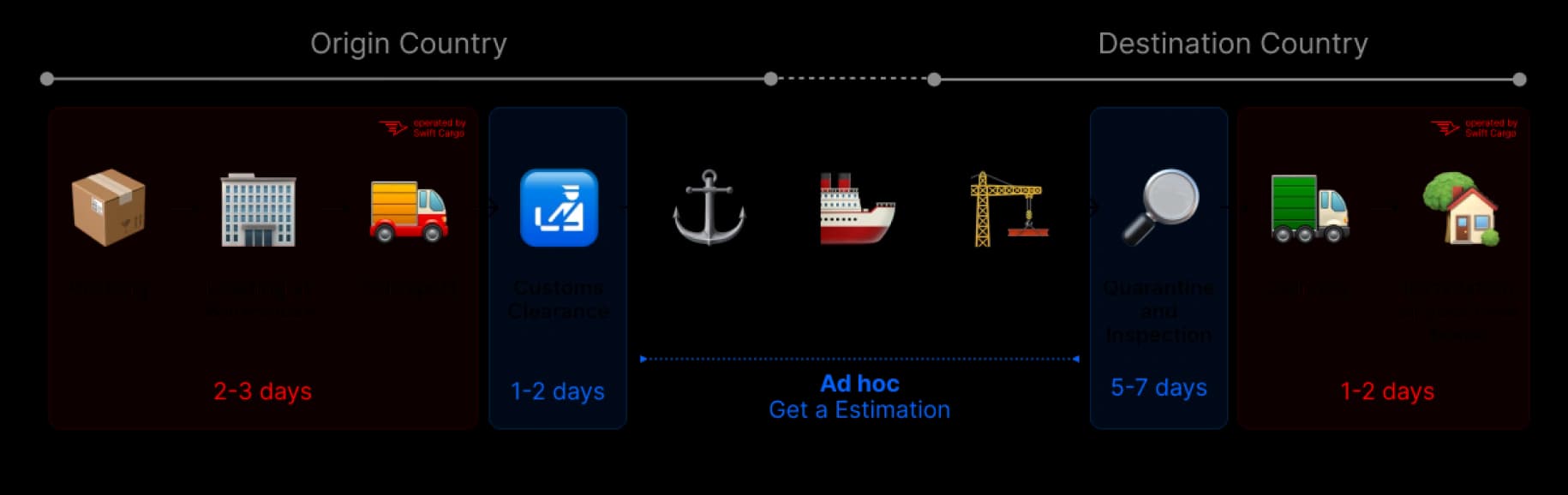
Required documents to import household goods to Portugal
Portuguese clearance is document-led, and the relief is granted on the strength of the file rather than on the contents of the container. To clear your shipment you will need:
- Ocean bill of lading or air waybill matching the shipment details exactly
- Detailed inventory, itemised and valued, in Portuguese or English, signed and dated by you
- Passport or national ID copy for the person transferring residence
- Portuguese tax number (NIF), issued by AT. Clearance cannot proceed without one, and obtaining it takes time if you are not yet in the country
- Evidence of residence outside the EU for at least 12 continuous months, such as a consular certificate, employer letter, foreign tax records, or utility accounts covering the period
- Proof of your Portuguese address, normally a rental contract, deed of purchase, or certificate of residence from your junta de freguesia
- Declaration that the goods were owned and used for at least six months before you ceased to have your normal residence outside the EU
- Customs declaration, lodged electronically with AT by your specialist or appointed customs representative
Inspection triggers and potential delays
Portugal applies EU plant-health and animal-health controls at the border. A handful of predictable items account for most physical inspections, and each of them is avoidable with preparation.
- Untreated wood packaging, crates, and pallets. Anything wooden entering the EU from a third country must meet the ISPM 15 standard and carry the stamp. Unmarked timber is the single most common reason a household container is held.
- Soil and plant residue on garden tools, bicycles, camping gear, lawnmowers, and sports equipment, along with seeds, plants, and food of animal origin, which range from restricted to prohibited depending on the item and origin.
Sea arrivals and customs documents
Where you travel separately from your goods, the shipment is treated as unaccompanied personal effects and the relief still applies, provided the timing conditions are met. Keep your entry stamp or boarding documentation, because AT may ask you to evidence the date you established residence in Portugal.
Products subject to restrictions in Portugal

Narcotics & controlled substances

Explosives & pyrotechnics

Biohazardous materials

Industrial & household chemicals

Corrosive substances

Counterfeit & pirated goods

Ivory & protected species products

Loose lithium batteries

Flammable liquids & gases

Firearms, ammunition & weapons

Prescription & non-prescription medicines

Hazardous & dangerous goods
Minimum and maximum shipment size
Our service is built for household relocations, not small parcel shipments.
- Minimum shipment: 6 boxes
Our services start at a minimum of six boxes, the typical volume for a studio apartment with no furniture.
- No maximum capacity
Swift Cargo handles shipments of any size, from full family homes to relocations requiring multiple shipping containers.
Note: These capacity options apply specifically to household goods and personal effects imported into Portugal.
Official references
- Council Regulation (EC) No 1186/2009 sets the duty-relief conditions for personal property on a transfer of residence
- Request the exemption from vehicle tax when moving to Portugal covers the ISV exemption process on gov.pt
Useful contacts

Taxes and duties when importing to Portugal
Two charges can apply to a household shipment entering Portugal from outside the EU: customs duty and IVA, Portugal's value added tax. Transfer-of-residence relief removes both when the conditions are met, which is why the documentation matters more than the contents.
General rules for goods entering Portugal
- Portugal is inside the EU customs union, so goods arriving from another EU member state move freely. Goods arriving from a third country are declared to AT and assessed for duty and IVA unless a relief applies.
- Where charges do apply, the standard IVA rate is 23% on the mainland, 22% in Madeira, and 16% in the Azores (rates in force for 2026). IVA is calculated on the customs value plus any duty assessed.
Transfer-of-residence relief
- Used household goods and personal effects enter free of duty under Council Regulation (EC) No 1186/2009 where your normal residence was outside the EU customs territory for at least 12 continuous months, the goods were in your possession and used for at least six months before you ceased to live there, and the shipment is entered for free circulation within 12 months of establishing residence in Portugal.
- The equivalent IVA exemption follows the same conditions under Council Directive 2009/132/EC. Goods admitted under either relief cannot be lent, given as security, hired out, or transferred for 12 months after import without notifying the authorities first, and doing so makes the original charges payable.
What the relief does not cover
The relief is deliberately narrow. These categories are assessed normally even inside an otherwise qualifying household shipment:
- Alcohol and tobacco products, which are excluded from the personal-property relief entirely and carry excise duty in addition to IVA
- New goods, particularly anything still boxed or bought shortly before departure, because they fail the six-month prior-use condition
- Items that read as commercial quantity or trade stock rather than household use, and goods intended for a business or professional activity carried on in Portugal
A separate point worth planning around: becoming resident in Portugal also changes your income tax position.
The non-habitual resident regime closed to new entrants and was replaced by the IFICI regime, sometimes called NHR 2.0, introduced by the 2024 State Budget.
IFICI offers a flat 20% rate on qualifying Portuguese employment and self-employment income for up to ten years, and is aimed at scientific research, higher education, and specified innovation-linked activities rather than at retirees.
Eligibility requires becoming a Portuguese tax resident after 1 January 2024, not having been tax resident in Portugal in the previous five years, and not having previously benefited from NHR. Applications are made to AT by 15 January of the year following the year you become resident.
This is a tax matter rather than a customs one, and it turns on individual circumstances. Confirm your position with a Portuguese tax adviser before you rely on it. It does not affect whether your household goods qualify for customs relief.
Insuring your shipment
Carriers limit their liability by law, and that limit is calculated by weight rather than by what an item is worth. On a household move the gap between the two is usually large, which is why marine transit cover is worth arranging separately.
Why you need cargo insurance
A container bound for Portugal is handled at origin, at transhipment, at the Portuguese terminal, and again on delivery. Most claims trace back to one of the following:
- Handling damage during loading, transhipment, or discharge
- Moisture and condensation over a long sea voyage, particularly on Atlantic routes into Leixões and Lisbon
- Damage arising from a customs inspection, where a container is opened, unpacked, and repacked by a third party
- Accidental loss or breakage in transit, including delays that leave goods stored longer than planned
What is covered
Cover depends on your insurer and the policy you choose. Marine transit policies for household goods generally include:
- Protection door to door, covering the packing, transport, and delivery legs
- Named risks such as fire, theft, and water damage, subject to the policy exclusions
- Limits set against the values you declare, which is why a realistic valued inventory matters for insurance as well as for customs
Review the exclusions and declared values with your broker before the container is sealed. Pairs and sets, and items already damaged before packing, are commonly excluded or limited.
How to arrange cover
You can arrange cargo insurance for a shipment to Portugal through any of the following:
- A general insurer offering marine or cargo policies
- A specialist cargo or relocation insurance broker
- Your bank or financial institution, where that service is available
- Swift Cargo's own cargo insurance programme.
Note: Our insurance is charged at 3% of your declared shipment value.
Residence permissions for Portugal
Customs relief and immigration status are separate processes, but they are linked in practice: AT wants evidence that your main residence is genuinely moving to Portugal, and your residence permission is the clearest form of that evidence. EU, EEA, and Swiss citizens do not need a visa and register locally instead. Everyone else applies for a national visa before travelling, then completes residency with AIMA, the Agency for Integration, Migration and Asylum. Categories and thresholds change, so confirm current requirements with AIMA or the Portuguese consulate covering your area before you book freight.
Main residence routes
Most people moving household goods to Portugal arrive on one of the following national visa routes:

Short-stay and visitor visas
For tourism, short business trips, and temporary visits. A short-stay visa does not establish normal residence, so it does not on its own support a transfer-of-residence customs claim
Work and remote-work visas
For employment with a Portuguese employer, self-employment, or entrepreneurial activity, and separately the D8 route for people working remotely for clients or employers outside Portugal
Study and research visas
For enrolment at a Portuguese institution, academic research, and approved training or exchange programmes, generally issued for the duration of the course
Passive income and family routes
The D7 route for people living on pensions, rental income, or other regular passive income, plus family reunification for joining a relative already resident in Portugal
Note: the D7 income threshold is tied to the Portuguese national minimum wage, which rose to €920 per month for 2026 under Decreto-Lei n.º 139/2025. Because it is indexed annually, treat any figure you read as valid only for the year it was published, and check the current requirement before applying.
Requirements differ by nationality and change without much notice. Confirm the current position with AIMA or your Portuguese consulate before finalising relocation or shipping arrangements.
Main entry points in Portugal
Most household shipments arrive through Lisbon or Leixões. Sines handles the largest volumes in the country but is primarily a deep-sea transhipment and industrial port, so it is the right choice on some long-haul services and the wrong one for a straightforward household delivery. Your specialist selects the entry point on transit time and final delivery address rather than on port size.
Ports and airports in Portugal
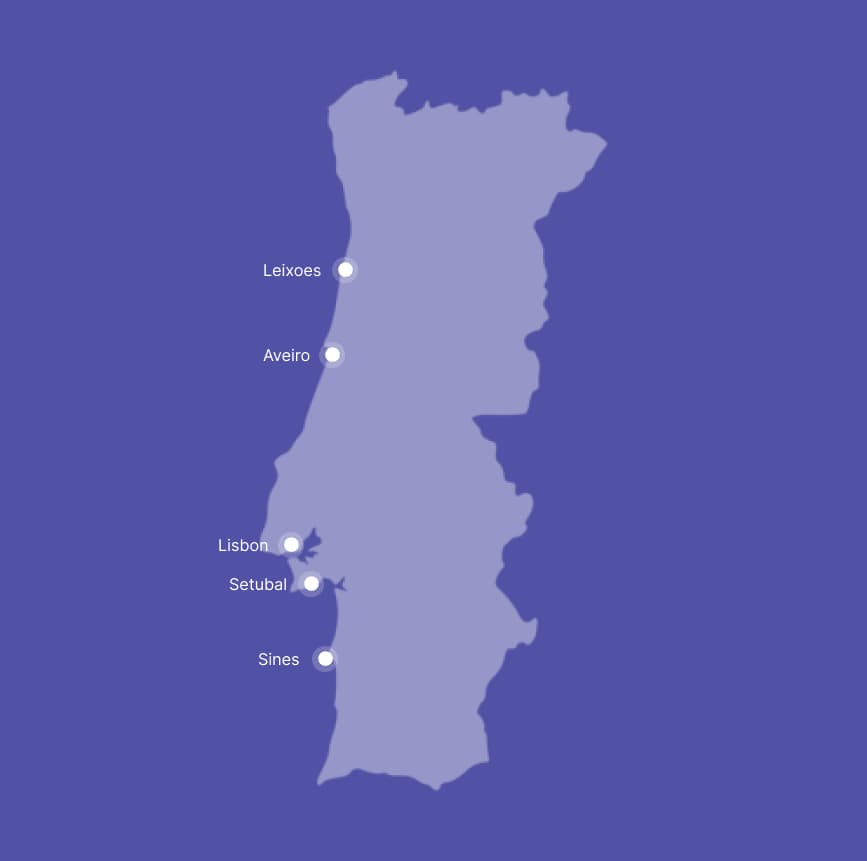
Ports and airports in Portugal
- Port of Lisbon (APL) – The main gateway for household goods bound for Lisbon, the Setúbal peninsula, and the Algarve
- Port of Leixões (APDL) – Serves Porto and northern Portugal, and is usually the shortest route to Braga, Guimarães, and the Douro
- Port of Sines (APS) – Portugal's largest deep-water container port, used mainly for transhipment and long-haul services from Asia and the Americas
- Port of Setúbal – Bulk and vehicle traffic, relevant mainly when a car is moving separately from the household shipment
- Lisbon Humberto Delgado Airport (LIS) – Portugal's principal air cargo gateway and the fastest route for an air shipment of essentials
- Porto Francisco Sá Carneiro Airport (OPO) – Air freight entry for northern Portugal
- Faro Airport (FAO) – Serves the Algarve, with limited freight capacity outside the summer schedule
- Funchal, Madeira – Served by feeder services from mainland Portugal, which adds a leg to the transit time
- Ponta Delgada, Azores – Served by feeder services from the mainland, with sailing frequency the main constraint on timing
Global route timings
| From | To | Est. transit time |
|---|---|---|
| London, United Kingdom | Lisbon, Portugal | 8-12 days |
| New York, United States | Leixões (Porto), Portugal | 14-18 days |
| Dubai, United Arab Emirates | Lisbon, Portugal | 18-24 days |
| Incheon (Seoul), South Korea | Sines, Portugal | 30-38 days |
| Milan, Italy | Lisbon, Portugal | 7-10 days |
| Singapore | Sines, Portugal | 26-32 days |
| Sydney, Australia | Lisbon, Portugal | 35-45 days |
| Johannesburg, South Africa | Lisbon, Portugal | 25-32 days |
Door-to-door relocation to Portugal
Since 1999 we have managed door-to-door household relocations, from packing at origin through customs clearance to delivery at your address in Portugal.
1. Packing your household goods
Our crews pack for the journey the goods will actually take, which for Portugal usually means a long Atlantic or Mediterranean sea leg followed by road delivery. Materials include:
- Packing boxes
Sized for standard household items and rated for stacking inside a container over several weeks at sea. - Bubble wrap and moisture protection
Used for glassware, ceramics, artwork, and electronics, where condensation over a long voyage is a greater risk than impact. - Timber crates to ISPM 15
Built for large, fragile, or high-value items. Any timber entering the EU must be treated and marked to ISPM 15, and unmarked wood is a common cause of inspection delays.
Everything is listed on a valued inventory as it is packed. That inventory is the document AT assesses the relief against, so it is built properly at origin rather than reconstructed later.
2. Collection at origin
Our agents collect from your home, and every movement is tracked and documented from that point onward. Where a vehicle or pet is travelling as part of the move, those are booked as separate consignments with their own paperwork and timelines.
3. Shipping and Portuguese customs clearance
We book sea or air freight as agreed and lodge the customs declaration with AT on arrival. Your specialist checks the relief conditions against your file before the container sails, because a gap found at the Portuguese terminal costs storage and demurrage as well as time.
4. Delivery and unloading
Once cleared, we deliver to your address and unload. Older buildings in Lisbon and Porto often have narrow stairwells and no lift, so access is surveyed in advance and a shuttle vehicle or external lift arranged where needed.
5. Unpacking and placement
Furniture and boxes are placed where you want them and packing debris is removed, so the goods arrive ready to use rather than stacked in a hallway.
Your move specialist
You work with one specialist from the first quote to the final delivery confirmation. That person tracks the shipment, prepares the customs file, and raises issues before they become delays, so you are not explaining your situation again to a new contact at each stage.
On Portuguese moves the specialist's most useful work happens early: confirming you hold a NIF, checking the twelve-month residence evidence and the six-month prior-use condition against your inventory, and flagging anything in the shipment that falls outside the relief. Every one of those is cheap to fix before the container sails and expensive to fix at the terminal.
You get updates at each stage: booking confirmation, departure, arrival, customs progress, and delivery scheduling, including access constraints at the Portuguese address.
Talk to an agent now
Importing a vehicle to Portugal
Portugal charges Imposto Sobre Veículos (ISV) on vehicles registered in the country, calculated on engine capacity and emissions. Anyone transferring residence can apply for an ISV exemption on one vehicle, but the conditions are strict and the deadline is easy to miss.
Vehicle import essentials

Vehicle import essentials
- Six months of prior ownership
You must have owned the vehicle in the country of origin for at least six months before transferring residence, counted from the date on the registration document or lease contract. - Owner's documents
Passport or ID, registration certificate, bill of lading or air waybill, and the purchase invoice showing that taxes were paid in the origin country without any exemption. - Application within twelve months
The ISV exemption is requested online through the AT portal, within twelve months of transferring residence, and covers one vehicle per person.
Costs to expect
- ISV, where no exemption applies, calculated from engine capacity and CO2 emissions. Older and higher-emission vehicles are charged substantially more, and the amount frequently exceeds the market value of an older car
- Customs duty and IVA on vehicles arriving from outside the EU that do not qualify for transfer-of-residence relief
- Inspection and registration, covering the technical inspection, homologation where the vehicle was not EU-type-approved, and the Portuguese registration itself
Run the numbers before committing. For an older vehicle, the combined cost of freight, ISV, inspection, and homologation often exceeds what the same car is worth in Portugal, and selling at origin is the better outcome.
We can help: Swift Cargo handles vehicle moves to Portugal end to end, including documentation, international transport, and customs clearance. Ask your specialist for a comparison against replacing the vehicle locally.
Moving to Portugal with your pets
Dogs, cats, and ferrets entering Portugal from outside the EU travel under harmonised EU rules. Requirements depend on whether the origin country is listed or unlisted for rabies control, and the sequence matters: several steps have minimum waiting periods that cannot be compressed once booked.

Key requirements for bringing pets into Portugal
- Microchip first
The animal must be identified by microchip, and it must be implanted before the rabies vaccination. A vaccination given before the chip does not count and has to be repeated. - Rabies vaccination
Administered after microchipping by an authorised veterinarian, and valid at the time of travel. - Rabies antibody test where required
Animals from countries not listed in the EU rules must pass a rabies antibody titration test at an approved laboratory, followed by a waiting period before travel. Animals from listed countries are exempt. Confirm which list applies to your origin country early, because this step drives the whole timeline. - EU animal health certificate
Issued by an official veterinarian, valid for ten days from issue until the documentary and identity checks, and presented at a designated travellers' point of entry where you must contact the competent authority on arrival.
Who qualifies for transfer-of-residence relief
This is the main case the relief is written for. You qualify where your normal place of residence was outside the EU customs territory for a continuous period of at least twelve months, the goods were in your possession and used at that residence for at least six months, and the shipment clears within twelve months of you establishing residence in Portugal.
The twelve-month residence condition is tested on your circumstances, not on your nationality. A Portuguese citizen returning after a decade abroad and a first-time arrival from the same country are assessed on the same basis.
Goods already in free circulation within the EU do not need this relief. There is no customs entry and no duty or IVA to assess, because the goods are moving inside the customs union rather than importing into it.
What remains is practical rather than fiscal: an accurate inventory for insurance purposes, access arrangements at both ends, and correct handling of any vehicle, which is registered in Portugal under a separate process regardless of where in the EU it comes from.
The relief requires a genuine transfer of normal residence. Furnishing a holiday property while your main home stays outside the EU does not meet that test, and a claim made on that basis is likely to be refused and reassessed for duty and IVA.
Where your situation is genuinely mixed, say the same again to your specialist before the container is booked rather than after it arrives. There are legitimate routes for some cases, but they are chosen at the planning stage, not argued at the terminal.
Restricted dog breeds in Portugal
Portugal does not ban these breeds, but classifies them as potentially dangerous under Decreto-Lei n.º 315/2009, with the breed list set by Portaria n.º 422/2004. Owners need a licence from their junta de freguesia and civil liability insurance, and crossbreeds are covered as well as pure breeds:
- Cão de Fila Brasileiro
- Dogue Argentino
- Pit Bull Terrier
- Rottweiler
- Staffordshire Terrier Americano and Staffordshire Bull Terrier
- Tosa Inu
The licence is obtained locally between three and six months of age and renewed annually, and insurance must be in place. If you are bringing one of these breeds, start the local registration as soon as you have a Portuguese address, and confirm current requirements with the DGAV, Portugal's food and veterinary authority.
Rated 4.8 by customers
Verified reviews from people who moved to Portugal with Swift Cargo:
Prepare your move to Portugal
What to expect when settling in
Portugal has absorbed a large wave of new residents over the past decade, and the practical consequence is that the administrative side is busier than it used to be. Appointments with AIMA, tax registration, and rental supply in Lisbon and Porto are the three places where timelines slip most often.
The country is small enough that your entry port and your final address are rarely more than a few hours apart, which keeps inland delivery costs low compared with larger destinations. The trade-off is the housing market in the two main cities, where competition is strong and short-notice lettings are scarce.
1999
Managing international household relocations since
120+
Countries served, including every EU member state
24h
Typical turnaround for a personalised quote
Understanding the cost of living in Portugal
Portugal is less expensive than most of western Europe, but the gap has narrowed sharply in Lisbon and Porto, where housing costs have risen faster than wages for several years. Outside those two cities, and away from the Algarve coast in season, costs fall considerably.
Housing is the dominant variable. Central Lisbon and central Porto command a substantial premium, while the interior, the Alentejo, and smaller northern cities remain markedly cheaper for comparable space.
Day-to-day costs are moderate. Fresh produce, fish, and wine are inexpensive by western European standards, while imported goods, electronics, and cars are not. Anything imported carries the standard 23% IVA on the mainland, which is worth remembering when deciding what to ship and what to replace.
Utilities are the seasonal surprise. Much of the older housing stock has poor insulation and no central heating, so winter electricity bills in an old apartment can exceed what newcomers expect from a country with mild winters.
Transport is inexpensive. Public transport in Lisbon and Porto is cheap and extensive, intercity rail is reasonable, and a car is genuinely optional in either city, though close to essential in rural areas.
Safety and everyday risks in Portugal

Safety and everyday risks in Portugal
Portugal consistently ranks among the safest countries in Europe, and violent crime is rare. The realistic risk for new arrivals is opportunistic theft in tourist areas, on the Lisbon trams, and at the main railway stations.
Driving takes adjustment. Motorways are modern and well maintained, but many use electronic-only tolls that require a transponder or prior registration, and hire cars and foreign-registered vehicles are frequently caught out by this. Older city centres have narrow one-way streets and very limited parking.
Wildfire is the seasonal risk that matters. Central and northern interior regions face a real fire season through summer, and if you are moving to a rural property it is worth understanding the local civil protection guidance and the legal obligations on clearing vegetation around a dwelling.
Healthcare, schooling, and public services
Portugal runs a national health service, the SNS, alongside a substantial private sector. Residents register with a local health centre and are assigned a family doctor, though waiting times for that assignment vary considerably by area. Most new arrivals hold private insurance in parallel, which is inexpensive relative to northern Europe.
State schooling is free and taught in Portuguese. International schools are concentrated in Lisbon, Cascais, Porto, and the Algarve, and offer British, American, and IB curricula. Places at the better-known schools are limited and are often the binding constraint on where a family can realistically settle.
Public administration has digitised substantially. The Portal das Finanças handles tax matters well, and much can be done online once you hold a NIF and a digital login. Immigration appointments are the notable exception, where waiting times have been long and unpredictable.
Connectivity is strong. Fibre coverage is extensive by European standards and reaches well beyond the major cities, which is part of why Portugal became a practical base for remote workers.
Earnings and the labour market
Portuguese salaries sit below the western European average, which matters if you are moving without an existing income. Two figures anchor the picture:
- The national minimum wage rose to €920 per month for 2026 under Decreto-Lei n.º 139/2025, paid across fourteen months in the standard Portuguese arrangement
- It is indexed and rising under a tripartite agreement, with further increases already agreed for subsequent years, so treat any published figure as year-specific
Where new arrivals typically find work:
- Technology and shared service centres in Lisbon and Porto, which employ substantial numbers of English speakers
- Tourism and hospitality, concentrated in Lisbon, Porto, and the Algarve, and strongly seasonal outside the cities
- International schools and language teaching, where demand is steady in the main expatriate areas
- Remote work for employers outside Portugal, which is the route the D8 visa exists to formalise
- Trades and construction, where demand has followed sustained residential investment in the main urban areas
Tax residency in Portugal
Tax residency is a separate question from immigration status, and it is worth settling before you arrive rather than after:
- You are generally treated as tax resident if you spend more than 183 days in Portugal in a twelve-month period, or maintain a home there in circumstances implying an intention to keep it as your habitual residence
- Residents are taxed on worldwide income under progressive IRS rates; non-residents are taxed on Portuguese-source income only
- Portugal has an extensive treaty network, and double taxation agreements usually determine which country taxes a given income stream
The regime that most often comes up:
- The non-habitual resident regime is closed to new entrants and was replaced by IFICI under the 2024 State Budget
- IFICI applies a flat 20% rate to qualifying Portuguese employment and self-employment income for up to ten years
- It targets scientific research, higher education, and specified innovation activities, and is not a general regime for retirees or passive income
- Applications go to AT by 15 January of the year after you become resident, and eligibility requires not having been Portuguese tax resident in the previous five years
Working in Portugal
What determines your right to work depends on your status rather than your occupation:
- EU, EEA, and Swiss citizens work without a permit and register their residence locally after three months
- Everyone else needs a residence permit that carries the right to work, obtained through the relevant national visa route and completed with AIMA
- A D8 remote-work permission covers work for clients or employers outside Portugal, and is not a route to employment with a Portuguese company
Practical points that catch people out:
- You need a NIF for almost everything, including a lease, a bank account, and employment, and it is worth obtaining early
- A social security number, NISS, is separate from the NIF and is required before payroll can start
- Portuguese employment contracts commonly pay across fourteen months rather than twelve, so a quoted annual figure does not divide the way you might assume
- Professional qualifications from outside the EU frequently need formal recognition, which takes months in regulated fields
- Working Portuguese matters outside the international sector, even where a role is advertised in English
Banking and moving money
Portugal uses the euro, so anyone arriving from the eurozone avoids currency conversion entirely. For everyone else:
- Opening a Portuguese account requires a NIF, proof of address, and identification, and some banks require you to attend in person
- Multibanco, the domestic payment network, handles far more than card payments, including tax, utilities, and public-service charges, and is central to daily life
- MB WAY, the associated mobile payment system, is widely used and generally requires a Portuguese account and number
When transferring a large sum for a property purchase or a move:
- Compare the total cost including the exchange spread rather than the advertised fee, since the spread is usually the larger figure
- Specialist currency brokers typically price better than high-street banks on large transfers
- Large inbound transfers may prompt source-of-funds questions, so keep the documentation available
- Confirm the tax treatment of the transfer with an adviser before moving a large balance, because the timing can matter for your residency year
Climate and seasons
Portugal's climate is Mediterranean on the coast and more continental inland, and the regional variation is larger than the country's size suggests:
- Summers are hot and dry, markedly more so inland in the Alentejo and the Douro valley than on the Atlantic coast
- Winters are mild and wet, with the north substantially wetter than the Algarve
- The Atlantic keeps coastal temperatures moderate year-round, so Lisbon and Porto rarely see extremes in either direction
What this means for your shipment and your first months:
- Older housing is built to shed summer heat rather than retain winter warmth, so damp and cold indoors surprise most newcomers
- A dehumidifier is one of the more common first purchases, particularly in the north
- Time a summer arrival around the August slowdown, when both the freight market and local administration run at reduced capacity
- Wildfire risk peaks in the interior through the summer months, which is worth factoring into a rural delivery schedule
Frequently asked questions
Usually not, provided the shipment qualifies as personal property on a transfer of residence. Under Council Regulation (EC) No 1186/2009 the goods enter free of import duty where three conditions are met together.
- Twelve months abroad: your normal place of residence was outside the EU customs territory for a continuous period of at least twelve months.
- Six months of prior use: the goods were in your possession and, for non-consumables, used by you at that former residence for at least six months.
- Twelve months to import: the shipment is entered for free circulation within twelve months of the date you establish your normal residence in Portugal.
The matching IVA exemption follows the same conditions under Council Directive 2009/132/EC, so a qualifying shipment pays neither duty nor IVA.
Where the conditions are not met, duty is assessed on the customs value and IVA is charged on top at the standard rate for the region: 23% on the mainland, 22% in Madeira, and 16% in the Azores.
A NIF is the Portuguese tax identification number issued by the Autoridade Tributária e Aduaneira. You need one before your goods can be cleared, and it is required for essentially everything else you will do in Portugal, including signing a lease, opening a bank account, and connecting utilities.
This is the single most common cause of avoidable delay on moves to Portugal. People assume it can be arranged on arrival alongside everything else, and then a container sits at the terminal accruing storage while the number is obtained.
If you are not yet in Portugal, a NIF can generally be obtained through a representative. Raise it with your specialist at the quote stage rather than when the vessel is a week out.
Not for twelve months, at least not without telling customs first. Goods admitted under the transfer-of-residence relief may not be lent, given as security, hired out, or transferred, whether for payment or free of charge, until twelve months have elapsed from the date of the customs declaration.
Where goods are disposed of inside that period without prior notification to the authorities, the duty and IVA that were relieved become payable.
This rarely causes problems in practice, because the relief exists for genuine household moves and most people are furnishing a home rather than reselling. It matters if you are shipping items you intend to sell on arrival, in which case those should be declared normally rather than included in the relief claim.
Transit time depends on the origin, the port pairing, and whether the service is direct or transships.
From the UK and northern Europe: typically 8 to 12 days by short-sea service into Lisbon or Leixões, and road freight is often competitive on time and cost for smaller volumes.
From the US East Coast: around 14 to 18 days to Leixões or Lisbon. The West Coast runs longer and usually transships.
From the Gulf: around 18 to 24 days into Lisbon.
From East Asia: around 26 to 38 days, frequently routed via Sines, which is Portugal's deep-sea transhipment hub.
From Australia: around 35 to 45 days, the longest common lane into Portugal.
Add clearance time on arrival, and add more for a shipment landing in August or over the year-end, when both terminals and customs run with reduced staffing. Air freight moves in days rather than weeks and is usually reserved for a small consignment of essentials sent ahead of the main shipment.
For household goods it is usually Lisbon or Leixões. Lisbon serves the capital, the Setúbal peninsula, and the Algarve; Leixões serves Porto and the north.
Sines is Portugal's largest container port by volume, but it is primarily a deep-sea transhipment and industrial facility. Some long-haul services from Asia and the Americas discharge there, and the goods then move inland by road.
Setúbal handles bulk and vehicle traffic, which is relevant mainly when a car is shipped separately from the household consignment.
Madeira and the Azores are served by feeder services from the mainland, so an island delivery adds a leg and a scheduling constraint. Your specialist selects the routing on total transit time and delivery address, not on port size.
Yes, and anyone transferring residence can apply for an exemption from Imposto Sobre Veículos (ISV) on one vehicle. The conditions are specific.
- You must have owned the vehicle in the country of origin for at least six months before transferring residence, counted from the registration document or lease contract.
- The vehicle must have been purchased in your country of origin or previous residence with all applicable taxes paid there, without benefiting from any exemption.
- The exemption is requested online through the AT portal within twelve months of transferring residence.
- The exemption covers one vehicle per person.
Where no exemption applies, ISV is calculated on engine capacity and CO2 emissions, and older or higher-emission vehicles attract substantially more. Add the technical inspection, homologation where the vehicle was not EU-type-approved, and registration.
Do the arithmetic before you commit. For an older car the total frequently exceeds what the same vehicle is worth in Portugal.
Portugal applies the harmonised EU rules for pets arriving from outside the EU. The order of steps matters, because several carry minimum waiting periods.
- Microchip: implanted first. A rabies vaccination given before the microchip does not count and must be repeated.
- Rabies vaccination: administered after microchipping by an authorised veterinarian and valid at the time of travel.
- Rabies antibody test: required for animals from countries not listed in the EU rules, carried out at an approved laboratory and followed by a waiting period before travel. Animals from listed countries are exempt.
- EU animal health certificate: issued by an official veterinarian and valid for ten days from issue until the documentary and identity checks.
You must enter through a designated travellers' point of entry and contact the competent authority there for documentary and identity checks.
Confirm early whether your origin country is listed or unlisted, because that single fact determines whether the timeline is a few weeks or several months.
No breed is banned outright, but several are classified as potentially dangerous under Decreto-Lei n.º 315/2009, with the list set by Portaria n.º 422/2004. Crossbreeds are covered as well as pure breeds.
The classified breeds are the Cão de Fila Brasileiro, Dogue Argentino, Pit Bull Terrier, Rottweiler, American Staffordshire Terrier, Staffordshire Bull Terrier, and Tosa Inu.
Owners must hold a licence from the junta de freguesia covering their address, obtained between three and six months of age and renewed annually, and must carry civil liability insurance. Additional rules govern muzzling and leads in public.
If you are bringing one of these breeds, start the local registration as soon as you have a Portuguese address, and confirm the current position with the DGAV, Portugal's food and veterinary authority.
Most inspections on household containers trace back to a small number of predictable causes.
- Untreated wood packaging. Timber crates and pallets entering the EU from a third country must meet the ISPM 15 standard and carry the mark. Unmarked wood is the most common single trigger.
- Soil and plant residue on garden tools, bicycles, camping equipment, and lawnmowers. Clean thoroughly before packing.
- Vague inventories. A line reading "box of miscellaneous items" invites an officer to look inside. Specific descriptions and realistic values reduce inspection risk more than any other single measure.
- Value inconsistencies, where declared values look implausible against the described contents.
- Restricted categories declared incorrectly, particularly alcohol, which is excluded from the relief entirely.
Your specialist reviews the inventory against these before the container sails, because a problem identified at origin costs an email and a problem identified at the terminal costs storage.
It depends on your citizenship. EU, EEA, and Swiss citizens do not need a visa and register their residence with the local council after three months.
Everyone else applies for a national visa at the Portuguese consulate covering their area before travelling, then completes the residence permit with AIMA, the Agency for Integration, Migration and Asylum, after arrival.
The routes most relevant to people shipping household goods are the D7, for those living on pensions or other regular passive income; the D8, for people working remotely for clients or employers outside Portugal; work and entrepreneurial routes tied to activity in Portugal; and family reunification.
The D7 income threshold is indexed to the Portuguese national minimum wage, which rose to €920 per month for 2026. Because it moves annually, verify the current figure with AIMA or your consulate rather than relying on a published guide.
Your residence permission also matters for customs, because it is the clearest evidence that your main residence is genuinely transferring.
It depends on volume, quality, and whether the shipment qualifies for relief.
Shipping usually wins where you have a full household of good-quality furniture, the relief applies so there is no duty or IVA, and the pieces would be expensive to replace to the same standard.
Replacing usually wins for bulky low-value items, anything already near the end of its life, and appliances. Electrical goods are the clearest case: Portugal runs on 230V at 50Hz with European plugs, so equipment from North America needs transformers and often does not justify the freight.
Two Portugal-specific factors are worth weighing. Older buildings in Lisbon and Porto have narrow stairwells and frequently no lift, so oversized furniture can be genuinely difficult to deliver and occasionally will not fit at all. And anything you buy new in Portugal carries 23% IVA on the mainland, which narrows the saving from replacing locally.
Your specialist will price both against your actual inventory rather than in the abstract.
Late spring and early autumn are the practical windows. April to early June and mid-September to November avoid both the freight peak and the administrative slowdown, and the weather makes delivery day easier at both ends.
August is the period to avoid where you have a choice. Much of Portugal takes leave, terminals run with reduced staffing, and both customs processing and local administration slow accordingly. A container arriving mid-August frequently clears in September.
The year-end holidays have a similar though shorter effect, and carriers apply peak-season surcharges on several long-haul lanes into December.
Families moving for the school year are usually locked into the July and August peak. If that is you, book four to six weeks earlier than you otherwise would and have the customs file complete before the container sails, because the queue for corrections is longest exactly when you are in it.
Checklist for your Portugal relocation
Checklist for your Portugal relocation
Enter your move details and inventory.
Obtain a Portuguese tax number (NIF) if you do not already hold one.
Gather evidence of twelve months of residence outside the EU.
Confirm your Portuguese address and any access constraints for delivery.
Review your estimate, routing, and clearance plan.
Prepare vehicle or pet documentation separately if either is travelling.
Track your shipment while we complete clearance and final delivery.