
Moving to Portugal from Australia: EU customs relief, visas, and door-to-door shipping
Swift Cargo is rated 4.87 by 25k+ customers.
Planning your move to Portugal?
Moving from Australia to Portugal: customs, visas, shipping times and key rules
Sea freight from Australia to Portugal is a long-haul, transhipped route: door-to-door for a full container typically runs 8–12 weeks, and shared (LCL) shipments usually add 2–3 weeks on top of that for consolidation.
Portugal's transfer-of-residence relief lets you import used household goods free of customs duty and IVA (VAT) if you've lived outside the EU for at least 12 months, owned and used the goods for at least 6 months before moving, and bring them into Portugal within 12 months of establishing residence.
Australian citizens need a Portuguese national visa before shipping — most movers use the D7 (passive income) or D8 (digital nomad) route. Arriving on a tourist stamp doesn't support a transfer-of-residence customs claim.
Right-hand-drive Australian vehicles need headlight modification and individual homologation to register in Portugal, and the cost rarely justifies it. Most Australians sell locally and buy in Portugal instead.
There's no fixed headline price for this route — the total depends on your volume, whether you ship FCL or LCL, and the time of year. Your specialist builds a fixed-price quote once they know what's moving and when.
Moving from Australia to Portugal means coordinating Australian export reporting, a long sea transit that almost always involves transhipment through a hub port, and clearance through Portugal's Autoridade Tributária e Aduaneira (AT) on arrival. The distance is the main planning challenge: unlike a short regional corridor, there's little room to fix a documentation gap once your container has sailed, so the paperwork has to be right before departure, not after.
Swift Cargo manages the full chain: export-grade packing at your Australian address, lodging the Australian Export Declaration where required, sea freight booking with confirmed vessel and transhipment schedules, preparing the AT transfer-of-residence file, customs clearance at Lisbon or Leixões, and delivery to your door. Your specialist stays on your case from first quote to final delivery.
Below: Portugal's customs relief rules for Australian-origin shipments, realistic transit times, D7 and D8 visa requirements, restricted items, and what it actually costs to bring a right-hand-drive vehicle into Portugal.
Portuguese Customs for Australians Moving to Portugal
Customs in Portugal is administered by the Autoridade Tributária e Aduaneira (AT). Australia is outside the EU customs union, so almost every outcome for an Australian-origin shipment turns on one question: does it qualify as personal property under a transfer of residence? If it does, the goods enter free of customs duty and free of IVA. If the file doesn't support the claim, duty and IVA are assessed on the declared value instead.
To qualify, you need to have had your normal residence outside the EU customs territory for at least 12 continuous months, have owned and used the goods for at least 6 months before you stopped living in Australia, and enter the shipment for free circulation within 12 months of establishing residence in Portugal. The relief applies once per house move — you can't split a single relocation into several shipments to reset the conditions.
Goods admitted under the relief can't be lent, given as security, hired out, or sold for 12 months after import without notifying AT first. Doing so makes the original duty and IVA payable retroactively. High-value electronics are checked more closely: if serial numbers and purchase records support genuine prior use, the claim is usually accepted without issue.
Documents you need for importing personal goods from Australia
- Passport (valid, with entry/exit stamps or travel history supporting your Australian residence)
- Portuguese national visa or residence permit (D7, D8, or another qualifying category) — not a tourist stamp
- Número de Identificação Fiscal (NIF), Portugal's tax number, obtained before or shortly after arrival
- Baggage Certificate (Certidão de Bagagem) from your local Portuguese consulate or AT, confirming the goods qualify for transfer-of-residence relief
- Detailed packing list (inventory) with item descriptions, quantities, and declared values
- Bill of Lading from your freight forwarder
- Proof of Australian residence for at least 12 months (lease agreement, utility bills, or an employment record)
- Purchase receipts or valuations for high-value items, showing ownership for at least 6 months
- Australian export reporting reference: unaccompanied personal effects normally use exemption code EXPE; an EDN is required only for non-exempt or permit-controlled goods
Customs Inspections and Delays
AT officers at Lisbon and Leixões can carry out full or partial physical inspections of inbound containers. A physical inspection typically adds several working days to clearance, since the container is moved to an examination bay and its contents checked against the declared inventory.
The most common triggers are: a packing list that doesn't match the container contents, high-value electronics without supporting purchase records, alcohol or tobacco beyond the personal allowance, and shipments that arrive before the owner's Portuguese residence is confirmed with AIMA, the Agency for Integration, Migration and Asylum.
Your specialist reviews the transfer-of-residence file before the container sails, so any gap — a missing NIF, an inventory item that doesn't fit the personal-use test — gets fixed at your Australian address rather than at the Portuguese terminal.
Products subject to restrictions in Portugal

Narcotics & controlled substances

Explosives & pyrotechnics

Biohazardous materials

Industrial & household chemicals

Corrosive substances

Counterfeit & pirated goods

Ivory & protected species products

Loose lithium batteries

Flammable liquids & gases

Firearms, ammunition & weapons

Prescription & non-prescription medicines

Hazardous & dangerous goods
Minimum Shipment Size for Portugal
There's no formal minimum volume for a personal-effects shipment to Portugal. A full 20ft or 40ft container (FCL) makes sense once you're moving the contents of a complete home. For a studio or single room, a shared container (LCL, Less than Container Load) is more cost-effective, though it adds consolidation time at both ends of a route this long.
Swift Cargo offers both FCL and LCL on the Australia–Portugal route. Sea freight to Portugal is almost always the more economical choice once you're shipping a full household rather than a handful of boxes, and shipping a container to Portugal FCL avoids the consolidation handling LCL adds at both ends. Because most sailings involve at least one transhipment, that consolidation window matters more here than on a direct short-haul lane — your specialist will flag if a particular sailing adds meaningful time to your specific move.
Download the Customs Forms
Portugal's transfer-of-residence documentation is filed through AT's own portal, Portal das Finanças. On the Australian side, unaccompanied personal effects are normally reported to the Australian Border Force using exemption code EXPE rather than an Export Declaration. An EDN may still be required for non-exempt or permit-controlled goods; see ABF's export requirements. Your Swift Cargo specialist prepares the applicable export reporting and Portuguese-side paperwork with you.
Contact Portuguese Customs

Taxes and Duties on Imported Household Goods
Two charges can apply to a household shipment entering Portugal from Australia: customs duty and IVA, Portugal's value-added tax. Transfer-of-residence relief removes both when the conditions above are met — which is why the paperwork matters more than what's actually in the container.
Where the relief doesn't apply, IVA is charged at the standard rate of 23% on mainland Portugal (22% in Madeira, 16% in the Azores, for 2026), calculated on the customs value plus any duty assessed. Duty rates vary by HS code classification of the item.
General Tax Rules
Portugal taxes residents on worldwide income once you become tax resident, generally by spending more than 183 days in Portugal in a 12-month period or by making Portugal your habitual home. Portuguese personal income tax (IRS) is progressive, with rates that scale up through several brackets to a top marginal rate in the mid-40s%.
Portugal closed its former Non-Habitual Resident (NHR) tax regime to new applicants at the end of 2024. Its replacement, IFICI (unofficially called NHR 2.0), is far narrower: it's aimed at highly qualified professionals in scientific research and innovation roles, and doesn't cover retirees or people living on passive income — which is most people moving to Portugal on a D7 visa. Anyone who moved here expecting the old NHR terms should check their actual tax position with a Portugal-qualified adviser before relocating, not assume the older regime still applies.
Tax Exemptions on Personal Effects
The transfer-of-residence relief from Portuguese customs duty and IVA applies under Council Regulation (EC) No 1186/2009 and Council Directive 2009/132/EC when: (1) your normal residence was outside the EU for at least 12 continuous months, (2) the goods were owned and used by you personally for at least 6 months before you left Australia, (3) the goods are for personal use and not for resale, and (4) the shipment enters free circulation within 12 months of establishing your Portuguese residence.
Your specialist checks these conditions against your inventory before the container sails — an item that fails the six-month prior-use test, or a shipment timed to arrive before your residence is confirmed with AIMA, is far cheaper to fix in Australia than to argue at the Portuguese terminal.
Duty-Free Status for Qualifying Relocations
Under the transfer-of-residence relief, the following categories typically clear free of duty and IVA: clothing and personal items, used household furniture and furnishings, used kitchen equipment and appliances, books and personal documents, hobby equipment in personal quantities, and personal computers and peripherals (used, with supporting documentation).
Alcohol and tobacco are excluded from the relief entirely and carry excise duty in addition to IVA, regardless of how long you've owned them. New goods — particularly anything still boxed or bought shortly before departure — fail the six-month prior-use condition. Items that read as commercial quantity, or that are intended for business or professional use, are also assessed normally even inside an otherwise qualifying shipment.
If your shipment mixes qualifying and non-qualifying items, AT assesses the non-qualifying portion only. An accurate, itemised packing list keeps that assessment narrow and reduces the risk of the whole shipment being reviewed more closely.
Import your Vehicle
Portugal charges Imposto Sobre Veículos (ISV) on vehicles registered in the country, calculated on engine capacity and emissions. Anyone transferring residence can apply for an ISV exemption on one vehicle, but the deadline and conditions are strict — and Australian vehicles carry an extra complication most other origins don't.
Australia drives on the left, so Australian cars are right-hand-drive. Portugal drives on the right, and a right-hand-drive vehicle wasn't originally EU-type-approved for that configuration, so importing one typically requires headlight modification and individual homologation rather than the standard registration process. For most Australians, the combined cost of freight, ISV, inspection, and homologation exceeds what the same car is worth once it's in Portugal — selling in Australia and buying locally is usually the better outcome.
What You Need

What You Need
- Six months of prior ownership, counted from the date on the Australian registration document
- Passport or ID, Australian registration certificate, Bill of Lading, and the original purchase invoice showing tax was paid in Australia without any exemption
- ISV exemption application, filed online through the AT portal within 12 months of transferring residence, covering one vehicle per person
- Individual homologation and headlight modification, arranged through a Portuguese-approved workshop before the vehicle can be registered
Costs to Expect
ISV, where no exemption applies, calculated from engine capacity and CO2 emissions. Older and higher-emission vehicles are charged substantially more, and the amount frequently exceeds the market value of an older car.
Customs duty and IVA on vehicles that don't qualify for transfer-of-residence relief, plus the technical inspection and homologation fees a right-hand-drive vehicle requires.
We can help: Swift Cargo handles vehicle moves to Portugal end to end, including documentation, transport, and customs clearance. Ask your specialist for an honest comparison against replacing the vehicle locally before you commit to shipping it.
Import your Pets
Dogs, cats, and ferrets entering Portugal from Australia travel under the EU's harmonised third-country pet rules. Australia is classified as a rabies-listed (low-risk) country, which simplifies the process — but the sequence still matters, since several steps have minimum waiting periods that can't be compressed once booked.

Key Requirements for Pet Import to Portugal
- Microchip first
Your pet must be identified with an ISO-compliant microchip before the rabies vaccination. A vaccination given before the chip doesn't count and has to be repeated. - Rabies vaccination
Administered after microchipping, at least 21 days before travel, by an accredited Australian veterinarian. - No titer test required
Because Australia is a rabies-listed country, the rabies antibody titration test required from unlisted countries doesn't apply — one less step, and one less delay, than for pets travelling from many other origins. - EU animal health certificate
Issued by an official veterinarian, valid for 10 days from issue to the point of entry check, and presented at a designated travellers' point of entry in Portugal, where you contact the competent authority on arrival.
Shipping Ports and Routes
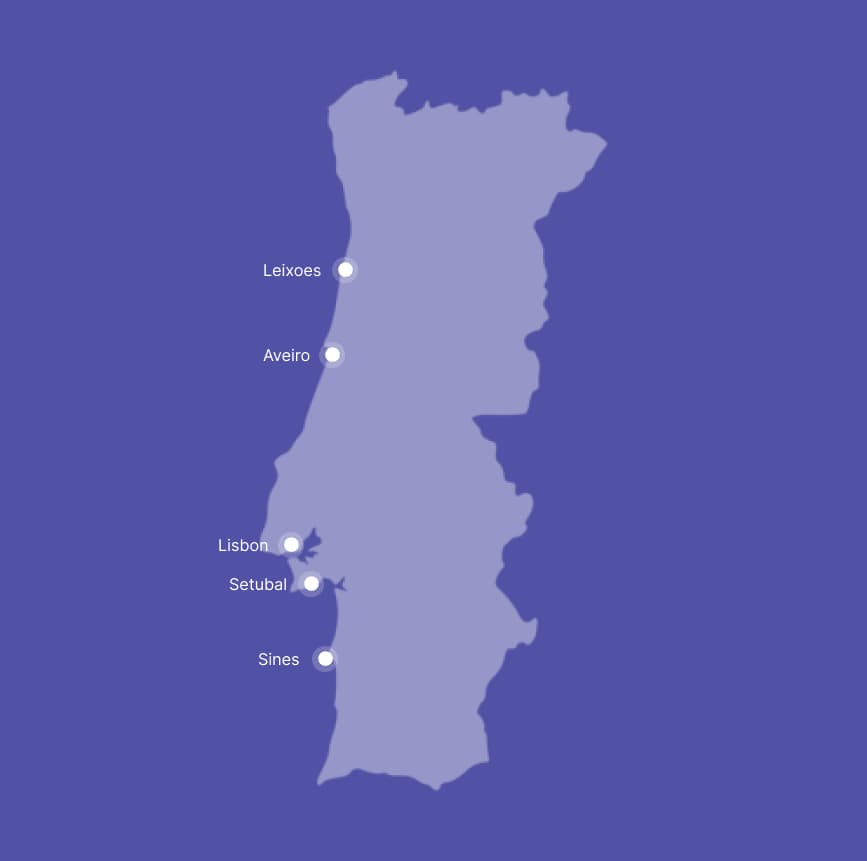
Most household shipments from Australia arrive through Lisbon or Leixões. Because the Australia–Portugal corridor is long-haul, very few sailings run direct — most route through a transhipment hub in Asia, the Middle East, or elsewhere in Europe before a final feeder service to Portugal. Sines, Portugal's largest deep-water container port, handles a meaningful share of this long-haul traffic, though it's primarily a transhipment and industrial port rather than the usual final stop for a household delivery.
Your specialist selects the entry port based on transit time and your final delivery address, not port size — a shipment bound for Porto or the north generally clears faster through Leixões, while Lisbon, the Setúbal peninsula, and the Algarve are usually better served through the Port of Lisbon.
Ports and Routing from Australia
Ports and Routing from Australia
Sea freight departs from Australia's major container ports — Sydney, Melbourne, Brisbane, or Fremantle — depending on where you're based. Because there's no single direct service to Portugal, your container typically transships once, adding several days to the overall transit compared with the fastest point-to-point sailing on this route.
Port of Lisbon (APL) is the main gateway for shipments bound for Lisbon, the Setúbal peninsula, and the Algarve. Port of Leixões (APDL) serves Porto and northern Portugal. Lisbon Humberto Delgado Airport (LIS) is Portugal's main air cargo gateway.
Air freight from Australia to Portugal also transships — there's no direct commercial air freight service between the two countries — typically routing through a Middle Eastern or European hub. It suits urgent or high-value items rather than a full household move.
Transit Times: Australia to Portugal
| From | To | Est. Transit Time |
|---|---|---|
| Sydney, Australia | Lisbon, Portugal | 35-45 days |
| Melbourne, Australia | Lisbon, Portugal | 36-46 days |
| Brisbane, Australia | Lisbon, Portugal | 38-48 days |
| Fremantle (Perth), Australia | Lisbon, Portugal | 30-40 days |
| Adelaide, Australia | Lisbon, Portugal | 37-47 days |
| Sydney, Australia | Leixões (Porto), Portugal | 38-49 days |
| Melbourne, Australia | Sines, Portugal | 35-45 days |
| Fremantle (Perth), Australia | Leixões (Porto), Portugal | 33-43 days |
Peak Months
June to August is the busiest period for Australia-to-Portugal household moves. It lines up with the Portuguese school year change and with much of Portugal taking annual leave in August, when Lisbon and Leixões terminals run with reduced staffing. Expect blank sailings, longer inspection queues, and possible customs delays rather than any actual closure — book six to eight weeks earlier than you would outside this window, since the transhipment leg leaves less slack to absorb delays than a direct sailing would. September sees a second surge as Portugal's corporate relocation cycle and school year both start at once; documentation errors are costlier here because clearance queues are already long. On the Australian side, the run-up to 30 June (the end of the Australian financial year) is when many retirees finalise property sales and lock in a move date, which also pushes volumes higher through winter. December to early January is the quietest window for bookings but the slowest for clearance: Portuguese customs and terminal staffing drops over the holidays, and Australian packers and freight forwarders run reduced schedules over the same period, so a shipment timed for late December often doesn't clear until January.
Visa and Residence Requirements for Australians Moving to Portugal
Customs relief and immigration status are separate processes, but they're linked in practice: AT wants evidence that your main residence is genuinely moving to Portugal, and your residence permission is the clearest form of that evidence. Australian citizens aren't EU, EEA, or Swiss nationals, so a Portuguese national visa is required before travelling — arriving on the visa-exemption stamp available to Australian passport holders for short stays doesn't establish residence and won't support a transfer-of-residence customs claim.
You apply for the national visa at the Portuguese Embassy or a consulate covering Australia before departure, then complete residency registration with AIMA, the Agency for Integration, Migration and Asylum, once in Portugal. Categories and income thresholds change and are indexed annually, so confirm current requirements with AIMA or your consulate before you book freight.
Main residence routes for Australians
Most Australians moving household goods to Portugal arrive on one of the following national visa routes:

D7 — Passive income route
For people living on pensions, rental income, or other regular passive income. The minimum income threshold is tied to the Portuguese minimum wage — €920 per month for 2026 under Decreto-Lei n.º 139/2025 — and rises for a spouse or dependents. Because it's indexed annually, confirm the current figure before applying.
D8 — Digital nomad / remote work route
For people working remotely for employers or clients based outside Portugal. Requires proof of stable remote income at roughly four times the Portuguese minimum wage, plus evidence the work can genuinely be performed from Portugal.
Work visas
For employment with a Portuguese employer, self-employment, or entrepreneurial activity in Portugal.
Family reunification
For joining a spouse, partner, or family member who already holds Portuguese residence.
Note: Portugal closed its Non-Habitual Resident (NHR) tax regime to new applicants at the end of 2024. Its replacement, IFICI, targets qualified professionals in research and innovation roles and generally doesn't apply to D7 retirees or passive-income movers — don't assume the old NHR tax terms still apply to your situation.
Requirements and thresholds change without much notice. Confirm the current position with AIMA or your Portuguese consulate before finalising your relocation or shipping arrangements.
Frequently Asked Questions (FAQ)
There's no fixed headline price for this route — the total depends on your volume, whether you ship a full container (FCL) or a shared container (LCL), your origin port, and the time of year. The best way to get an accurate figure is to request a quote with your inventory and both addresses; your specialist will build a fixed-price quote from there.
Door-to-door for a full container (FCL) typically runs 8–12 weeks, and shared (LCL) shipments usually add 2–3 weeks for consolidation. This is a long-haul, transhipped route — almost no sailings run direct from Australia to Portugal, so the transit time reflects at least one connection along the way rather than a single direct voyage.
A Portuguese national visa — most Australians use the D7 (passive income) or D8 (digital nomad/remote work) route, though work and student visas and family reunification are also options. The short-stay visa exemption available to Australian passport holders doesn't establish residence and won't support a transfer-of-residence customs claim, so you need the national visa in place, and residency registered with AIMA, before your shipment is due to clear.
Not if you qualify for transfer-of-residence relief. You need to have lived outside the EU for at least 12 continuous months, have owned and used the goods for at least 6 months before leaving Australia, and bring the shipment into Portugal within 12 months of establishing residence there. Alcohol and tobacco are excluded from the relief regardless of how long you've owned them, and new or unused items don't qualify.
Usually not. Australian cars are right-hand-drive, and because Portugal drives on the right, an Australian vehicle needs headlight modification and individual homologation to register there — on top of ISV (vehicle tax), inspection, and any customs duty that applies. For most vehicles, especially anything more than a few years old, the combined cost exceeds what the car is worth once it's in Portugal. Selling in Australia and buying locally is usually the better outcome; ask your specialist to run the actual numbers for your specific vehicle before deciding.
You'll need an ISO-compliant microchip implanted before the rabies vaccination, the rabies vaccination itself at least 21 days before travel, and an EU animal health certificate issued within 10 days of travel by an accredited vet. Because Australia is a rabies-listed (low-risk) country, the antibody titration test required from unlisted countries doesn't apply to Australian pets, which simplifies the timeline noticeably.
FCL (Full Container Load) means your goods fill an entire 20ft or 40ft container that travels exclusively with your shipment. LCL (Less than Container Load) means your goods share a container with other customers' shipments. FCL generally suits the contents of a full home; LCL suits a studio or single room. On this route specifically, LCL consolidation adds more time than it would on a shorter corridor, because of the transhipment involved.
Sea freight departs from Sydney, Melbourne, Brisbane, or Fremantle depending on where you're based, and arrives through the Port of Lisbon or the Port of Leixões, near Porto, depending on your delivery address. Sines, Portugal's largest deep-water port, handles a share of the long-haul transhipment traffic but isn't typically the final stop for a household delivery.
Yes. Once your container is loaded and the Bill of Lading is issued, your specialist provides a tracking link and updates at key milestones: departure, transhipment, arrival at the Portuguese port, customs clearance status, and delivery scheduling.
Request a quote online or via WhatsApp with your Australian address, your destination in Portugal, an estimate of your volume, and your target move date. A specialist will follow up within 24 hours with a detailed, fixed-price quote. For larger or more complex moves, a video walkthrough or an in-home survey can be arranged at no cost.
Living in Portugal as an Australian
Lisbon & Leixões
the two main gateways for household goods arriving from outside the EU
EU transfer-of-residence relief
the duty-free path for genuine movers, if the paperwork is filed correctly
7th safest country worldwide
Portugal's 2026 Global Peace Index ranking, held since 2023
Cost of living in Portugal
Portugal's cost of living runs well below Australia's major cities across most everyday categories — groceries, dining out, and public transport in particular. Accommodation is the exception worth planning for: Lisbon and Porto's popularity with international arrivals has pushed rents up sharply in central neighbourhoods over the past several years, so a comfortable central apartment now costs closer to what you'd expect in a smaller Australian city than what older cost-of-living guides suggest.
Costs vary significantly by region. Lisbon and the Algarve's coastal towns carry the highest accommodation costs; Porto is meaningfully cheaper for a broadly comparable lifestyle; smaller towns inland and in the north are cheaper again, at the cost of fewer English-speaking services and a longer drive to an international airport.
Safety and Security in Portugal

Safety and Security in Portugal
Portugal ranked 7th in the 2026 Global Peace Index, a position it has held since 2023, placing it among the ten safest countries in the world. Violent crime affecting residents or visitors is rare, even in Lisbon and Porto's busier districts. Petty theft — bag snatching, pickpocketing in tourist areas and on public transport — is the most common issue, and standard urban precautions apply.
Road safety is the more genuine everyday risk. Portuguese motorway standards are high, but rural roads and mountain routes can be narrow and poorly lit, and driving culture is more assertive than most Australians are used to. Most expats find it takes a few months of local driving to adjust.
Salaries and employment for Australians in Portugal
Portuguese salaries sit well below Australian equivalents in nominal terms, and this is the single biggest financial adjustment most Australians make. The national minimum wage is €920 a month gross on the mainland in 2026, with higher floors in the Azores and Madeira, and average gross monthly earnings run in the region of €1,600–€1,750 according to Statistics Portugal (INE). Set against Australian salary expectations, a locally-engaged role is close to always a substantial nominal pay cut.
The comparison is less stark once cost of living is accounted for, but it does not disappear. Technology, finance, energy and senior management pay materially above the national average, and the average itself is pulled upward by a relatively small band of high earners — so the median experience is below the headline figure. Lisbon salaries are the highest in the country and Lisbon accommodation absorbs most of the difference.
Remote workers employed by Australian companies while living in Portugal are in the strongest position, keeping Australian pay against Portuguese costs. This is common enough that Portugal created a dedicated route for it, and it is worth confirming with your employer that they are willing to support an overseas-resident arrangement before you commit to the move — payroll, superannuation and insurance all change when you cease Australian tax residency.
Portugal's personal income tax for Australian residents
Portugal taxes residents on worldwide income. You generally become tax resident by spending more than 183 days in Portugal in a 12-month period, or by maintaining a home there in circumstances implying it is your habitual residence. Mainland progressive IRS rates run from roughly 12.5% to 48%, with a solidarity surcharge above that on high incomes.
The old NHR regime is closed. Non-Habitual Resident status was abolished at the end of 2023 and replaced by IFICI, informally called NHR 2.0. IFICI gives a flat 20% rate on qualifying Portuguese employment or self-employment income for up to ten years, but it is far narrower than what it replaced: it is limited to defined scientific research, innovation and high-value activities recognised by bodies such as IAPMEI and AICEP, and it requires that you were not Portuguese tax resident in the previous five years. Applications are due by 15 January of the year after your first year of residency.
Retirees should read the change carefully. Unlike the old NHR, IFICI does not cover pension or passive income. Australians moving to Portugal on retirement income are taxed under the standard progressive rates, which is a materially different outcome from the regime many older guides still describe.
The Australia–Portugal tax treaty is signed but not yet in force. Australia and Portugal signed a double taxation convention on 30 November 2023, and as of August 2026 it still awaits ratification and exchange of instruments. Until it enters into force, relief from double taxation depends on each country's domestic rules rather than treaty provisions. This is a genuine difference from most of our other corridors and a point to raise with an accountant who handles Australian expatriate affairs, not one to assume.
Finding work in Portugal as an Australian
Australians are not EU citizens and need a residence permit carrying work authorisation before taking up Portuguese employment. In practice most arrive on one of three routes: a work visa tied to a specific job offer, the D7 for those with sufficient passive or pension income, or the D8 digital nomad visa for remote workers employed or contracted outside Portugal.
The sectors most open to English-speaking foreign professionals are technology and software, shared service and customer support centres serving European markets from Lisbon and Porto, tourism and hospitality, and international education. Lisbon's startup ecosystem is the most visible entry point and is genuinely international in working language.
Portuguese is the working language across most of the domestic economy, and its absence narrows options considerably outside the international sectors above. Australians who intend to work locally rather than remotely should treat language acquisition as part of the relocation plan rather than something to address later. Recognition of Australian professional qualifications is a separate process again, and regulated professions — medicine, law, engineering, teaching — require formal recognition before practice.
Education, healthcare and public services in Portugal
Education: Portugal has more than 70 international schools concentrated around Lisbon, Porto, the Algarve and Madeira, offering British, American, IB, French and German curricula. Annual tuition typically runs from about €6,000 to €26,000 depending on school and year group. St. Julian's, Carlucci American International School of Lisbon (CAISL) and TASIS Portugal are among the long-established options. Public schooling is free and open to resident children, and is a realistic path for younger children who pick up Portuguese quickly.
Healthcare: Legal residents can register with the Serviço Nacional de Saúde (SNS), the public health service, where most essential care is free or heavily subsidised and prescriptions are inexpensive. Waiting times for non-urgent specialist appointments are the common complaint, which is why many expatriates carry private cover alongside SNS registration — private insurance is considerably cheaper than Australian equivalents. English is widely spoken by clinicians in Lisbon, Porto and the Algarve.
Public services: Registration is sequential and the order matters. You need a NIF (tax number) before almost anything else — including opening a bank account, signing a lease, or connecting utilities — and then a residence certificate and an SNS number. Starting the NIF process early, and before your shipment arrives, prevents the most common delays.
Connectivity: Fibre broadband is widespread and inexpensive by Australian standards, with strong coverage across cities and most coastal towns. Mobile coverage is good nationally. Portugal's remote-work appeal rests on genuinely reliable infrastructure rather than marketing.
Currency and banking in Portugal for Australians
Portugal uses the euro (EUR). The AUD–EUR rate has been volatile over recent years, and because your shipping costs, rental deposit and initial setup all fall within a short window, exchange timing has a real effect on what the move costs. Moving money in stages rather than as a single transfer is the usual way to limit that exposure.
You need a NIF first. Portuguese banks will not open an account without a Portuguese tax number, so the NIF is the first administrative step of the move, not a later one. Non-residents can obtain one through a fiscal representative or an online service before arrival, which is what most Australians do.
Multibanco and MB Way are central to daily life. Multibanco is the national interbank network, and its machines handle far more than cash — bill payments, tax payments, top-ups and transfers all run through it. MB Way, the linked mobile app, is used routinely for instant person-to-person transfers, in-store QR payments and cardless ATM withdrawals. Australians consistently underestimate how much of Portuguese daily life assumes you have it.
Transfers: Australian bank international transfers carry poor exchange margins for a move of this size. Wise and similar services are widely used by expatriates in Portugal and typically cost substantially less on a relocation-sized transfer. For the larger sums involved in property purchase, a specialist foreign exchange broker is usually better again than either.
Portugal's climate and weather
Portugal's climate and weather
Mainland Portugal has a Mediterranean climate with a strong Atlantic influence: mild, wet winters and warm, dry summers, with meaningful regional variation. Lisbon and the south see hot, largely rain-free summers and mild winters rarely below 8°C (46°F). Porto and the north are cooler and considerably wetter year-round, with a climate closer to what many Australians would associate with a mild European autumn.
Australians relocating from the southern states generally find Portugal's seasons run in the opposite direction to what they're used to — Portuguese summer overlaps with the Australian winter — which is worth factoring into a move timed around a school year or a lease.
Door-to-Door Relocation Service
Swift Cargo's door-to-door service for Australia-to-Portugal moves covers every stage of the relocation, from your Australian address to your front door in Portugal. The process runs as follows:
- Home survey and quote:
Your specialist assesses your volume (in person or by video walkthrough), confirms your packing requirements, and builds a fixed-price quote covering packing, sea freight, customs, and delivery. - Export packing at your Australian address:
A packing crew attends your home. Items are wrapped, inventoried, and packed into export-grade cartons or crates. The resulting packing list becomes the core of your Portuguese customs declaration. - Australian export reporting:
Unaccompanied personal effects are normally reported using exemption code EXPE. If the shipment contains non-exempt or permit-controlled goods, Swift Cargo confirms and completes the additional declaration requirements before departure. - Sea freight transit:
Your container is booked onto a confirmed sailing, usually with one transhipment. You receive a Bill of Lading with vessel details and an estimated arrival window at Lisbon or Leixões. - Pre-arrival customs preparation:
While your goods are in transit, your specialist prepares the full AT transfer-of-residence file: Baggage Certificate, packing list, Bill of Lading, NIF, and proof of your Australian residence. - Portuguese customs clearance:
Our Portuguese customs broker files the declaration with AT on your behalf, monitors the container's status, and manages any inspection requests or additional documentation. - Port release and onward delivery:
Once cleared, your container is released and transported to your Portuguese address. The delivery crew unpacks and places items as directed, then removes all packing materials.
Rated 4.8 by Customers
What Our Customers Say — Australia to Portugal Moves
Checklist for your Australia to Portugal relocation
Checklist for your Australia to Portugal relocation
Request a quote with your inventory list and destination address in Portugal. Provide your target move date.
We complete the applicable Australian export reporting before departure, normally using exemption code EXPE for unaccompanied personal effects and an EDN only where non-exempt or permit-controlled goods require one.
Professional packing at your Australian address; we produce an itemised packing list that doubles as the core of your Portuguese customs file.
Container departs Australia; you receive tracking and updates through transhipment to arrival at Lisbon or Leixões.
Portuguese customs clearance: AT reviews your transfer-of-residence file, prepared in advance so there's nothing to sort out at the terminal.
Final delivery to your address in Lisbon, Porto, the Algarve, or elsewhere in mainland Portugal.
Your specialist stays available through delivery and answers any questions after you've arrived.