
Moving to Thailand from the UK, from £1,754
We pack, ship and handle customs.
Guide to relocating from the UK to Thailand
Sea freight from UK ports to Bangkok currently takes 57–72 days port-to-port, as sailings route around the Cape of Good Hope. Air freight arrives in 7–10 days but costs significantly more and suits essentials only.
Thai customs allows duty-free import of personal effects for residents relocating from abroad, provided items were owned and in personal use for at least six months before the move date.
For household goods, Thai Customs looks for a one-year basis to stay: if you are working in Thailand, a one-year non-immigrant visa or, until it is granted, an Immigration letter confirming an annual stay or a work permit of at least a year (some foreigners qualify through a quota shown in their passport). Its Thai-language guidance says Non-Immigrant O entries for retirement or to follow a Thai wife fall outside that quota route, so check your category, including any O-A retirement visa, with Customs before you ship.
Vehicles are subject to import duties of 80–328% of declared value in Thailand. Most people relocating from the UK sell or store their vehicle rather than shipping it.
A studio-sized move from the UK to Bangkok starts at £1,754; a full 20ft household container runs higher depending on volume, origin port, packing services, and final delivery distance. UK-to-Thailand move costs vary significantly by move size and routing.
Moving from the United Kingdom to Thailand involves coordinating UK export clearance, a long-haul sea freight transit routed around the Cape of Good Hope, and Thai customs clearance on arrival. The process is manageable when planned properly, but the two most common failure points are shipments that miss Thai Customs' timing window (from one month before to six months after the owner arrives), and undeclared or incorrectly valued items flagged at Thai customs.
Swift Cargo manages the full chain: professional packing and export wrapping in the UK, sea freight booking with confirmed vessel schedules, customs documentation preparation, Thai customs clearance at Laem Chabang or Bangkok Port, and delivery to your door. A dedicated Move Manager stays on your case from first quote to final delivery.
This page covers what you actually need to know: Thai customs rules, realistic transit times from UK ports, visa requirements, what's restricted, and what life in Thailand costs for someone moving from the UK.
UK-to-Thailand removal costs vary by move size, origin port, and current routing.
Thai Customs for Moving from the UK to Thailand
Thailand’s customs authority (Thai Customs Department) allows returning residents and foreigners changing residence to Thailand to import personal effects and household goods duty-free under specific conditions. Eligibility depends on immigration status and the shipment meeting the exemption rules, not on British nationality. Qualifying items must have been owned and in personal use for at least six months before the date of relocation.
The exemption applies once per year and per shipment. You cannot split a single move into multiple shipments and claim the exemption multiple times. All items must be declared with an Application for Duty Exemption and the import declaration (normally Customs Form กศก. 99/1), and customs officers may conduct physical inspection of containers at Laem Chabang Port.
High-value electronics (laptops, cameras, audio equipment) are scrutinised carefully. If serial numbers can be matched to purchase records and items show visible use, the claim under the duty exemption for people changing residence is typically upheld. New, unopened electronics are treated as commercial imports and subject to VAT and import duty.
Thailand exempts used personal and household effects, in reasonable quantities, for people changing residence there. A foreigner needs an immigration quota shown in their passport or, if working in Thailand, a one-year non-immigrant visa (or, until it is granted, an Immigration letter confirming an annual stay or a work permit of at least a year); experts, government-contract staff and spouses accompanying workers have their own routes. Customs' Thai-language guidance adds that Non-Immigrant O entries for retirement or to follow a Thai wife do not meet the first of these, so check your visa category with Customs before you ship. Thai nationals qualify if they worked abroad for at least a year.
Goods must have been owned and used abroad and arrive between 1 month before and 6 months after you do. The allowance is one unit of each kind of household item per person, or two per family, and extras pay duty. Cars, firearms, provisions, musical instruments and sports equipment stay dutiable. A stay of less than one year gets the exemption for personal effects only.
- United Kingdom · before export
Check for controlled items
Controlled firearms and cultural objects need an export licence first. CITES-listed items need an APHA permit unless the household effects exemption applies. A UK licence is not import permission, so check the destination's rules too.
- United Kingdom · before the goods leave
Your agent sends the clearance request
You can appoint a UK-established forwarder or customs agent to send a C21e Customs Clearance Request using the code for private exportations of non-commercial goods, with no value limit. For some routes, such as Eurotunnel and Dover Eastern Docks, HMRC wants the declaration submitted as 'arrived' before the goods set off.
- Thailand · to claim the exemption
File the Application for Duty Exemption
You or your agent submit it, with your passport, proof of your stay or work permit and the bill of lading or air waybill, to Customs' duty exemption office at Bangkok Port or your port of entry. Customs examines the documents, and items that do not qualify are charged duty like normal goods. Get any permit for restricted goods from the relevant agency first.
- Thailand · once Customs returns your documents
Submit the import declaration
You or your agent submit the import declaration (normally Customs Form กศก. 99/1) and pay any duty and tax due.
- Thailand · at clearance
Green Line or Red Line
As with any import, Customs profiles the declaration: a Green Line shipment is released without inspection and a Red Line shipment is opened and checked first. Goods left in customs custody for more than 30 days without a declaration, duty payment or guarantee, and not dealt with within 15 days of a written notice to the carrier, can be auctioned or destroyed.
Documents you need for importing personal goods from the UK
- Passport (valid, with relevant entry stamps)
- Proof of permission to stay for at least a year: a one-year non-immigrant visa, an Immigration letter confirming an annual stay, or a work permit of at least a year (experts and government-contract staff: a letter from their agency); a stay of less than a year gets the exemption for personal effects only
- Application for Duty Exemption (household effects) and the import declaration (normally Customs Form กศก. 99/1), filed by you or your agent
- Packing list with item descriptions, quantities, and estimated values (GBP)
- Bill of Lading or Air Waybill from your freight forwarder
- Proof of overseas residence for at least one year (UK tenancy agreement, council tax or utility bills, or employment contract)
- Work permit or Immigration letter confirming an annual stay, if applicable
- Original purchase receipts or valuations for high-value items
Inspections and Delays
Thai customs officers at Laem Chabang and Bangkok Port (Klong Toey) may conduct full or partial physical inspections of inbound containers. Physical inspections typically add 3–7 working days to the customs clearance timeline. Containers flagged for inspection are moved to an examination bay at port and itemised against the declared packing list.
The most common triggers for inspection are: inconsistencies between the declared packing list and observed contents, high-value electronics without supporting purchase documentation, and restricted food or plant products.
Swift Cargo's Thailand customs team monitors container status through the Thai Customs e-Declaration system and flags potential inspection triggers during the documentation review stage, before goods reach port.
What you can import to Thailand

Personal belongings

Used clothing

Household appliances

Fragile items

High-value items

Large items & furniture

Excess luggage

Pets
Import permit and health certificate required
Restricted and Prohibited Goods

Plants, seeds & soil-related items

Food, supplements & consumables

Alcohol & tobacco products

Prescription & non-prescription medicines

Weapons, firearms & controlled items

Vehicles
Banned in most cases; exceptions are very costly

E-cigarettes & vapes
Minimum Shipment Size for Thailand
There is no formal minimum volume for personal effects shipments to Thailand. However, the economics of full sea freight containers (20ft or 40ft) typically apply when you are moving the contents of a complete home. For smaller volumes, such as a single room or studio apartment, a shared container (LCL, Less than Container Load) groupage service is more cost-effective.
Swift Cargo offers both FCL (Full Container Load) and LCL options on the UK–Thailand route. LCL consignments from Felixstowe and Southampton consolidate on a regular sailing schedule; because groupage cargo waits for a full container before loading, LCL adds 7–10 days to FCL transit estimates through consolidation and deconsolidation handling.
Air freight is available for high-priority or time-sensitive items. Air cargo from UK airports to Bangkok Suvarnabhumi (BKK) typically takes 7–10 days door-to-door including customs clearance.
Thai Customs forms and guidance
To claim the exemption, you or your agent file an Application for Duty Exemption with your supporting documents, then submit the import declaration (normally Customs Form กศก. 99/1). The steps and required documents are set out in the Thai Customs Department's household-effects guidance.
Contact Thai Customs

Taxes and Duties on Imported Household Goods
Personal effects and household goods imported duty-free under the duty exemption for people changing residence are not subject to Thai import duty or VAT, provided the conditions are met. If any items fail the exemption criteria (for example, new goods, commercial quantities, or items without proof of prior ownership), they are assessed for duty and VAT individually. What actually qualifies as duty-free in Thailand depends on a combination of documentation, proof of ownership, and timing — the edge cases catch many first-time importers.
Thai import duty on household goods not qualifying for exemption ranges from 0% to 30% depending on the HS code classification of the item. Electronics typically attract 0–10% duty; furniture 5–20%; clothing 5–30%. VAT of 7% applies on top of the CIF value (cost + insurance + freight) plus any applicable duty.
General Tax Rules
Thailand imposes a personal income tax on Thai-source income for all residents, regardless of nationality. For foreign residents living and working in Thailand on a work permit, Thai personal income tax rates are progressive: 0% on the first 150,000 THB, 5% on 150,001–300,000 THB, scaling up to 35% on income above 5,000,000 THB.
For people within the UK tax system, liability is generally based on tax residence rather than citizenship. Once you become non-UK-resident under the Statutory Residence Test, most foreign income falls outside UK income tax, though UK-source income (such as UK rental property or certain pensions) can remain taxable. The UK and Thailand have a Double Taxation Convention that may provide relief where the same income would otherwise be taxed twice. People with tax obligations in another country should obtain advice for that jurisdiction as well. Confirm your residence position and any split-year treatment with a qualified adviser before you relocate.
Duty Exemption for People Changing Residence
The exemption from Thai customs duty for used household goods and personal effects applies when: (1) you meet one of Thai Customs' criteria for changing residence: if you are working in Thailand, a one-year non-immigrant visa or, until it is granted, an Immigration letter confirming an annual stay or a work permit of at least a year (some foreigners qualify through a quota shown in their passport, but Customs' Thai-language guidance says Non-Immigrant O entries for retirement or to follow a Thai wife fall outside that quota route, so confirm a retirement visa with Customs first), (2) the goods were owned and used by you personally for at least six months before the move, (3) the goods are for your personal use and not for sale, and (4) the shipment arrives between one month before and six months after you do.
Work permit holders with BOI (Board of Investment) company sponsorship may qualify for an enhanced exemption that removes the six-month prior ownership requirement for certain household categories. Your Swift Cargo Move Manager will advise whether BOI exemption rules apply to your relocation.
Duty-Free Status for Qualifying Relocations
Under the duty exemption for people changing residence, the following categories are typically cleared duty-free: clothing and personal items, household furniture and furnishings (used), kitchen equipment and appliances (used), books and personal documents, hobby equipment in personal quantities, personal computers and peripherals (used, with documentation).
Items that do not qualify for the duty exemption for people changing residence and will be assessed for duty include: new goods (still in original packaging), commercial quantities of any item, alcohol beyond the 1-litre allowance, tobacco beyond the 200-cigarette allowance, and vehicles.
If your shipment contains a mix of qualifying and non-qualifying items, Thai customs will separate the assessment. Duty is applied only to the non-qualifying portion. Accurate, itemised packing lists reduce the risk of over-assessment and delays.
Import your Vehicle
Importing a personal vehicle from the United Kingdom to Thailand is technically possible but carries significant cost and complexity. Thai import duties on vehicles are among the highest in the region, ranging from 80% for used cars up to 328% for new vehicles depending on engine size, fuel type, and age. For most people relocating from the UK, the economics strongly favour selling the vehicle in the UK and buying locally. Right-hand-drive UK cars are at least mechanically suited to Thai roads, which also drive on the left.
The exception is specialised or collector vehicles that hold significant personal or monetary value. If your vehicle qualifies as a personal effect (owned for more than one year and used personally), a partial duty exemption may apply, but this must be applied for in advance through Thai Customs and is not guaranteed.
What You Need

What You Need
- V5C registration certificate (UK logbook)
- Bill of sale or independent valuation for customs valuation
- Vehicle identification number (VIN) documentation
- UK export declaration (filed via HMRC Customs Declaration Service)
- Thai Customs import application and duty payment confirmation
- Vehicle inspection certificate from the Thai Department of Land Transport
- Thai motor insurance policy before registration
Costs to Expect
Import duty: 80–328% of CIF value (cost + insurance + freight to Thailand). A £20,000 used car can attract £16,000–£65,000+ in duty depending on engine size and age.
VAT: 7% applied on (CIF value + import duty).
Excise tax: Additional 10–50% excise duty applies to most passenger vehicles in Thailand on top of import duty and VAT.
Import your Pets
Thailand allows import of dogs and cats from the United Kingdom with proper documentation. Unlike Australia, there is no mandatory quarantine period for pets arriving from the UK with the correct health certificate and vaccinations, provided the documentation is complete and verified at the point of entry. Pets typically clear through Suvarnabhumi Airport (BKK) on the same day as arrival.
All pet import documentation must be approved by the Thai Department of Livestock Development (DLD) before travel. The import permit from DLD is required in advance; it cannot be obtained on arrival.

Key Requirements for Pet Import to Thailand
- Thai DLD import permit, applied for online at the DLD portal at least 15 days before travel
- ISO microchip implanted before rabies vaccination
- Rabies vaccination, administered at least 21 days before departure and not more than 12 months before
- Export Health Certificate endorsed by APHA (Animal and Plant Health Agency), completed by an Official Veterinarian in the UK within 10 days of departure
- Rabies titre test (antibody level test), required if the pet has not been continuously resident in a rabies-controlled country. The UK qualifies as a rabies-controlled country, so this is typically not required for UK-origin pets.
- Airline-compliant travel crate meeting IATA standards
- Pets must arrive as live animal cargo on an approved carrier direct flight to Suvarnabhumi (BKK), not Don Mueang (DMK)
Shipping Ports in Thailand
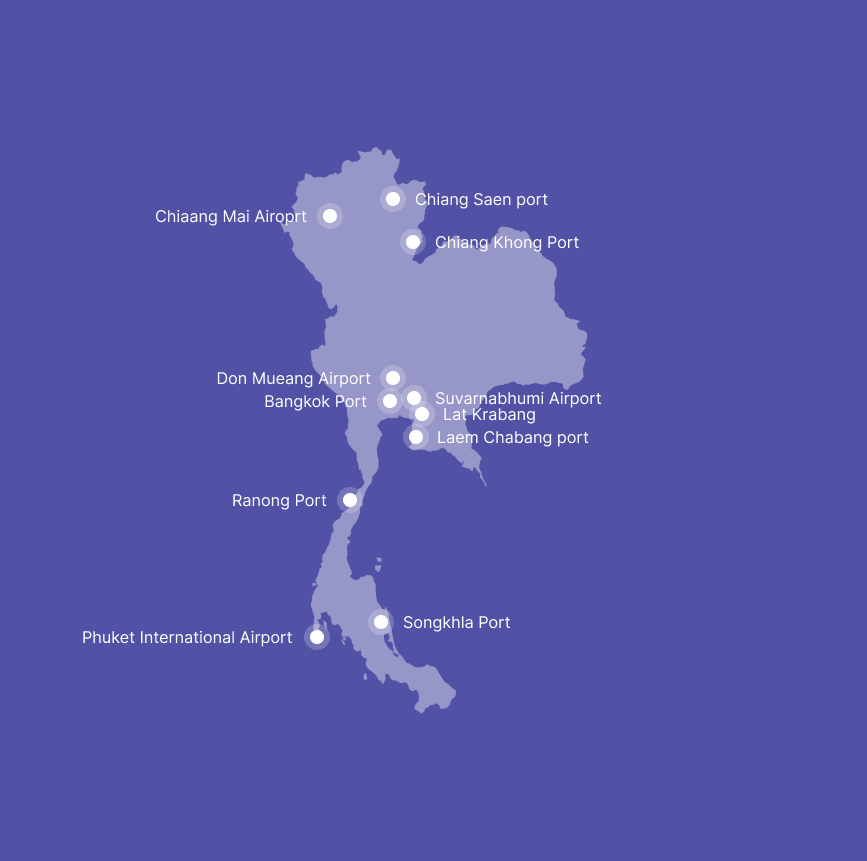
Thailand’s main deep-water container port is Laem Chabang Port (LCB), located 130 km south of Bangkok in Chonburi Province. Laem Chabang handles the majority of imported household goods and personal effects containers arriving from the United Kingdom. It is directly connected to Bangkok by motorway and rail freight links.
Bangkok Port (Klong Toey), located on the Chao Phraya River 5 km from central Bangkok, handles a smaller volume of general cargo including some personal effects containers. Klong Toey is more convenient for deliveries in central Bangkok and is sometimes used for LCL groupage consignments.
UK Ports and Shipping Methods
From Felixstowe and Southampton, the UK’s two largest deep-sea container ports, FCL and LCL containers sail to Laem Chabang on major carrier services. With current Cape of Good Hope routing, port-to-port transit runs 57–70 days.
From London Gateway, Tilbury, and Liverpool, sailings typically route via a transshipment hub before reaching Laem Chabang; transit is 60–72 days. Cargo from Scotland, Northern Ireland, and the north of England is usually feedered or trucked to Felixstowe or Southampton for the main leg.
For LCL (groupage) shipments, Swift Cargo consolidates cargo from Felixstowe and Southampton. LCL is cost-effective for volumes below approximately 15 cubic metres (the equivalent of a 1–2 bedroom apartment). Above this threshold, a 20ft FCL container usually offers better value.
Transit Times per UK Port to Bangkok
| From | To | Est. Transit Time |
|---|---|---|
| Felixstowe | Bangkok (Laem Chabang) | 58–70 days |
| Southampton | Bangkok (Laem Chabang) | 57–68 days |
| London Gateway | Bangkok (Laem Chabang) | 58–70 days |
| Tilbury | Bangkok (Laem Chabang) | 60–72 days |
| Liverpool | Bangkok (Laem Chabang) | 60–72 days |
| Glasgow (via Felixstowe) | Bangkok (Laem Chabang) | 63–75 days |
Peak Months
May–August is the busiest period for UK-to-Thailand household moves. Families relocating from the UK with school-age children often time their move to arrive before international school terms begin in August, and retirement relocations rise as people leave ahead of the UK winter. Vessel space tightens over the summer, and with Cape of Good Hope routing adding several weeks to transit, booking 10–12 weeks ahead during this window is advisable. A second, smaller peak follows the New Year. The quietest window for both availability and pricing is October–December.
Visa Requirements for Moving from the UK to Thailand
British passport holders can enter Thailand without a visa for tourist stays of up to 30 days under the visa exemption scheme (cut from 60 days on 15 September 2026); other nationalities resident in the UK should check their own visa-exempt status, which varies by passport. For a relocation where you are bringing household goods and intending to stay long-term, Thai Customs looks for a one-year basis to stay (see the visa question in the FAQ), so check your category with Customs before you ship. A stay of less than a year, including a tourist or visa-exemption stay, gets the exemption for personal effects only.
The Thai Non-Immigrant visa must be obtained before departure from the UK. The Royal Thai Embassy in London processes Non-Immigrant visa applications, which are now submitted online through the Thai e-Visa system (thaievisa.go.th). Apply well ahead of your move date, as processing and appointment lead times vary through the year.
Main Visa Categories for Long-Term Stays
People relocating from the UK to Thailand long-term use one of the following visa categories:

Non-Immigrant B (Work)
For those with a confirmed job offer from a Thai or BOI-registered company. Requires a work permit within 90 days of arrival.
Non-Immigrant O (Retirement / Family)
For those aged 50+ with 800,000 THB in a Thai bank account, or for spouses and dependents of Thai nationals.
Long-Term Resident Visa (LTR)
Thailand's premium visa for wealthy retirees, remote workers, and qualified professionals. 10-year renewable, multiple entry.
Destination Thailand Visa (DTV)
5-year multiple-entry visa for digital nomads and remote workers. 180-day stay per entry, available since 2024.
Note: Whether your household goods qualify depends on Thai Customs' criteria for changing residence, and a stay of less than a year gets the exemption for personal effects only. Thai Customs' Thai-language guidance says Non-Immigrant O entries for retirement or to follow a Thai wife fall outside its quota route for foreigners, and its household-effects guidance does not mention the O-A, LTR or DTV visas. Confirm your visa type with your Move Manager and with Thai Customs before goods are dispatched.
For current application requirements, visit the Royal Thai Embassy London or apply through the Thai e-Visa system.
Frequently Asked Questions (FAQ)
A studio-sized move from the UK to Bangkok starts at around £1,754 door-to-door, covering packing, sea freight, Thai customs clearance, and delivery. A 20ft container (a 2–3 bedroom home) typically runs £4,300–£4,900 all-in, depending on origin port and delivery location. LCL (groupage) is charged from roughly £40–£80 per cubic metre. Air freight for priority items runs higher per kg. The best way to get an accurate figure is to request a quote with your inventory and address details.
On current Cape of Good Hope routing, port-to-port sea transit is about 57–70 days from Felixstowe or Southampton, and 60–72 days from London Gateway, Tilbury, or Liverpool. Add 3–7 days for packing, loading, and export clearance at the UK end, and 7–15 working days for Thai customs clearance and delivery at the Thai end. Total door-to-door is typically 75–95 days. Air freight takes 7–10 days door-to-door for urgent items.
Not if you qualify for the duty exemption for people changing residence. Thailand allows duty-free import of used household goods and personal effects for residents relocating from abroad, provided: (1) you meet one of Thai Customs' criteria for changing residence (see the visa question below; a retirement visa may not meet them), (2) goods were owned and in personal use for at least six months before the move, (3) items are for personal use and not for resale. New or unopened items, alcohol beyond the 1-litre allowance, and tobacco beyond the 200-cigarette limit are dutiable regardless.
If you are working in Thailand, Thai Customs asks for a one-year non-immigrant visa (or, until it is granted, an Immigration letter confirming an annual stay or a work permit of at least a year); experts and government-contract staff need a letter from their agency, accompanying spouses of workers and experts count as changing residence too if Immigration has issued them a non-immigrant visa for their first 90 days in Thailand, and some foreigners qualify through a quota shown in their passport. Its guidance does not mention B, O-A, LTR or DTV visas, and its Thai-language guidance adds that Non-Immigrant O entries for retirement or to follow a Thai wife fall outside that quota criterion, so confirm your category, including any O-A retirement visa, with Customs before you ship. A stay of less than a year, including a tourist or visa-exemption stay, gets the exemption for personal effects only. Your goods must arrive in Thailand between one month before and six months after you do. Apply for your visa through the Royal Thai Embassy in London before you ship.
Yes. Swift Cargo collects from anywhere in England, Scotland, Wales, and Northern Ireland. For FCL containers we use the most cost-effective port for your location — usually Felixstowe or Southampton, with London Gateway, Tilbury, or Liverpool used where routing suits. Cargo from Scotland, Northern Ireland, and the north of England is feedered or trucked to the main sailing port. The collection and port allocation are included in your quote.
Technically yes, but it is rarely cost-effective. Thai import duties on vehicles range from 80% to 328% of the car’s CIF value, plus 7% VAT and excise duties of 10–50%. A £20,000 used car can face £25,000–£85,000+ in combined taxes on arrival. Most people relocating from the UK sell their vehicle before leaving and buy in Thailand. One practical point in your favour: the UK and Thailand both drive on the left, so a right-hand-drive car is at least suited to Thai roads.
You need a Thai DLD import permit (apply online at least 15 days before travel), an ISO microchip, a current rabies vaccination (given at least 21 days before departure), and an Export Health Certificate endorsed by APHA and completed by an Official Veterinarian within 10 days of travel. Unlike Australia, Thailand does not require a quarantine period for pets arriving from the UK with complete documentation. Pets arrive as live cargo through Suvarnabhumi Airport (BKK).
FCL (Full Container Load) means your goods fill an entire 20ft or 40ft container that travels exclusively with your shipment. LCL (Less than Container Load) means your goods share a container with other customers' shipments; your cargo is consolidated before loading and deconsolidated on arrival. FCL is more cost-effective above approximately 15 cubic metres (a 2+ bedroom home). LCL suits studios and 1-bedroom apartments. LCL adds 5–7 days to transit time due to consolidation handling at both ends.
Yes. Swift Cargo provides full professional packing at your UK address. Our teams use export-grade materials: double-wall cartons, foam wrap, bubble wrap, and wooden crating for fragile or high-value items. An itemised packing list is produced at the time of packing; this list is for your own and Customs' use. Partial packing is also available if you prefer to pre-pack non-fragile items yourself.
Physical inspection by Thai customs at Laem Chabang typically adds 3–7 working days to clearance. Swift Cargo's Thai customs broker attends the inspection, ensures the declared packing list matches the container contents, and manages any additional documentation requests. The most common trigger for inspection is a discrepancy between declared and observed contents, or high-value electronics without supporting documentation. We review your packing list for inspection risk before goods are dispatched.
Yes. Once your container is loaded and the Bill of Lading is issued, your Move Manager provides a tracking link and regular updates at key milestones: departure from the UK port, transshipment confirmation (if applicable), arrival at Laem Chabang, customs clearance status, and delivery confirmation. You can also contact your Move Manager directly at any point during transit.
You can request a quote online or via WhatsApp. Provide your UK town or city, your destination city in Thailand, an estimate of your volume (number of rooms or cubic metres), and your target move date. A Move Manager will follow up within 24 hours with a detailed, fixed-price quote. For large or complex moves, a video walkthrough or in-home survey can be arranged at no cost.
Prepare your move to Thailand
Southampton → Laem Chabang
the main deep-sea routing for UK household shipments to Thailand
Duty-free potential
used household goods can enter Thailand duty-free when you meet Thai Customs' conditions
Suez corridor
UK–Thailand sea freight transits the Suez Canal, so disruptions there ripple into schedules
Cost of living in Thailand
Thailand offers a significantly lower cost of living than the United Kingdom across most major expense categories. A comfortable Bangkok lifestyle, including a modern 2-bedroom apartment in a central area, dining out regularly, and running a car, typically costs £1,600–£2,800 per month for a couple. The same lifestyle in Chiang Mai or Hua Hin runs £1,100–£1,750 per month.
Accommodation: A 2-bedroom serviced apartment in central Bangkok (Sukhumvit, Silom, Sathorn) costs 35,000–80,000 THB/month (roughly £780–£1,780). The same quality in Chiang Mai or Phuket is 15,000–35,000 THB/month.
Food: Local Thai restaurants cost 60–150 THB per meal. Western-style restaurants in Bangkok run 300–800 THB per person. Supermarkets carry most imported UK and Western brands at 2–3x UK prices; local produce is very cheap.
Transport: Bangkok's BTS Skytrain and MRT metro are efficient and inexpensive (25–65 THB per trip). Grab (rideshare) is widely used and cheap. Owning a car adds significant cost due to high vehicle prices from import duties.
Healthcare: Private hospital care in Thailand is high quality and significantly cheaper than the UK, though there is no NHS-style free system — health cover is essential. A GP consultation at a Bangkok private hospital costs 800–1,500 THB (roughly £18–£33). Expat health insurance runs £800–£2,800/year depending on age and coverage.
Safety and Security in Thailand

Safety and Security in Thailand
Thailand is generally safe for foreign residents. Bangkok, Chiang Mai, and most tourist areas have low rates of violent crime affecting expats. Petty theft (bag snatching, phone theft) occurs in busy areas of Bangkok and tourist zones in Phuket; standard urban precautions apply.
Thailand’s southern provinces (Pattani, Yala, Narathiwat, and parts of Songkhla) have an ongoing low-level insurgency. The UK Foreign, Commonwealth & Development Office (FCDO) advises against all but essential travel to these areas. The vast majority of expats live and work in Bangkok, Chiang Mai, Phuket, Pattaya, or Hua Hin, all well outside the affected southern region.
Road safety is a genuine concern. Thailand has one of the highest road fatality rates in Southeast Asia, driven primarily by motorcycle accidents. Wearing helmets and avoiding motorcycle travel late at night significantly reduces risk. Tuk-tuks and songthaews are safe for short daytime trips.
Salaries and employment for expats in Thailand
Expatriate salaries for foreign professionals working in Thailand vary significantly by industry, employer type, and whether the role is a local hire or an expat package. Foreign-currency expat packages, common in multinational companies, oil and gas, aviation, and senior finance roles, typically run £3,200–£12,000+ per month, often with housing allowances and flights included.
Locally-engaged positions with Thai companies typically pay in Thai Baht and are set against local market rates, which are considerably lower than UK equivalents. Teaching English at international schools pays 45,000–80,000 THB/month (roughly £1,000–£1,780). Thai-market IT roles: 50,000–120,000 THB/month. Hospitality management: 60,000–150,000 THB/month for senior roles.
Remote workers employed by UK companies and based in Thailand retain their home salary while benefiting from Thailand’s lower cost of living. The LTR Visa and Destination Thailand Visa (DTV) were specifically created to accommodate this demographic.
Thailand’s personal income tax for expatriates
Thailand taxes individuals on income earned in Thailand, and on foreign income remitted to Thailand, if they are Thai tax residents (present 180 days or more in a tax year). For expatriates relocating from the UK, Thai-source employment income is always taxable in Thailand; foreign-source income (including UK remote-work payments) can be taxable in Thailand if remitted to a Thai bank account in the year it is earned. Remittance rules have been under active review, so confirm the current position before relocating.
The UK and Thailand have a Double Taxation Convention that provides relief where the same income would otherwise be taxed in both countries. Unlike US citizens, people who are no longer UK tax residents are generally not taxed by the UK on foreign income once they leave, though UK-source income and any UK property gains can still fall within UK tax. A UK-qualified adviser with expat experience is essential before a permanent move.
Finding work in Thailand as an expat
Foreign nationals generally require both an appropriate work-authorising visa, commonly a Non-Immigrant B visa, and a Thai work permit to legally work for a Thai employer in Thailand. Requirements vary by nationality and visa category. The work permit is employer-sponsored; your Thai employer applies for it through the Department of Employment. You cannot legally start work before the permit is issued.
Key sectors employing foreign professionals include: international education (international schools and universities), finance and banking (Bangkok is a regional hub), manufacturing and supply chain (automotive, electronics), hospitality and tourism, and technology. Remote work for overseas employers does not legally require a Thai work permit, though visa compliance still applies.
Thailand's Board of Investment (BOI) maintains a Smart Visa programme for specialists and senior executives working with BOI-promoted companies. This visa type carries additional immigration privileges and simplified work authorisation.
Education, healthcare and public services in Thailand
Education: Bangkok has a large international school sector with British, American, International Baccalaureate, and bilingual curricula. British-curriculum schools include Bangkok Patana and Harrow International School Bangkok. Annual fees run roughly £12,000–£24,000+ per child. Chiang Mai, Phuket, and Pattaya also have international schools.
Healthcare: Thailand's private hospital system is excellent by regional standards and affordable by UK standards. Bangkok's leading hospitals, including Bumrungrad International, Bangkok Hospital, and Samitivej, attract medical tourists and are accredited by the Joint Commission International. Most senior staff are English-speaking.
Public services: Thailand's public infrastructure in Bangkok is modern and functional. The BTS Skytrain and MRT metro cover most of central Bangkok. Internet connectivity is reliable; average fixed-line broadband speeds in Bangkok exceed 200 Mbps.
Banking: Foreign residents can open Thai bank accounts with a valid visa, passport, and proof of address. Kasikorn Bank (KBank), Bangkok Bank, and SCB all offer English-language services for expats. Thailand and the UK both participate in the OECD Common Reporting Standard (CRS), so Thai banks share account information with HMRC — the process is generally smoother than the FATCA checks US citizens face.
Currency and banking in Thailand for expats
Thailand’s currency is the Thai Baht (THB). The exchange rate against the Pound Sterling has traded broadly in the 42–46 THB/GBP range through 2024–2025. The Baht is a managed float; the Bank of Thailand intervenes to limit extreme volatility.
ATMs are widely available in cities and tourist areas. Most Thai ATMs charge a 220–250 THB fee per foreign card transaction. Using a UK account with low or no international ATM fees (Wise, Revolut, Starling, or Chase UK) significantly reduces this cost.
Wise (formerly TransferWise) is widely used by expatriates in Thailand for regular transfers from UK accounts. The mid-market exchange rate and low fixed fees make it one of the most cost-effective options for regular GBP-to-THB transfers; Revolut is also popular.
Thai bank accounts: Kasikorn Bank and Bangkok Bank are the most expat-accessible. Kasikorn’s K-Plus mobile app is English-language and feature-complete for day-to-day banking. Bangkok Bank offers international wire services that are frequently used by retirees receiving a UK State Pension or private pension.
Thailand's climate and weather

Thailand's climate and weather
Thailand has a tropical climate divided broadly into three seasons: the hot season (March–May), the rainy season (June–October), and the cool season (November–February). Bangkok temperatures range from 26°C (79°F) in December to 38°C (100°F) in April. Humidity is high year-round, particularly during the rainy season.
Chiang Mai in the north experiences a more pronounced cool season (15–25°C November–February) and a severe hot season (March–May) exacerbated by agricultural burning, which affects air quality significantly in March–April. Phuket and the southern islands have a different rainfall pattern: the southwest monsoon hits Phuket's west coast May–October, while the east coast and Gulf resorts (Koh Samui) are affected September–December.
For anyone used to the UK’s cool, temperate climate, Thailand’s year-round heat and humidity take real adjustment. The cool season (November–February) in Bangkok and Chiang Mai is the most comfortable window to arrive and settle in before the hot season builds from March.
Door-to-Door Relocation Service
Swift Cargo’s door-to-door service for UK-to-Thailand moves covers every stage of the relocation from your UK address to your front door in Thailand. The process runs as follows:
- Home survey and quote:
A Move Manager assesses your volume (in-person or via video walkthrough), confirms your packing requirements, and produces a fixed-price quote covering packing, sea freight, customs, and delivery. - Export packing at your UK address:
Our packing team attends your UK home. All items are wrapped, inventoried, and packed into export-grade cartons or wooden crates. A detailed packing list is generated for your own and Customs' use. - UK export clearance:
Swift Cargo prepares and files the export declaration through HMRC’s Customs Declaration Service (CDS) before your container is loaded for sailing. - Sea freight transit:
Your container is booked onto a confirmed vessel from your nearest UK port. You receive a Bill of Lading with vessel name, voyage number, and estimated arrival date at Laem Chabang. - Pre-arrival customs preparation:
While goods are in transit, your Move Manager prepares the full Thai customs documentation package: Application for Duty Exemption, packing list, Bill of Lading, and copies of your visa and passport. - Thai customs clearance:
Our Thai customs broker files the import declaration on your behalf. We monitor container status through the Thai Customs e-Declaration system and manage any inspection requests or additional documentation requirements. - Port release and onward delivery:
Once cleared, your container is released from Laem Chabang and transported to your Thai address. Our delivery team unpacks and places items as directed, and removes all packing materials.
Rated 4.87 by customers
What Our Customers Say — UK to Thailand Moves
Checklist for your UK to Thailand relocation
Checklist for your UK to Thailand relocation
Confirm which Thai visa or permission to stay fits your move, check your category with Thai Customs, and apply through the Royal Thai Embassy London / Thai e-Visa system before booking your shipment.
Request a Swift Cargo quote at least 10–12 weeks before your target move date, or earlier during the May–August peak season, as Cape of Good Hope routing lengthens transit.
Prepare your document set: passport, visa, packing list, Bill of Lading, proof of overseas residence, and purchase receipts for high-value items.
Apply for a Thai DLD pet import permit at least 15 days before travel if you are bringing dogs or cats, and book your Official Veterinarian / APHA health certificate.
Arrange Thai health insurance before arrival. There is no NHS-style free care, so hospital cover is essential; Bumrungrad International and Bangkok Hospital both offer walk-in consultations.
Open a Thai bank account within the first weeks of arrival using your passport, visa, and a Thai tenancy agreement as proof of address.
British nationals can register their presence with the British Embassy Bangkok and check FCDO travel advice; other nationalities should use their own embassy and government travel guidance.