
Ship your household goods from the UK to Canada
Swift Cargo is rated 4.87 by 25k+ customers.
Planning a move from the UK to Canada?
✦ TL;DR
Sea freight from Felixstowe or Southampton to Halifax or Montreal typically takes 14–20 days; to Vancouver, expect 26–32 days. Door-to-door timing adds UK collection at origin and Canadian inland delivery at destination — which can vary by city and season.
Canadian customs allows duty-free import of used personal effects for people relocating long-term, but the basis is established when you first arrive in Canada, not when the container lands. Declaring goods to follow on BSF186 at first Canadian entry is the critical step.
UK appliances operate on 230V/50Hz. Canada runs on 120V/60Hz. Large appliances — washing machines, dryers, refrigerators, ovens — are generally not worth shipping. Most British movers buy these after arrival.
UK citizens moving to Canada for more than six months need a qualifying permit or permanent residence. The IEC Working Holiday scheme allows British nationals under 35 to live and work in Canada for up to two years.
Goods of UK origin may benefit from preferential tariff treatment under the UK-Canada Trade Continuity Agreement (CUKTCA). Your freight forwarder and customs broker should confirm correct commodity codes before shipment.
Moving household goods from the UK to Canada involves a UK export leg, a trans-Atlantic sea transit, and Canadian customs clearance at the receiving port. The customs outcome is largely determined before the container leaves the UK — by how you declare on your first Canadian arrival, what appears on the goods-to-follow list, and how cleanly your inventory separates qualifying personal effects from excluded categories.
Swift Cargo manages the full chain: collection and export packing at your UK address, sea or air freight booking with confirmed schedules, CBSA customs documentation, Canadian port clearance at Halifax, Montreal, or Vancouver, and delivery to your Canadian door. One dedicated Move Manager stays on your case from first quote to final delivery.
This page covers what UK movers actually need to know: CBSA rules and goods-to-follow, realistic UK port transit times to Canada, Canadian visa options for British nationals, what is restricted or excluded, and practical information about life in Canada for someone arriving from the UK.
Our import process
Navigate your UK-to-Canada move around BSF186, goods-to-follow, and CBSA clearance with a plan built for your specific shipment. Our three-step process provides specialist support to manage Canadian customs and choose the right shipping route for your timeline.
Request a Quote
Tell us your UK collection address, destination in Canada, and inventory. You get a clear plan, timeline, and cost upfront.
Get Connected
Your Move Manager builds the shipment plan, handles BSF186 documentation, and checks the inventory before anything leaves the UK.
Finalise your Plan
We execute the move. Collection, export, shipping, Canadian customs clearance, and delivery. Everything runs to plan.
Peak periods
UK-to-Canada household moves follow a seasonal pattern shaped by the British school year, employer relocations, and Canadian port conditions:
- June to August
The busiest period for British families. The UK school year ends in late July, and many families time their move to arrive before Canadian international school terms begin in late August or September. Vessel space from Felixstowe and Southampton tightens through this window — booking 8–10 weeks ahead is advisable. - January to March
A secondary peak driven by employer-sponsored relocations timed to the start of the Canadian financial year and post-Christmas fresh starts. Winter weather can add variability to Halifax and Montreal delivery scheduling. - October to November
Quieter for residential moves, often offering better vessel availability and shorter lead times for household shipments.
Customs
UK household-goods shipments to Canada are subject to CBSA (Canada Border Services Agency) rules on arrival. The basis for your customs treatment is established at your first entry into Canada, not when the container arrives at port. If your shipment is arriving after you — as most sea-freight moves do — the goods-to-follow declaration made on arrival becomes the foundation for the entire customs file.
There is also a UK export leg to manage before goods leave Britain. Since Brexit, UK goods exported to Canada are treated as third-country exports. Your forwarder will handle the UK customs export declaration, but the inventory and valuation on that document need to be consistent with what is declared on the Canadian side.
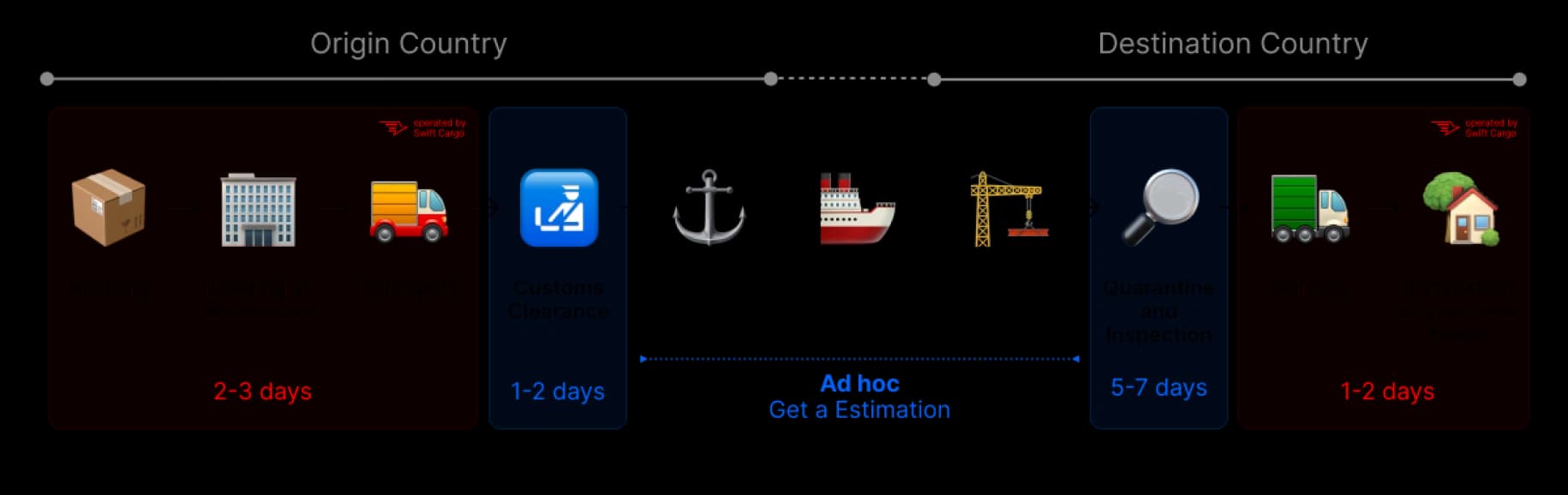
Documents usually needed for household-goods clearance from the UK to Canada
Requirements can vary by shipment and immigration status, but these documents are typically checked first:
- UK passport and Canadian immigration-status documents (confirmation of permanent residence, work permit, IEC, study permit, or other entry basis)
- BSF186 (Personal Effects Accounting Document) — declared on your first arrival in Canada; goods-to-follow are listed here
- BSF186A (continuation sheet) if your goods-to-follow inventory needs additional pages
- Detailed packing list — room-by-room, with item descriptions, quantities, and estimated values in CAD
- Bill of Lading (sea freight) or Air Waybill from your freight forwarder
- UK export customs declaration — handled by your forwarder at the UK origin port
- Proof of UK residence (UK tenancy agreement, utility bills, or employment records from the UK address)
- Canadian delivery address and consignee details
- Original purchase receipts or valuations for high-value items
Inspection, biosecurity, and restricted categories
CFIA (Canadian Food Inspection Agency) applies biosecurity rules to goods arriving from the UK as from any other origin. Common inspection triggers include:
- Soil-contaminated outdoor equipment, garden tools, bicycles, or camping gear — clean these thoroughly before packing
- Food, seeds, plant material, untreated wood packaging, and animal-origin products
- Alcohol, tobacco, and firearms — excluded from ordinary settler's effects treatment regardless of use
- New goods, commercial quantities, or items that look like stock rather than personal effects
If your goods are arriving after you
For UK-to-Canada sea freight moves, goods almost always arrive days or weeks after the owner enters Canada. This is the standard model, but it only works cleanly if you declare the later shipment properly at your first Canadian entry. The goods-to-follow list must match the inventory travelling by sea. A gap between what you declared on first arrival and what physically lands at the Canadian port is slower and more expensive to resolve after the fact than to prevent.
What you can import to Canada

Personal belongings

Used clothing

Household appliances

Fragile items

High-value items

Large items & furniture

Excess luggage

Pets
Rabies certificate unless from a rabies-free country

Vehicles
Non-US/Mexico cars must be 15+ years old
Products subject to restrictions in Canada

Plants, seeds & soil-related items

Food, supplements & consumables

Alcohol & tobacco products

Prescription & non-prescription medicines

Weapons, firearms & controlled items

Cannabis & CBD products
Banned even with medical authorisation

Used mattresses
Cleaning and fumigation certificate needed
Minimum shipment size for Canada
When shipping from the UK to Canada with Swift Cargo, minimum volume requirements apply to ensure efficient handling and delivery.
- Minimum shipment: 2 boxes
This is the smallest shipment size accepted for freight or relocation services from the UK to Canada.
- No maximum size limit
Swift Cargo can manage shipments of any size, from small personal moves to full household relocations.
For full household relocations from the UK, most families ship a 20ft or 40ft container. Single rooms or studio apartment contents typically ship as LCL (Less than Container Load) groupage, consolidated with other UK-to-Canada shipments at the UK origin port.
Key customs forms and guidance
Contact Canadian border guidance

Taxes and duties
For UK movers, the main tax questions are whether the shipment qualifies as settler's personal effects under CBSA rules, and whether goods of UK origin may benefit from preferential treatment under the UK-Canada Trade Continuity Agreement (CUKTCA). The CUKTCA provides tariff preferences for qualifying UK-origin goods — your customs broker can confirm which commodity codes apply to items in your shipment.
General tax rules
- Qualifying used household and personal effects may be eligible for relief from regular duties and taxes when properly declared as settler's or returning resident's effects on BSF186.
- New goods, replacement purchases, alcohol, tobacco, and other excluded categories can attract duty, GST/HST, excise, or other charges regardless of whether they originated in the UK.
Settler's-effects relief
- Settler's effects relief applies to goods owned and in personal use for at least six months before the move. British movers who have owned their household goods for years typically meet this threshold without difficulty.
- The core operational concept is goods to follow: if your UK shipment is arriving after you enter Canada, it should appear on the BSF186 goods-to-follow list at your first Canadian entry point.
Categories that need extra care
Even where settler's-effects relief applies, these categories require separate handling and should not be grouped into a generic household inventory:
- Alcohol and tobacco
- Firearms and weapons-related items
- New goods or items purchased shortly before shipping
- Commercial quantities or items that do not look like normal household effects
- UK-specification large appliances that will not function on Canada's 120V/60Hz supply
A UK-to-Canada file is usually stronger when the shipment separates qualifying used effects clearly from everything else. Items that blur the line — new electronics, unopened goods, duplicate appliances — are worth identifying before the container is packed, not after it arrives at Halifax or Vancouver.
If you are unsure whether an item belongs on your goods-to-follow list or should be declared separately, raise it before export. Resolving category questions after arrival is slower and more expensive than addressing them at origin.
Insuring your shipment
Trans-Atlantic sea freight from the UK to Canada covers a significant distance, and cargo insurance is strongly recommended for any household-goods shipment involving personal or valuable items.
Why you need cargo insurance
A UK-to-Canada sea voyage exposes your goods to risks during a long international transit.
- North Atlantic weather conditions, particularly during winter crossings
- Improper storage or handling at UK origin ports or Canadian receiving ports
- Customs inspection, container stripping, or quarantine treatment at Canadian port
- Accidental loss, breakage, or damage during loading, transit, or inland Canadian delivery
What is covered
Coverage depends on your policy terms. Most cargo insurance for UK-to-Canada household moves includes:
- Protection during sea or air transit between UK and Canadian ports
- Coverage for specific named risks such as fire, theft, or water damage
- Policy limits, exclusions, and conditions based on declared shipment value
Always review policy terms, exclusions, and declared values carefully with your broker or insurer before finalising coverage.
How to get insured by Swift Cargo
You can arrange cargo insurance for your UK-to-Canada shipment through:
- A general insurance company offering marine or cargo insurance
- A specialist cargo or relocation insurance broker
- Your bank or financial institution, where available
- Swift Cargo's own cargo insurance program.
Note: Our insurance is charged at 3% of your declared shipment value.
Visa and immigration options for British nationals moving to Canada
British nationals have a range of immigration pathways to Canada. The right route depends on your age, employment situation, whether you have a job offer, and how long you plan to stay. Requirements and program quotas change regularly, so always confirm current rules with Immigration, Refugees and Citizenship Canada (IRCC) before making relocation or shipping decisions.
Main immigration options for British nationals
The most common pathways for British nationals relocating to Canada:

eTA and visitor entry
British nationals do not need a visa for short visits to Canada (up to six months) but do need an Electronic Travel Authorization (eTA). An eTA is not a basis for shipping household goods or establishing long-term residence.
Work permits and IEC
The International Experience Canada (IEC) Working Holiday allows British nationals under 35 to live and work in Canada for up to two years. LMIA work permits apply for employer-sponsored roles where no qualified Canadian candidate is available.
Study permits
For formal education at a Canadian designated learning institution. Study permit holders can often work part-time during studies and may transition to post-graduation work permits.
Express Entry and family sponsorship
Express Entry manages federal skilled-worker permanent residence through a points-based system. Family sponsorship allows Canadian citizens or permanent residents to sponsor eligible British relatives for permanent residence.
Note: For long-term relocation and household-goods shipping, you need a qualifying permit or permanent residence — not just an eTA. Shipping goods as settler's effects requires confirmed immigration status.
For accurate and up-to-date requirements, always consult IRCC's official website before applying or finalising your relocation plans.
UK departure ports and Canadian arrival ports
UK household-goods shipments to Canada depart through a small number of specialist container and groupage ports, then arrive at one of Canada's major gateways before inland delivery by rail or truck. The UK origin port and Canadian arrival port you choose affects transit time, cost, and how straightforward the final delivery leg is.
Main UK departure and Canadian arrival ports
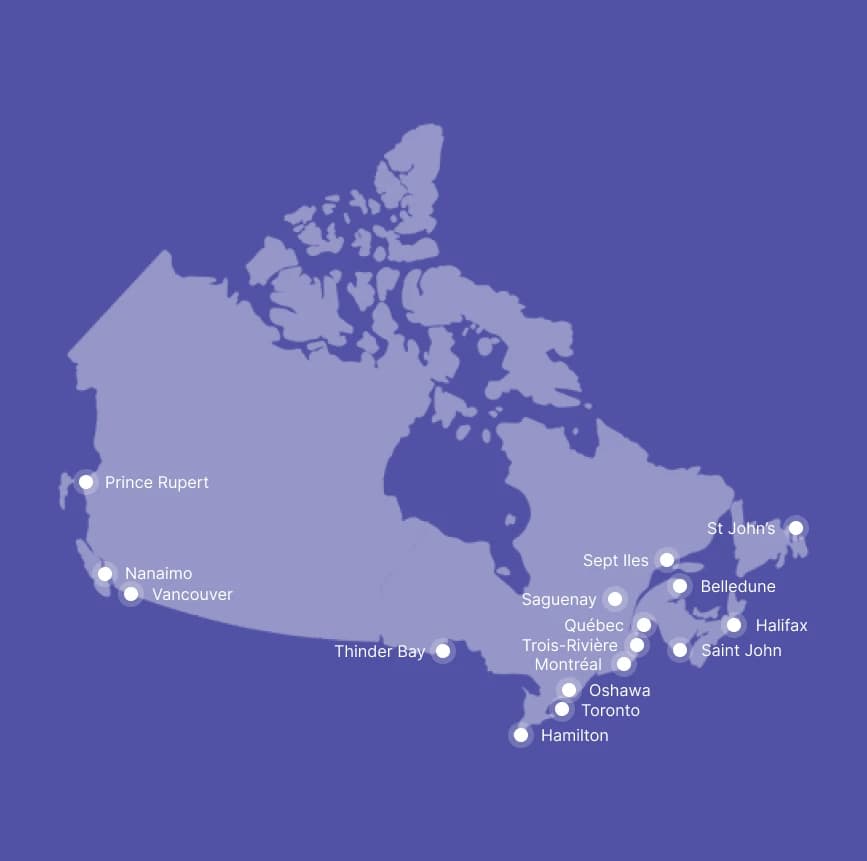
Main UK departure and Canadian arrival ports
- Felixstowe (Suffolk) – UK's largest container port, the primary option for east and southeast England. Most UK-to-Canada containerised shipments leave from here.
- Southampton – Major south-coast port handling significant household-goods and groupage traffic to Canada.
- Tilbury (London) – Thames-side container port used for London and home-counties collections.
- Liverpool – Preferred option for northwest England and the Midlands; reduces inland haulage for those regions.
- Grangemouth / Glasgow – Scottish origin port for northern UK collections, with regular services to Halifax.
- Port of Halifax – Canada's primary Atlantic gateway and the closest Canadian port to the UK. The most common arrival point for UK household-goods shipments.
- Port of Montreal – Key eastern entry point, particularly for Quebec and Ontario destinations.
- Port of Vancouver – West-coast gateway for BC destinations; transit times from UK are significantly longer than to Halifax.
- Toronto Pearson International Airport (YYZ) – Primary airfreight gateway for time-sensitive personal-effects shipments.
- London Heathrow (LHR) / Manchester (MAN) – UK airfreight departure options for air shipments to Canadian cities.
UK-to-Canada route timings
| From | To | Est. transit time |
|---|---|---|
| Felixstowe, UK | Halifax, Canada | 14-20 days |
| Felixstowe, UK | Montreal, Canada | 14-18 days |
| Southampton, UK | Halifax, Canada | 14-20 days |
| Liverpool, UK | Halifax, Canada | 12-18 days |
| Tilbury (London), UK | Montreal, Canada | 16-22 days |
| Grangemouth, Scotland | Halifax, Canada | 14-20 days |
| Felixstowe, UK | Vancouver, Canada | 26-32 days |
| Southampton, UK | Vancouver, Canada | 26-34 days |
Swift Cargo's door-to-door relocation service from the UK to Canada
Since 1999, we have managed all-inclusive relocation services for people moving from the UK to Canada. From collection at your UK address through export customs, trans-Atlantic sea freight, Canadian port clearance, and delivery to your new Canadian home — we manage every step so you can focus on the move itself.
1. Collection and packing at your UK address
Our UK team collects and packs your goods for international shipping. Professional packing materials include:
- Packing boxes
Available in different sizes and rated for international sea freight. - Bubble wrap
Used for fragile items — glassware, ceramics, and electronics — to minimise breakage risk during the North Atlantic crossing. - Wooden crates
For large, valuable, or structurally sensitive items that need reinforced protection over long distances.
2. UK export and port handling
We arrange UK export documentation, container loading at your UK origin port (Felixstowe, Southampton, Tilbury, Liverpool, or Grangemouth), and secure handoff to the vessel.
3. Trans-Atlantic sea freight and Canadian customs clearance
We book sea or air freight as agreed, track the container across the North Atlantic, and manage CBSA customs clearance at Halifax, Montreal, or Vancouver on arrival. Refer to the customs sections above for document requirements.
4. Delivery to your new Canadian home
Once the shipment clears CBSA, we coordinate inland delivery and final drop at your Canadian address.
5. Unpacking and setup
Our local delivery team places furniture and goods where you want them, so you can start settling in without the disruption of unpacking alone.
Support team
Swift Cargo's UK-to-Canada support is built around one contact: a dedicated Move Manager who handles your file from the initial quote through UK collection, export, sea transit, CBSA clearance, and Canadian delivery. You are not handed between teams at each stage.
For UK-to-Canada moves, that continuity matters because BSF186 and goods-to-follow paperwork must be consistent across every document in the file. Any gap between what you declared on first Canadian arrival and what physically lands at Halifax or Vancouver creates friction that costs more and takes longer to resolve after the fact. Having one accountable specialist who owns the full file is how that gets caught before it becomes a problem.
From UK origin collection through container loading at Felixstowe or Southampton, North Atlantic transit, CBSA clearance, port release, and final delivery to your Canadian address, your Move Manager stays in contact and updates you at each stage.
Talk to an agent now
Importing vehicles from the UK to Canada
Shipping a UK vehicle to Canada involves more complexity than a domestic car purchase. UK vehicles are right-hand drive — Canada drives on the right. Most Canadian provinces will not register a right-hand-drive vehicle for general road use, which means the majority of British movers sell their UK car before leaving rather than shipping it. If you intend to ship a vehicle, confirm its admissibility with Transport Canada and the Registrar of Imported Vehicles (RIV) before making any arrangements.
Vehicle import essentials from the UK

Vehicle import essentials from the UK
- Admissibility check
UK right-hand-drive vehicles are generally not admissible for Canadian road use. Confirm with Transport Canada before shipping. - Ownership and transport documents
UK V5C logbook, title, passport, and transport documents must all align. - Compliance and post-arrival requirements
Left-hand-drive vehicles from other markets that are admissible will still require RIV processing and provincial inspection.
Costs to expect
- Freight, handling, and destination charges at the UK export port and Canadian arrival port
- Any applicable duty, GST/HST, or regulatory fees depending on the vehicle and import basis
- RIV processing, inspection, and provincial registration costs after arrival where applicable
Moving from the UK to Canada with pets
UK pet owners moving to Canada benefit from the UK's disease-free status in many respects, but Canada's entry rules are specific and airline requirements add a separate layer. Dogs and cats are generally manageable, though the documentation and routing process requires advance planning — especially for cargo-hold travel.

Key pet-import requirements from the UK
- Rabies vaccination certificate
Canada requires valid rabies documentation for dogs entering from most origins. UK dogs must carry a current rabies vaccination certificate issued by a licensed veterinarian. - Health certificate
A health certificate issued within ten days of travel is typically required by the airline or carrier. - Microchip
An ISO 15-digit microchip is strongly recommended and required by some airlines for cargo-hold transport. - Airline and routing rules
Breed restrictions, seasonal embargoes on cargo-hold transport, and in-cabin size limits vary by carrier. Confirm both CFIA and carrier requirements before booking your flight or shipment.
Rated 4.87 by customers
Verified reviews from people who moved from the UK to Canada with Swift Cargo:
Preparing your move from the UK to Canada
Canada is a common destination for British movers — for work, study, family reunion, and long-term settlement. The two countries share a language, legal traditions, and some cultural expectations, but the practical realities of life in Canada differ from the UK in ways that affect how you plan and pack your shipment.
From a shipping perspective, Canada is generally predictable for British movers who prepare their CBSA file properly. The main operational challenges are not customs opacity but rather the inland delivery chain across a very large country, seasonal disruption in eastern Canada, and the appliance voltage difference that determines how much of your UK kitchen is worth shipping.
483,591
Estimated permanent immigrants gained by Canada in 2024
8.3 million
Immigrants living in Canada (23% of the population, 2021 Census)
CAD 3,000+
Average monthly cost of living for a single expat in Toronto or Vancouver
Cost of living: UK vs Canada
Canada's major cities — Toronto and Vancouver in particular — are expensive by any measure. One-bedroom rentals in city centres regularly exceed CAD 2,000–2,500 per month. In GBP terms, that is broadly comparable to equivalent London zones 2–3, but often higher than equivalent-sized UK regional cities like Manchester, Edinburgh, or Bristol. Montreal and Halifax are substantially more affordable, while Calgary sits in the middle range.
Groceries in Canada cost more than in the UK for most categories. Alcohol is significantly more expensive due to provincial liquor control boards. Utilities and broadband costs vary by province but are generally higher than UK equivalents. Transport costs depend heavily on whether you are in a walkable city centre — Toronto and Vancouver have reasonable transit options; many Canadian cities outside those two effectively require a car.
Salaries in Canadian skilled-worker roles are competitive in GBP terms, particularly in technology and healthcare. The practical consideration for shipment planning is housing: whether you have a confirmed Canadian address before your container departs the UK determines whether you will need temporary storage on arrival. Aligning the container's estimated arrival with a confirmed delivery address is the most important planning decision in the whole move.
Safety and day-to-day stability

Safety and day-to-day stability
Canada is consistently ranked among the safest major developed countries, with strong rule-of-law institutions, reliable property rights, and predictable administrative processes. For British movers, the overall character of day-to-day life in Canadian cities — policing, healthcare access, public services, legal certainty — is broadly familiar, though the specific mechanics differ from the UK.
From a customs planning standpoint, CBSA operates systematically. A well-prepared BSF186 declaration, a clean inventory, and a consistent goods-to-follow list produce predictable outcomes. This is worth noting for British movers now navigating a changed UK export environment post-Brexit.
Property rights and contracts in Canada are enforced under common-law frameworks comparable to England and Wales. For movers signing Canadian leases or buying property, the legal structure will feel largely familiar, though provincial landlord-tenant laws vary and differ from the Housing Acts framework most British tenants know.
Income and salary expectations
British professionals moving to Canada typically find salary levels competitive, particularly in technology, finance, healthcare, and skilled trades — the sectors that drive most employer-sponsored UK-to-Canada relocation. Mid-career software developers or data engineers in Toronto or Vancouver commonly earn CAD 90,000–130,000+. Healthcare professionals often move for improved working conditions alongside salary that compares favourably to NHS rates once provincial benefits are factored in.
British STEM workers are well-positioned for Canada's Express Entry system, which prioritises age, education, language proficiency, and work experience. An employer LMIA offer can significantly accelerate the process. Note that Canadian regulators assess credentials through provincial licensing bodies — confirm your specific qualification recognition pathway before relying on it in a job offer timeline.
Canada's 2026 immigration intake targets were reduced by approximately 25% compared to previous years, making permanent residence more competitive. Aligning your container's arrival with confirmed immigration status — rather than banking on approval by a target date — reduces the risk of your shipment arriving before you have a confirmed Canadian delivery address.
Tax environment: UK and Canadian obligations
Canada combines federal and provincial income taxes. Ontario and BC have mid-to-high combined rates; Alberta does levy provincial income tax, but its entry rate is lower than in many other provinces; Quebec has the highest provincial rate. For British movers, becoming a Canadian tax resident does not automatically extinguish UK tax obligations in the year of departure — HMRC's split-year treatment applies if you leave the UK mid-tax-year, and you may need to file a UK return for the departure year even after settling in Canada.
If you retain UK assets — property, bank accounts, ISA holdings — with a combined cost amount above CAD 100,000 after becoming a Canadian tax resident, you are required to file Form T1135 (Foreign Income Verification Statement) annually. This is a disclosure obligation, not an additional tax, but non-filing carries significant penalties. British movers who own UK property or have substantial pension savings should take cross-border tax advice before their first Canadian tax return. For property you already owned when you became resident, the cost amount is its fair market value on that date; for property acquired later, it is generally the adjusted cost base, not simply today's market value. Property you hold mainly for your own use does not count towards it, and interests in foreign pension or retirement plans are generally excluded. You are also exempt for the first tax year in which you become a Canadian resident, so the obligation starts the year after.
ISA accounts do not retain their UK tax-free status after you become a Canadian resident. Income and gains generated in an ISA after Canadian residency begins are generally taxable in Canada. UK State Pension payments can be received in Canada, but are not uprated annually unlike those paid within the UK and certain other countries — confirm the implications with HMRC's International Pension Centre before relying on this income in retirement planning.
Work and hiring market
Canada remains a significant destination for British skilled-worker migration, employer-sponsored relocation, and professional transitions. Express Entry manages federal skilled-worker permanent residence; provincial nomination programs allow provinces to target specific occupations. British professionals in technology, healthcare, engineering, and skilled trades are among the most in-demand categories in recent draws.
British nationals under 35 can access the IEC Working Holiday as a low-commitment first step — arriving without a job offer in hand, working legally for up to two years, and using the Canadian experience as a platform for Express Entry points or a PR-qualifying LMIA work permit. This is a common route for British movers who are uncertain about committing to permanent settlement before experiencing Canadian working life.
Quebec's labour market is distinct: French is the language of work under Loi 101, and immigration goes through the Quebec-Canada Accord rather than federal Express Entry. British movers going to Montreal should factor in French language requirements for certain sectors and the different provincial nomination pathway.
Infrastructure and services
Canada's provincial healthcare system (Medicare) is free at point of use for registered residents, comparable in that respect to the NHS. However, some provinces, British Columbia and Quebec among them, have a waiting period of up to three months before new residents are enrolled in provincial coverage. British movers should check their destination province's rules, which also turn on immigration status, and arrange private interim health insurance where a gap applies — GHIC does not apply in Canada. Dental, vision, and prescription drugs are not universally covered by provincial plans and often require private supplemental insurance.
Banking is straightforward. The major Canadian banks (RBC, TD, Scotiabank, BMO, CIBC) all offer newcomer packages designed for people arriving without a Canadian credit history. For large GBP-to-CAD transfers — savings, property sale proceeds, or deposit funds — specialist currency services like Wise typically offer substantially better rates than traditional bank wire transfers.
UK driving licences are generally accepted for an exchange period in most Canadian provinces without a full driving test. Ontario, BC, and Alberta typically allow a direct exchange from a full UK licence; Quebec requires a knowledge test. The exchange window varies by province — usually 60–90 days from arrival. Drive on the right in Canada from day one, even while using your UK licence.
Banking, currency, and GBP-to-CAD transfers
Canada uses the Canadian dollar (CAD). The GBP/CAD exchange rate has been broadly in the 1.65–1.80 range in recent years, though this can shift meaningfully over the course of a multi-month relocation plan. For British movers converting GBP savings to CAD — particularly for rental deposits, first-month costs, or a Canadian property purchase — the timing and method of the transfer can make a material difference.
Wise (formerly TransferWise) offers mid-market exchange rates with transparent fees and is widely used by British movers for GBP-to-CAD transfers. Traditional UK bank wire transfers to Canadian accounts are slower and typically less cost-efficient for personal transfers. If you are managing ongoing GBP income — UK rental income, pension payments, or investment distributions — a regular conversion service or a multi-currency account is worth setting up before you leave the UK.
CAD pricing for your shipment means freight quotes, Canadian port charges, inland delivery, and temporary storage are all priced in a currency that may shift against GBP between the time you book and the time you pay. For large moves where the final delivery cost is substantial, confirming the CAD total at the time of booking is worth clarifying upfront.
Climate: what to pack and what to buy in Canada

Climate: what to pack and what to buy in Canada
Canada's climate varies dramatically by city. Vancouver is mild and rainy from October to April, with summers reaching 25–28°C — British movers find it broadly comparable to a warmer version of the UK, though summer air conditioning becomes relevant. Toronto has proper winters (−10 to −20°C in January and February) and warm, humid summers. Montreal is similar to Toronto but with heavier snowfall. Calgary sees cold dry winters with Chinook warm spells.
Seasonality directly affects shipment timing. Winter deliveries in eastern Canada (November–February) face elevated risk of weather-related delays at ports, rail ramps, and on final-mile delivery routes. If your Canadian arrival is in winter, factor in that Halifax and Montreal port operations can be disrupted by ice conditions and that road delivery in January or February in Ontario or Quebec may be slower than estimated.
The most practically important climate decision for British movers is appliances. UK appliances run on 230V/50Hz. Canada runs on 120V/60Hz. Washing machines, dryers, ovens, refrigerators, and dishwashers will not run directly on Canadian power without a high-wattage transformer — expensive, large, and inefficient. For most British movers, the practical answer is to leave UK white goods behind and buy Canadian-specification appliances after arrival. This meaningfully reduces both the volume and cost of your shipment.
Frequently asked questions
Possibly, if your shipment qualifies as settler's personal effects and you declare it correctly on first Canadian arrival. The key steps are: declare goods to follow on BSF186 when you enter Canada, ensure the goods were owned and in personal use for at least six months before the move, and separate excluded categories (alcohol, tobacco, firearms, new goods) from the main settler's effects inventory.
Port-to-port transit from Felixstowe or Southampton to Halifax or Montreal is typically 14–20 days. To Vancouver, expect 26–32 days. Door-to-door timing adds UK collection time at origin and Canadian inland delivery after port clearance — which can add one to two weeks depending on your destination city and the season.
BSF186 is the CBSA Personal Effects Accounting Document. When you first enter Canada, you declare your personal effects here — including items that will ship later as goods to follow. For UK movers whose sea freight typically arrives weeks after they do, listing the shipment as goods to follow on BSF186 at first entry establishes the customs basis for the whole move. Failing to do this correctly is the most common source of customs complications for UK-to-Canada shipments.
Not directly. UK appliances run on 230V/50Hz. Canada uses 120V/60Hz. Large appliances — washing machines, dryers, ovens, refrigerators, dishwashers — will not function on Canadian power without a high-wattage transformer, which is expensive and inefficient. Most British movers leave UK white goods behind and buy Canadian-specification appliances after arrival. Small dual-voltage personal electronics (laptops, phone chargers) usually work fine with a plug adapter.
British nationals need a qualifying permit or permanent residence for long-term stays — not just an eTA. Options include the IEC Working Holiday (under 35, up to two years), employer-sponsored LMIA work permits, Express Entry permanent residence, study permits, and family sponsorship. An eTA allows entry for up to six months but does not permit household-goods imports on settler's-effects basis. Always confirm current requirements with IRCC before finalising your relocation plans.
Felixstowe is the most common choice for southeast England and handles the largest volume of UK-to-Canada containerised household-goods shipments. Southampton is a strong alternative for south-coast collections. Liverpool is typically more practical for northwest England and the Midlands. Grangemouth or Glasgow works well for Scottish collections. Your forwarder will route the collection vehicle to the most practical port based on your UK address and the service frequency to your Canadian destination.
This is usually not practical. UK cars are right-hand drive; Canada drives on the right, and most provinces will not register right-hand-drive vehicles for general road use. Even left-hand-drive vehicles imported from the UK must go through Transport Canada's admissibility check and the Registrar of Imported Vehicles (RIV) process. Most British movers sell their UK car before leaving and buy a Canadian-specification vehicle after arrival.
The CUKTCA provides preferential tariff treatment for goods of UK origin imported into Canada. For personal-effects shipments that qualify as settler's effects, the main CUKTCA relevance is confirming the correct origin and commodity codes on the export documentation. Your customs broker in Canada and your freight forwarder in the UK should coordinate on this for any items that might otherwise attract import duty.
The same categories that cause problems from any origin: undeclared food, seeds, plant material, soil-contaminated outdoor equipment, alcohol, tobacco, firearms, new goods, and duplicate appliances. For British movers specifically, garden tools (likely to have soil residue), camping gear, and any plant material from UK gardens should be cleaned thoroughly or left behind. Post-Brexit UK export paperwork needs to be consistent with the Canadian import declaration.
June to August is peak season for UK family moves. Vessel space tightens from Felixstowe and Southampton during this period, and booking 8–10 weeks ahead is advisable. January to March is a secondary peak for employer-sponsored moves. The quietest windows — with better availability and sometimes better rates — are typically October to November and April to May. Winter (December–February) adds weather-related risk to Halifax and Montreal delivery timing.
The UK-Canada social security agreement allows British nationals to receive UK State Pension payments in Canada — the pension can be paid directly to a Canadian bank account. However, UK State Pension paid to Canadian residents is not uprated annually unlike pensions paid within the UK and certain other countries. The amount you receive when you first claim becomes the fixed amount. This is worth factoring into retirement planning before you leave. HMRC's International Pension Centre handles overseas pension enquiries.
Swift Cargo manages the freight and logistics side of your move, but pet-specific entry requirements are governed by CFIA and must be arranged separately. UK dogs need a valid rabies vaccination certificate. A health certificate issued within ten days of travel is typically required by the airline. An ISO microchip is strongly recommended and required by some carriers for cargo-hold transport. Breed restrictions and seasonal cargo embargoes vary by airline. Cats require current vaccination records. Confirm both CFIA and carrier requirements before booking your flight or shipment.
UK licences are generally accepted for exchange in most Canadian provinces without a full driving test. Ontario, BC, and Alberta typically allow a direct exchange from a full UK licence. Quebec requires a knowledge test. The exchange window varies by province — usually 60–90 days from arrival before you must hold a provincial licence. Drive on the right in Canada from day one, even while using your UK licence. Check your specific destination province's rules before assuming you can drive immediately on arrival.
Detailed enough for a CBSA officer to understand the shipment without guessing. A room-by-room inventory identifying furniture, clothing, kitchenware, and electronics is far stronger than a generic household effects description. For high-value items, include estimated values in CAD and keep purchase receipts accessible. The packing list also needs to be consistent with the UK export declaration — a mismatch between what left the UK and what is declared on BSF186 creates friction that is avoidable with preparation.
Wise (formerly TransferWise) is widely used by British movers for GBP-to-CAD transfers and offers mid-market exchange rates with transparent fees. Traditional UK bank wire transfers are slower and typically less cost-efficient. For large transfers — property sale proceeds, savings, or deposit funds — compare rates at the time of transfer. If you have ongoing GBP income (UK rental income, pension payments), a multi-currency account or regular conversion service is worth setting up before you leave the UK.
Next steps
Next steps
Confirm your Canadian immigration status — settler's effects relief requires a qualifying permit or permanent residence, not just an eTA.
Decide which UK appliances are worth shipping given the 230V/50Hz to 120V/60Hz difference, and adjust your inventory accordingly.
Build a detailed, room-by-room packing list that separates used personal effects from new purchases and excluded categories.
Declare your goods to follow on BSF186 at your first Canadian entry point — this establishes the customs basis for your sea freight shipment.
Choose your UK origin port based on your collection address and the frequency of services to your Canadian destination city.