
Moving to France from Thailand, from $5,280
Request a free estimate in 60 seconds.
Guide to relocating from Thailand to France
Sea freight from Laem Chabang to Le Havre takes around 49–56 days on current sailings, which route around the Cape of Good Hope instead of through the Suez Canal; Marseille-Fos usually involves transhipment in Singapore and takes around 50–60 days. Air freight from Bangkok Suvarnabhumi to Paris CDG arrives in 1–2 days but costs significantly more and suits essentials only.
France allows duty-free import of personal effects (franchise de droits) for people moving their residence to France from outside the EU. To qualify, you must have been resident in Thailand for 12 or more consecutive months and owned the items for at least 6 months before the move date.
A valid French long-stay visa (VLS-TS or equivalent) must be in place before your household goods shipment arrives at a French port. The personal effects exemption requires proof of legal residence in France.
Importing a vehicle from Thailand to France is complex: Thai vehicles are right-hand drive, and a Thai-market model usually needs an individual approval (réception à titre isolé) through the DREAL before it can be registered, often with headlight modifications. Without transfer-of-residence relief, passenger cars pay 10% EU duty plus 20% TVA. Most relocating residents sell their Thailand vehicle and purchase in France.
Starting price for a full household move from Thailand to France is $5,280. Volume, packing requirements, customs complexity, and final delivery distance all affect the final figure.
Moving from Thailand to France involves coordinating Thai export clearance through the Thai Customs Department, a long sea freight transit that currently routes around the Cape of Good Hope, and French customs clearance at Le Havre or Marseille-Fos on arrival. The process requires careful sequencing: Thai export documentation must be filed before the container departs Laem Chabang, and the French franchise de droits exemption requires supporting documents to be prepared during transit.
Swift Cargo manages the full chain: packing and export wrapping at your Thailand address, Thai customs export declaration filing, sea freight booking with confirmed vessel schedules, pre-arrival French customs documentation preparation, DGDDI clearance at Le Havre or Marseille-Fos, and final delivery to your French address. A dedicated Move Manager follows the file from first quote to completed delivery.
This page covers what residents leaving Thailand actually need to know about this route: Thai export customs procedures, French import rules and the franchise de droits exemption, transit times from Laem Chabang, French visa requirements, vehicle and pet import rules, and what to expect from life in France in the aboutFrance section below.
French residents already familiar with the France-to-Thailand route will find the reverse process uses the same DGDDI and Thai Customs frameworks — the documentation logic runs in both directions.
Thai Export Customs for Residents Moving to France
Thailand does not charge export duty on personal effects. However, Thai Customs requires an export declaration for all outbound container shipments. Your freight forwarder files this declaration before the vessel departs Laem Chabang, and the document becomes part of the supporting evidence for the French franchise de droits exemption on arrival. The same Customs Department that processes inbound household goods to Thailand handles the export declaration, so the paperwork framework is consistent in both directions.
Certain items require special handling under Thai export rules. Antiques, Buddha images, and cultural artifacts require an export permit from the Thai Fine Arts Department (Krom Silpakorn) before departure. This permit must be obtained in advance; it cannot be arranged after the container is loaded. Swift Cargo's Thailand operations team identifies these items during the packing survey and initiates the permit process accordingly.
High-value items that were declared at Thai customs on original import must match the export declaration. Discrepancies between original import records and the outbound declaration can cause delays at the Laem Chabang Container Terminal. Accurate item descriptions and consistent valuations across all documentation reduce this risk.
The EU relief for a transfer of normal residence waives customs duty and VAT on your used personal belongings. You must have lived outside the EU for at least 12 months (the UK counts as outside since 2021), have owned and used the goods for at least 6 months before leaving, and bring them within 12 months of settling in France. The goods must have borne duty or tax abroad. Alcohol, tobacco, professional equipment (except portable instruments of a trade or liberal profession) and second-home goods are excluded, and you cannot sell, rent, lend or pledge the goods for 12 months.
- Thailand · before you file
Check for licensed objects
Antiques and art objects need a Fine Arts Department export licence: apply online, bring the objects for examination and pay the fee. State-owned antiques may not leave, and foreigners exporting a Buddha image use the department's English form. Wildlife items may need a National Parks, Wildlife and Plant Conservation Department permit; Customs lists CITES-listed wildlife among its examples of prohibited goods.
- Thailand · before the goods are loaded
File the export declaration
You or your agent send the export declaration (Customs Form กศก. 101/1) and an invoice for every item to Customs electronically, for air freight at least 6 hours before departure, with any export licence. Customs then releases it as Green Line or checks it first as Red Line.
- France · before you pack
Prepare the inventory and proof
Write a detailed, estimated, dated and signed inventory in two copies, with a sworn statement that the items are in use and have been yours for at least 6 months. Gather proof that you lived outside the EU for 12 months and are settling in France.
- France · before clearance
Complete form Cerfa 10070
Fill in Cerfa 10070*03 and hand it to customs with the inventory, your proof of residence and an ID copy for each family member who moves. The relief has to be requested before the goods are cleared.
- France · at customs clearance
Customs stamps the inventory
Customs hands back a stamped copy. Goods can arrive in one or several lots, but the first inventory must list everything you claim relief for. Goods that arrive before you settle need an undertaking to settle within six months and a guarantee. Alcohol, tobacco and other excluded goods pay duty and tax.
Documents You Need to Export Your Household Goods from Thailand
- Thai passport (valid)
- Valid Thai visa or residence permit confirming your legal presence in Thailand
- Completed Thai Customs export declaration form (filed by your freight forwarder)
- Packing list with full item descriptions and declared values in USD or EUR
- Bill of Lading or Air Waybill issued by the carrying vessel or airline
- Proof of Thai residence: rental lease agreement, work permit, or utility bills in your name
- Original purchase receipts for high-value electronics, watches, or jewellery
- Fine Arts Department export permit for any antiques, Buddha images, or cultural artefacts (if applicable)
French Customs Inspections and Clearance Delays
French customs at Le Havre and Marseille-Fos is administered by DGDDI (Direction Générale des Douanes et Droits Indirects). Containers arriving with household goods may be selected for physical inspection; this is a risk-based selection process rather than a routine check applied to all shipments.
Physical inspection typically adds 5–10 working days to the customs clearance timeline. Common triggers include: an inconsistent or vague packing list that does not match expected container contents, high-value items that appear undeclared or undervalued, CITES-listed biological materials (ivory, certain woods, animal products), and shipments where the franchise de droits documentation is incomplete or contradicts the declared move timeline.
Swift Cargo prepares all documentation in advance of vessel departure to minimise inspection risk. Your Move Manager reviews the packing list for potential flagging triggers before goods leave Thailand, and submits a complete pre-arrival customs package to DGDDI to support clearance on arrival.
What you can import to France

Personal belongings

Used clothing

Household appliances

Fragile items

High-value items

Large items & furniture

Excess luggage

Pets
EU pet rules; attack-type dogs banned

Vehicles
Customs certificate and French type approval required
Restricted and Prohibited Goods

Drug Contraband

Explosives

Biohazard

Chemicals

Corrosives

Counterfeit

Ivory

Batteries

Flammables

Firearms

Drugs

Hazardous

Meat & dairy products
Banned from outside the EU

Plants, seeds & soil-related items
Plant-health certificate required

Alcohol & tobacco products
No relocation relief; duty and excise payable
Minimum Shipment Size for France
There is no formal minimum volume for personal effects shipments to France. However, the economics of full container load (FCL) shipping typically apply when moving the contents of a complete home: a standard 20ft container holds the contents of a 2–3 bedroom apartment; a 40ft container suits a larger home. For smaller volumes, a shared container (LCL, Less than Container Load) groupage service from Laem Chabang is the more cost-effective option.
Swift Cargo offers both FCL and LCL options on the Thailand–France route. LCL shipments consolidate weekly from Laem Chabang. Cost-effective for volumes under 15 cubic metres. LCL transit times add 4–6 days to FCL estimates due to consolidation handling at origin and deconsolidation at Le Havre or Marseille-Fos.
Air freight is available for time-sensitive or high-priority items. From Bangkok Suvarnabhumi (BKK) or Don Mueang (DMK) to Paris CDG, air freight transit takes 1–2 days. Air freight is significantly more expensive than sea freight per kilogram and is best suited to essential items needed before your sea freight container arrives.
Download the Customs Forms
For Thai export documentation, visit the Thai Customs Department website (customs.go.th). For the French franchise de droits (personal effects exemption) declaration, the CERFA n°10070*03 form is required by DGDDI; it is published on Service-Public (formulaires.service-public.gouv.fr), and the French customs page on transfers of residence (douane.gouv.fr) links to it. Your Swift Cargo Move Manager provides completed form templates as part of the documentation package.
Contact Thai Customs

French Import Taxes and Duties on Household Goods
France allows duty-free import of personal effects under the franchise de droits exemption for people transferring their habitual residence to France from outside the EU. If the exemption conditions are met, no EU import duty and no French VAT (TVA) applies to qualifying household goods. If items fail the exemption criteria, they are assessed for duty and VAT individually.
The franchise de droits rests on Council Regulation (EC) No 1186/2009 (customs duty) and Council Directive 2009/132/EC (VAT). The exemption is claimed at the time of import by submitting the CERFA n°10070*03 form along with supporting documentation. French customs officers at Le Havre and Marseille-Fos assess the declaration and may request additional evidence.
General Import Tax Rules
For items that do not qualify for the franchise de droits exemption, EU import duties apply based on the HS (Harmonised System) code classification of each item. Most household goods attract EU import duty of 0–6.5%. Luxury goods, certain electronics, and items with specific HS classifications may attract higher rates. French VAT (TVA) at 20% applies to the combined CIF value (cost + insurance + freight) plus any applicable duty.
New goods in original packaging that arrive in the same shipment as used personal effects are assessed separately. Each item is evaluated against the exemption criteria; duty applies only to the non-qualifying portion. An accurate, itemised packing list distinguishing used from new items is therefore important to avoid over-assessment.
Personal Effects Exemption (Franchise de Droits)
The franchise de droits exemption requires the following conditions to be satisfied: (1) you were resident in Thailand for 12 or more consecutive months immediately before moving to France; (2) the goods were owned and in your personal use for at least 6 months before the move date; (3) the goods are for your personal use and not intended for commercial purposes; (4) your goods arrive within 12 months of establishing your residence in France. Proof of all four conditions must be submitted with the CERFA n°10070*03 declaration.
Once imported under the exemption, goods cannot be sold, lent, or pledged as security for at least 12 months from the date of import. If you dispose of qualifying items within this period, the exemption is reversed and duty and VAT become payable. French customs can audit exemption claims for up to 3 years after import.
Duty-Free Categories for Qualifying Moves
Categories typically cleared duty-free under the franchise de droits exemption include: clothing and personal items (used), household furniture (used), kitchen equipment and appliances (used), personal electronics such as laptops and cameras (used, with documentation), books and personal documents, bicycles, and household decorations in personal quantities.
Items excluded from the franchise de droits exemption include: new goods still in original packaging, commercial quantities of any item, and all alcohol and tobacco products regardless of quantity. Motor vehicles can qualify for the exemption under the same residence and ownership conditions, but still require French customs certificate 846 A and proof of conformity before registration.
Mixed shipments containing both qualifying used personal effects and non-qualifying new goods are assessed item by item. Duty applies only to the non-qualifying items. An accurate, itemised packing list with clear descriptions and condition notes (used/new) prevents over-assessment at Le Havre or Marseille-Fos and supports any queries raised by DGDDI.
Import Your Vehicle to France
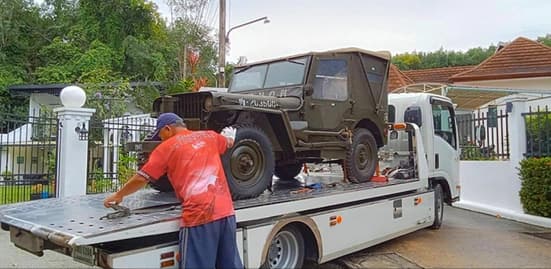
Importing a vehicle from Thailand to France is technically possible but carries significant complexity and cost. Thai-registered vehicles are right-hand drive. France does not require conversion to left-hand drive, but a vehicle built for the Thai market rarely has a European Certificate of Conformity (CoC), so it needs an individual approval (réception à titre isolé) through the regional DREAL before registration, typically including headlight adaptation for right-hand traffic. This is rarely economically viable for standard vehicles. European-market vehicles previously exported to Thailand face fewer technical issues but still require individual approval if a CoC is not available.
For most residents relocating from Thailand to France, the practical outcome is to sell the Thailand vehicle locally and purchase a vehicle in France after arrival. The exception is high-value, collector, or specialist vehicles where the personal and monetary value justifies the cost and administrative burden of the import and homologation process.
What You Need
What You Need
- Thai vehicle registration document (สมุดคู่มือการจดทะเบียนรถ)
- Certificate of origin for the vehicle
- Chassis number and VIN documentation
- Export declaration from Thai Customs
- European Certificate of Conformity (CoC) if the vehicle was originally manufactured for the EU market
- DREAL (Direction Régionale de l'Environnement, de l'Aménagement et du Logement) approval or UTAC homologation certificate for non-EU-type vehicles
- French insurance certificate valid before vehicle registration is completed
Costs to Expect
Homologation / EU type approval: €1,500–€5,000 for standard passenger vehicles with a valid CoC. Vehicles without CoC requiring full individual homologation via UTAC can cost significantly more, depending on the technical modifications required to meet EU safety and emissions standards.
Import duty and TVA: If the vehicle does not qualify for transfer-of-residence relief, EU import duty on passenger cars is 10% of the CIF value (cost + insurance + freight); pickups and other goods vehicles are classified separately and can carry a different rate. No EU-Thailand free trade agreement is in force, so no preferential tariff rate applies. French TVA (VAT) at 20% applies on the combined CIF value plus import duty.
Carte grise (French vehicle registration): Cost varies by region and is calculated based on the vehicle's CO2 emissions and fiscal power (CV fiscaux). Regional council taxes and ANTS processing fees apply. Budget €200–€1,500+ depending on region and vehicle.
Import Your Pets to France
France is an EU member state. Pet import from Thailand, which is not on the EU list of third countries exempt from rabies antibody testing, follows the EU rules for non-commercial movements that replaced Regulation 576/2013 in April 2026. Dogs and cats must have an ISO-standard microchip, a valid rabies vaccination given on or after the day the microchip was implanted, and an EU animal health certificate issued by an official veterinarian of the Thai Department of Livestock Development (DLD) no more than 10 days before arrival in the EU.
Because Thailand is not on that list, a rabies antibody titre test is also required. The blood sample must be taken at least 30 days after vaccination and show a result of at least 0.5 IU/mL at an EU-approved laboratory, and the EU health certificate can only be issued at least 3 months after the sample date. This 3-month waiting period is the most common source of delays in pet relocation planning from Thailand. No quarantine period applies if all requirements are met on arrival.

Key Requirements for Pet Import to France
- ISO 15-digit microchip implanted before or at the same time as the rabies vaccination
- Rabies vaccination given on or after the day of microchipping, at least 21 days before travel, and still valid on the manufacturer's schedule at entry
- Rabies antibody titre test (minimum 0.5 IU/mL) at an EU-approved laboratory, on a blood sample taken at least 30 days after vaccination and at least 3 months before the health certificate is issued
- EU animal health certificate for non-commercial movement, issued by an official Thai veterinarian (DLD) no more than 10 days before arrival in the EU
- Animal passport or equivalent health document approved for EU entry
- IATA-compliant travel crate meeting the airline's live animal transport requirements
- Arrival through a travellers' point of entry designated for pet checks in France, such as Paris CDG; confirm the entry airport with your airline before booking
Shipping Ports and Routes
The origin port for Thailand-to-France household moves is Laem Chabang (LCB), Thailand's main deep-water container port, located 130 km south of Bangkok in Chonburi Province. Laem Chabang is directly served by all major Asia-Europe mainline carriers and handles the majority of export container shipments from the Bangkok metropolitan area.
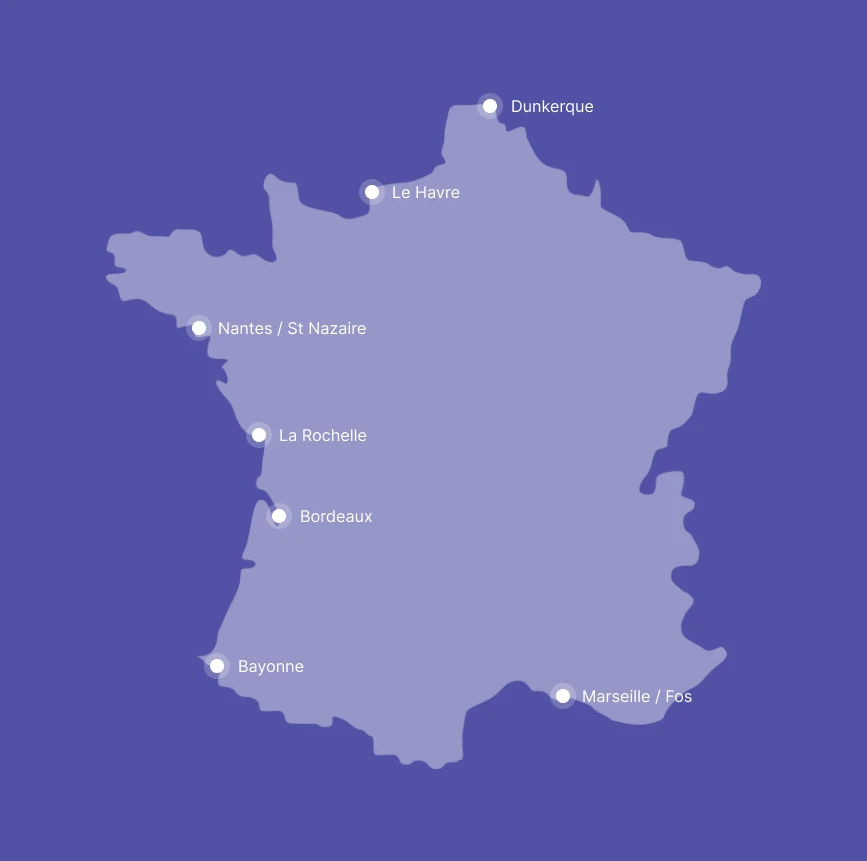
Destination ports are Le Havre, France's primary container gateway on the Normandy coast in northern France, and Marseille-Fos, France's main Mediterranean container port in southern France. Both are major EU container hubs with direct mainline services from Southeast Asia on the Asia-Europe trade lane.
Shipping Methods from Thailand
From Laem Chabang, mainline vessel services operated by carriers including CMA CGM, MSC, Hapag-Lloyd, and Evergreen run on the Asia-Europe trade lane. Since 2024 most of these services have routed around the Cape of Good Hope rather than through the Suez Canal, and only some services returned to Suez in 2026. On a published June 2026 schedule, Laem Chabang to Le Havre is 49 days; Marseille-Fos usually involves transhipment in Singapore and takes around 50–60 days. Sailings depart several times per week; routing and vessel schedules are confirmed at booking.
LCL groupage from Bangkok consolidates weekly from Laem Chabang with other customers' shipments, making it cost-effective for volumes under 15 cubic metres — typically the equivalent of a 1–2 bedroom apartment. LCL adds 4–6 days to FCL transit times due to consolidation at origin and deconsolidation at the destination port.
Air freight from Bangkok Suvarnabhumi (BKK) or Don Mueang (DMK) to Paris CDG takes 1–2 days. Best suited to urgent items, time-sensitive essentials, or high-value items that are not practical to ship by sea. Air freight is priced per kilogram and is significantly more expensive than sea freight for equivalent volumes.
Transit Times: Thailand to France
| From | To | Est. Transit Time |
|---|---|---|
| Bangkok (Laem Chabang Port) | Le Havre, France | 49–56 days |
| Bangkok (Laem Chabang Port) | Marseille-Fos, France | 50–60 days |
| Bangkok (Suvarnabhumi) | Paris CDG | 1–2 days |
Peak Moving Season
Thailand-to-France household moves peak in January through March, when expat postings end and families begin planning for the September school year start in France — typically 6–8 months ahead. A second peak runs June through August, driven by corporate rotation season and families targeting a September arrival to align with the French academic calendar. Vessel space on the Asia-Europe route tightens during these windows; booking 8–10 weeks ahead is advisable. Avoid scheduling delivery in July and August if possible: France's grandes vacances slows customs, tradespeople, and building services, creating delivery delays of 2–4 weeks in many destinations.
French Visa Requirements for Thailand Residents
EU nationals, including those from EU member states living in Thailand, do not need a visa to reside in France. Non-EU nationals require a long-stay visa (visa de long séjour, VLS-TS or VLS-T) from the French Embassy or a French consulate in Thailand before departure. The French Embassy in Bangkok is located at 35 Custom House Lane, Bang Rak. Processing typically takes 2–3 weeks from the date of a complete application submission.
A valid French long-stay visa must be in place before your household goods shipment arrives at a French port. The franchise de droits personal effects exemption requires proof of legal residence in France; a shipment arriving before the visa is confirmed may be cleared under standard duty and TVA rules rather than the exemption, resulting in unexpected tax exposure.
Main French Visa Categories for Long-Term Stays
Thailand residents relocating to France long-term use one of the following visa or permit categories:

Long-Stay Visa (VLS-TS)
For employment, family, retirement, or personal reasons. Valid for 12 months and renewable as a titre de séjour. Requires validation through OFII (Office Français de l'Immigration et de l'Intégration) within 3 months of arrival. Forms the basis of ongoing legal residence in France.
Passeport Talent
For highly skilled employees, entrepreneurs, investors, researchers, and international company transferees. Valid for up to 4 years and renewable. Covers eight sub-categories and offers a faster administrative track than a standard work permit.
Family Reunification Visa
For spouses and dependants of French nationals or EU citizens established in France. Non-EU nationals may also qualify via the regroupement familial pathway if an established resident in France applies on their behalf.
Student / Campus France Visa
For those enrolled in French higher education or language schools. Requires Campus France registration for most non-EU nationalities. Available as VLS-TS étudiant; permits part-time work in France alongside studies.
Note: A valid French long-stay visa must be in place before your household goods shipment arrives at a French port. The personal effects exemption requires proof of legal residence in France.
For current application requirements, visit the France-Visas official portal.
Frequently Asked Questions (FAQ)
Shipping household goods from Thailand to France starts at $5,280. This covers packing at your Thailand address, sea freight from Laem Chabang to Le Havre or Marseille-Fos, Thai export customs filing, French customs clearance, and door-to-door delivery in France. The final cost depends on volume, packing complexity, whether FCL or LCL is used, French customs exemption eligibility, and your delivery address in France. Request a quote with your inventory details and move date to receive a fixed-price figure.
Sea freight from Laem Chabang to Le Havre takes around 49–56 days on current sailings, which route around the Cape of Good Hope rather than through the Suez Canal. Marseille-Fos usually involves transhipment in Singapore and takes around 50–60 days. Add 3–5 days for packing, container loading, and Thai export customs filing at the origin end, and 5–10 working days for French customs clearance and delivery at the destination end. Total door-to-door time is typically 8–12 weeks. Air freight from Bangkok Suvarnabhumi to Paris CDG takes 1–2 days.
The franchise de droits is a French customs exemption that allows people transferring their habitual residence to France from outside the EU to import their household goods without paying EU import duty or French TVA (VAT at 20%). To qualify, you must have been resident in Thailand for 12 or more consecutive months, owned and personally used the goods for at least 6 months before the move date, and import the goods within 12 months of establishing French residence. The CERFA n°10070*03 form is submitted to DGDDI at the time of import. Goods imported under the exemption cannot be sold, lent, or pledged for 12 months after import.
A valid French long-stay visa must be in place before your household goods shipment arrives at Le Havre or Marseille-Fos. For most non-EU nationals, this means a VLS-TS (visa de long séjour valant titre de séjour) in the appropriate category: work, family, retirement, student, or Passeport Talent. The franchise de droits personal effects exemption requires proof of legal residence in France; a shipment arriving before your visa is confirmed risks being assessed for standard duty and TVA. Apply through the French Embassy in Bangkok at least 4–6 weeks before your planned departure from Thailand.
Not if you qualify for the franchise de droits exemption. If you have been resident in Thailand for 12 or more consecutive months and your goods were owned and in personal use for at least 6 months before the move, qualifying used household goods are imported duty-free with no French TVA. New goods in original packaging, commercial quantities, and all alcohol and tobacco regardless of quantity do not qualify and are assessed for EU import duty (typically 0–6.5% depending on the item) plus 20% TVA on the combined CIF value plus duty.
Technically yes, but it is rarely practical or cost-effective for standard vehicles. Thai-registered vehicles are right-hand drive. France does not require conversion to left-hand drive, but a Thai-market vehicle without a European Certificate of Conformity needs an individual approval (réception à titre isolé) through the DREAL before registration, usually with headlight changes, and the cost can approach the vehicle's value. A vehicle owned and used for at least 6 months can qualify for transfer-of-residence relief; otherwise EU import duty on passenger cars is 10% of CIF value, plus 20% TVA. Most residents relocating from Thailand to France sell their vehicle locally and purchase in France. The main exception is high-value or collector vehicles.
Because Thailand is not on the EU list of third countries exempt from rabies antibody testing, the process involves additional steps. Your pet needs an ISO microchip, a rabies vaccination given after the microchip, and a rabies antibody titre test showing at least 0.5 IU/mL at an EU-approved laboratory. The blood sample must be taken at least 30 days after vaccination, and the EU health certificate can only be issued at least 3 months after that sample, so planning well in advance is essential. The certificate is issued by an official Thai veterinarian no more than 10 days before arrival in the EU, and your pet must enter through a travellers' point of entry designated for pet checks, such as Paris CDG. No quarantine applies if all requirements are met.
Thai Customs requires an export declaration for all outbound container shipments. Your freight forwarder files this declaration on your behalf before the vessel departs Laem Chabang. The declaration requires a detailed packing list with item descriptions and values, your passport, proof of Thai residence, and the Bill of Lading. If your shipment includes antiques, Buddha images, or cultural artefacts, a separate export permit from the Thai Fine Arts Department must also be obtained before the container is loaded. Swift Cargo files all Thai export documentation as part of the standard service.
FCL (Full Container Load) means your goods fill an entire 20ft or 40ft container that travels exclusively as your shipment from Laem Chabang to France. LCL (Less than Container Load) means your goods share a container with other customers' shipments, consolidated at Laem Chabang and deconsolidated on arrival. FCL is more cost-effective above approximately 15 cubic metres — typically a 2+ bedroom home. LCL suits studios and 1-bedroom apartments. LCL adds 4–6 days to transit time due to consolidation and deconsolidation handling at both ends.
Yes. Once your container is loaded and the Bill of Lading is issued, your Move Manager provides tracking information and regular milestone updates: departure from Laem Chabang, confirmation of the vessel's routing (Cape of Good Hope or Suez Canal), estimated arrival at Le Havre or Marseille-Fos, French customs clearance status, and delivery confirmation. You can also contact your Move Manager directly at any point during transit for a status update.
Yes. Swift Cargo provides full professional packing at your Thailand address, whether in Bangkok, Chiang Mai, Phuket, or elsewhere. Our teams use export-grade materials including double-wall cartons, foam wrap, bubble wrap, and custom wooden crating for fragile or high-value items. A detailed, itemised packing list is produced at the time of packing; this list forms the basis of the Thai export declaration, the Bill of Lading description, and the French franchise de droits customs submission. Partial packing services are also available.
You can request a quote online or via WhatsApp. Provide your Thai city of origin, your destination city or region in France, an estimate of your volume (number of rooms or approximate cubic metres), and your target move date. A Move Manager will follow up within 24 hours with a detailed, fixed-price quote covering packing, sea freight, Thai and French customs, and door-to-door delivery. For larger or more complex moves, a video walkthrough or in-home survey can be arranged at no cost.
Prepare your move to France
France cost of living
The real France budget shock for many movers is not groceries or coffee. It is the combination of housing deposits, short-term accommodation, staged delivery costs, and the cash buffer needed while paperwork and household setup overlap.
Paris and close-in suburbs can punish bad planning quickly, especially if your shipment arrives before you have a workable address, building access rules, or enough room to receive it. In secondary cities, the pressure often shifts from rent to timing and local service availability.
If you are arriving from outside the EU, treat customs-adjacent costs as part of the living-cost conversation. Storage, inspection delays, extra document work, or non-exempt tax exposure can distort the first-month budget far more than routine supermarket prices.
The useful planning question is not 'Is France expensive?' but 'What will my first 60 to 90 days cost once housing, delivery, admin setup, and temporary inefficiencies are included?' That is the version that actually helps a relocation decision.
The best-prepared movers separate steady-state living costs from arrival friction. France becomes much easier to budget when you price the move-in phase honestly instead of pretending the monthly rhythm starts on day one.
Security in France

Security in France
For most expats, France is less a security problem than an awareness problem. The majority of avoidable issues are not dramatic crimes but predictable petty theft patterns around stations, dense tourist corridors, and distracted arrivals carrying documents or electronics.
From a relocation perspective, the more important security question is often where you land, how you move through the city during the first weeks, and whether your building, parking, and delivery access are sensible for a newly arrived household.
Good France relocation advice should therefore go beyond 'stay alert.' It should push people to think about neighbourhood fit, arrival routines, and the practical vulnerability of the first month, when you are still learning the city and handling move-related admin.
Salaries and income tax in France
France uses a progressive income tax (impôt sur le revenu) with rates from 0% to 45% across five brackets. Tax residency is established when France is your primary place of residence, your main professional activity is in France, or your centre of economic interests is in France.
For expatriate employees, the impatriation regime (régime d'impatriation) introduced by the Finance Act 2004 and updated since allows a partial exemption on expatriate allowances and foreign-sourced income for up to 8 years. This applies to employees recruited abroad to work in France — not to those already in France who change employers.
Income tax bands applied in 2026 to 2025 income (per household share):
- Up to €11,600: 0%
- €11,601 to €29,579: 11%
- €29,580 to €84,577: 30%
- €84,578 to €181,917: 41%
- Above €181,917: 45%
Double taxation and fiscal residency in France
France has double taxation agreements (conventions fiscales) with over 120 countries. The France-Thailand DTA, France-UK DTA, and France-USA DTA cover the most common origins for this route.
If you move to France from Thailand and previously earned income in another country, your exit from that country's tax system determines the timeline. France then taxes your worldwide income from the date you become French tax resident.
The exit tax (exit taxation) applies if you hold company shares worth over €800,000 when you leave France after at least six of the previous ten years as a French tax resident — relevant mainly for those planning a subsequent move out.
Key fiscal residency tests (one is sufficient):
- Your foyer (habitual home) is in France
- Your main professional activity is in France
- Your centre of economic interests is in France
- You spend more than 183 days per year in France
Working in France: visas, permits, and the job market
EU nationals have the right to work in France without a work permit. Non-EU nationals require a work permit tied to a specific employer, applied for by the employer through the DREETS (Direction Régionale de l'Économie, de l'Emploi, du Travail et des Solidarités).
The Passeport Talent visa category covers eight sub-types including highly-skilled employees, investors, founders, researchers, and international company employees. It allows up to 4 years residency and a faster administrative path than a standard work permit.
Paris is France's dominant employment hub with particular strength in finance, fashion and luxury goods, technology, media, and international organisations (OECD, UNESCO, ICC). Lyon has a significant life sciences and manufacturing cluster. Bordeaux is growing as a tech hub attracting companies from Paris and London.
Common work visa categories for non-EU nationals:
- Passeport Talent — Salarié qualifié (for employer-sponsored highly skilled)
- Passeport Talent — Créateur d'entreprise (for entrepreneurs)
- Passeport Talent — Investisseur économique (for investors)
- ICT (Intra-Company Transfer) permit for multinational secondments
- Working Holiday (PVT) for nationals of countries with bilateral agreements
Infrastructure and public services in France
France has strong infrastructure, but the relocation experience depends on how well your housing choice lines up with work, school, and admin reality. A beautiful arrondissement or suburb can still become a poor relocation decision if daily logistics are awkward.
For families, school catchment, childcare availability, and commute structure often matter more than generic rankings. For professionals, the critical issue is whether the address you choose makes the first months simpler or more administrative.
Healthcare quality is a genuine strength, but new arrivals should think in process terms: registration, temporary coverage gaps, document readiness, and how quickly they can move from 'eligible' to 'usable' in practice.
The most valuable France guidance is therefore not broad praise for public services. It is showing how schools, healthcare, transport, and local admin affect the actual move plan and the first quarter after arrival.
Banking and money in France
France is a Eurozone country. All banking is in EUR and Eurozone wire transfers (SEPA) are low-cost and same-day or next-day. International wire transfers use SWIFT.
Opening a French bank account as a new resident requires proof of address (a rental lease or utility bill in your name), your passport, and your titre de séjour or visa. Société Générale, BNP Paribas, and Crédit Agricole are the three largest retail banks. Online banks (Boursorama, N26, Revolut) are faster to open and widely used by expats as a bridge account until a main account is established.
Wise is fully functional in France for EUR to/from THB, USD, GBP, and most major currencies. Revolut and N26 are EU-regulated and available in France with IBAN accounts. Neither counts as a traditional French bank account for most landlord credit checks — a Boursorama or La Banque Postale account typically satisfies landlord requirements.
What you need to open a French bank account:
- Valid passport
- Titre de séjour or long-stay visa (VLS-TS)
- Proof of French address (rental lease, utility bill, host letter)
- Some banks require proof of income or employment contract
Climate and best time to move to France
Climate and best time to move to France
France has significant regional climate variation. Paris and northern France have a temperate oceanic climate — mild, often overcast, with rain distributed evenly through the year. Summers are warm (22–25°C), winters are cool (3–8°C) but rarely extreme. The Mistral wind affects Provence and the Rhône valley — strong, dry, and cold in winter.
The Mediterranean coast (Nice, Marseille, Montpellier) has hot, dry summers (25–32°C) and mild winters (8–14°C). This is the climate most lifestyle movers from warmer countries find easiest to adapt to — though it represents a significant adjustment from Thailand's tropical heat.
The best months for a household goods move to France are April through June and September through October — before the summer transport peak and outside the winter slowdown. Avoid moving in July and August if possible: French infrastructure slows significantly during the grandes vacances, and French tradespeople and customs agents take extended leave.
Seasonal considerations for moving to France:
- April–June: best window — good weather, no summer backlog
- July–August: grandes vacances — avoid if possible; 2–4 week delays common
- September–October: second-best window, autumn weather, manageable customs
- November–March: slower, cheaper, but wet weather can affect last-mile delivery
Door-to-Door Relocation Service
Swift Cargo's door-to-door service for Thailand-to-France moves covers every stage of the relocation from your address in Thailand to your front door in France. The process runs as follows:
- Home survey and quote: A Move Manager assesses your volume via video walkthrough or in-person visit, confirms packing requirements, and produces a fixed-price quote covering packing, sea freight, Thai export customs, French import customs, and door-to-door delivery.
- Export packing at your Thailand address: Our packing team attends your Bangkok or provincial address. All items are wrapped using export-grade materials, inventoried in full, and packed into export cartons or wooden crates. A detailed packing list is produced; this becomes the core customs declaration document.
- Thai export clearance: Swift Cargo files the Thai Customs export declaration on your behalf before the container is loaded at Laem Chabang. Antiques and cultural items requiring Fine Arts Department permits are flagged and processed during this stage.
- Sea freight transit from Laem Chabang: Your container is booked onto a confirmed Asia-Europe mainline vessel. A Bill of Lading is issued with vessel name, voyage number, and estimated arrival date at Le Havre or Marseille-Fos. Transit time is around 49–56 days to Le Havre on current Cape of Good Hope routings, and around 50–60 days to Marseille-Fos where transhipment applies.
- Pre-arrival French customs preparation: While your goods are in transit, your Move Manager prepares the complete franchise de droits documentation package: CERFA n°10070*03, itemised packing list, Bill of Lading, proof of prior Thailand residence, and copies of your French visa and passport. This is submitted to DGDDI in advance of vessel arrival.
- French customs clearance at Le Havre or Marseille-Fos: Swift Cargo's French customs broker files the import declaration with DGDDI, submits the franchise de droits exemption claim, and manages any inspection or additional documentation requests.
- Final delivery to your French address: Once customs-cleared, your container is transported to your French address. Our delivery team unloads, unpacks, and places items as directed, and removes all packing materials.
Rated 4.87 by customers
What Our Customers Say — Thailand to France Moves
Checklist for your Thailand to France relocation
Checklist for your Thailand to France relocation
Request a Swift Cargo quote at least 8–10 weeks before your target move date, providing your Thailand origin address, French destination, estimated volume, and move timeline.
Apply for your French long-stay visa at the French Embassy in Bangkok well ahead of your planned departure — processing takes 2–3 weeks and the visa must be in place before your goods arrive in France.
Confirm Thai export customs requirements with your Move Manager: ensure any antiques, Buddha images, or cultural artefacts requiring Fine Arts Department export permits are identified during the packing survey.
Arrange professional packing at your Thailand address: your Move Manager coordinates the packing team and produces the itemised inventory that underpins both the Thai export declaration and the French franchise de droits exemption claim.
Your container departs Laem Chabang for a sea transit of around 7–8 weeks, currently routed around the Cape of Good Hope; during this period your Move Manager prepares the complete French customs pre-arrival documentation package.
French customs clearance at Le Havre or Marseille-Fos: Swift Cargo's French customs broker submits the franchise de droits declaration and manages any DGDDI inspection or documentation requests.
Final delivery to your French address: our delivery team completes unloading, unpacking, and placement, and removes all packing materials so you can begin settling in.