
Move to Dubai without costly delays or hidden charges
Swift Cargo is rated 4.87 by 25k+ customers.
Planning a move to Dubai?
Moving to Dubai: customs, shipping times & visa support
Ship household goods to Dubai from major ports with door-to-door delivery in 8–12 days (sea freight).
UAE customs allows duty-free import of used personal effects if properly documented and in reasonable quantities for personal use.
Visa types (employment, business, investor, golden visa) determine timing and documentation requirements.
Restricted items: alcohol (prohibited), certain medications, weapons, and some food items. Check local regulations.
Starting from AED 7,100 for LCL (less-than-container load). Includes customs bond, clearance, and delivery.
Dubai is a well-structured destination with clear customs procedures, but timing your visa approval with shipment arrival is critical. Planning ahead, or working with an experienced relocation partner, keeps your documentation and timing aligned so goods clear customs without hold-ups.
This guide covers the essentials: UAE customs regulations, required documentation, visa alignment, restricted goods, and realistic timelines. We'll show you step-by-step what to expect and how to avoid delays.
Swift Cargo has 26+ years of relocation experience with 21,000+ international shipments completed. We manage every detail so you can focus on your Dubai move with confidence.
Our import process
We build Dubai moves around the paperwork first, then the freight mode, then clearance timing, so your shipment reaches Jebel Ali with the file already complete.
Peak Months
October to March is the busiest season for relocations to Dubai (cooler weather drives inbound moves). April to September typically has shorter wait times but still reliable service.
UAE Customs for Your Dubai Move
UAE customs is efficient but requires proper documentation and timing. Used personal effects are generally allowed duty-free, but only if you follow the rules.
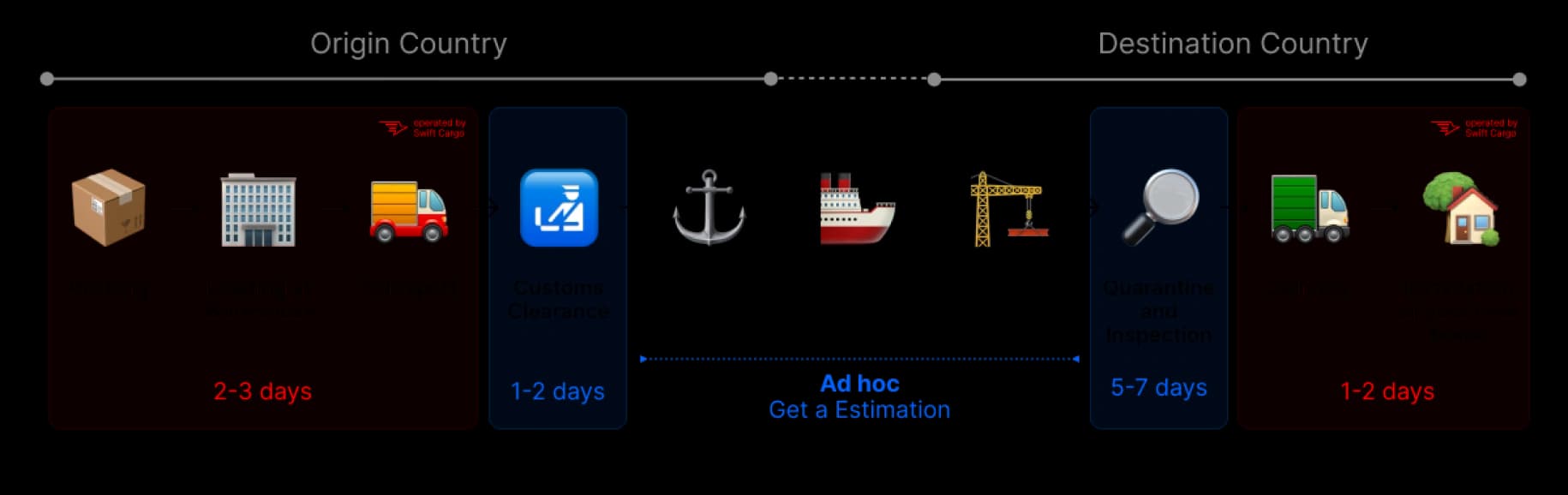
Documents You Need
A detailed inventory list, packing list, passport copy, visa approval/stamped passport, and air waybill or bill of lading. Declarations for electronics and valuables may also be required.
Inspections and Delays
Most shipments clear in 24–48 hours. Inspections are rare for household goods if documentation is correct. Heavy scrutiny applies to items on the restricted list.
For travellers entering the UAE by sea or air
Your used-effects claim clears more easily when your residency visa, your arrival date, and your shipment paperwork agree with each other. If the cargo travels unaccompanied, check that the timeline still fits the Dubai Customs window before the container reaches Jebel Ali.
What you can import to Dubai

Personal belongings

Used clothing

Household appliances

Fragile items

High-value items

Large items & furniture

Excess luggage

Pets
Import permit; max 2 pets; some breeds banned

Vehicles
5% duty, GCC specs and inspection required
Restricted and Prohibited Goods

Plants, seeds, and soil-related items

Food, supplements, and consumables

Alcohol & tobacco products
Needs Dubai Police approval; duty payable

Prescription and non-prescription medicines

Weapons, firearms, and controlled items

Drug Contraband

Banned publications & media

E-cigarettes & vapes
Prior approval needed

Drones
Prior approval needed

Used tyres
Shipment Size & Cost Thresholds
LCL (less-than-container load) starts at AED 7,100 and works for studio to one-bedroom shipments. FCL (full container load) for larger households. No maximum size limit, but timing and cost scale with volume.
UAE Customs Forms
Standard import declaration forms are filed by your freight forwarder. You'll sign off on documentation and customs declaration at clearance time.
Contact UAE Customs

Taxes and Duties on Imported Goods
UAE has no import duties on used household goods if properly documented as personal effects. New items or luxury goods may incur 5–50% duties plus VAT.
Tax Rules in UAE
No income tax on personal salaries. Import VAT (5%) applies to new items but not to used personal effects. Valuables and electronics may trigger additional assessments.
Tax Exemptions & Relief
Used household goods imported as personal effects are typically exempt from duties. Proper documentation and inventory are key to claiming this exemption.
Duty-Free Status
Personal effects (furniture, clothing, books, kitchenware) are duty-free if documented correctly. New appliances, jewelry, and vehicles are not eligible.
Work with Swift Cargo to classify your items correctly. We ensure you maximize duty-free eligibility and avoid surprise charges at customs.
Insuring your shipment
Importing household goods across borders always involves some level of risk. For this reason, cargo insurance is strongly recommended when shipping personal effects and valuable items to Dubai.
Why you need cargo insurance
Moving household goods by sea or air exposes your shipment to potential risks during international transport and handling.
- Rough weather conditions during sea or air transit
- Improper storage or handling at ports, terminals, or warehouses
- Heat exposure during summer transit and while cargo waits on the quay
- Accidental loss, breakage, or damage during transport
What is covered
Coverage depends on your insurance provider and policy terms. Most cargo insurance policies for household goods imports include:
- Protection during international transport by sea or air
- Coverage for specific risks such as fire, theft, or moisture damage
- Policy limits, exclusions, and conditions based on your declared shipment value
Always review policy terms, exclusions, and declared values carefully with your broker or insurer before finalising coverage.
How to get insured by Swift Cargo
You can arrange cargo insurance for your shipment to Dubai through:
- A general insurance company offering marine or cargo insurance
- A specialist cargo or relocation insurance broker
- Your bank or financial institution, where available
- Swift Cargo’s own cargo insurance program.
Note: Our insurance is charged at 3% of your declared shipment value.
Visa Requirements for Dubai
Your visa type (employment, freelancer, business, or golden visa) determines documentation timing and sponsorship requirements. Have your visa approved before your shipment arrives.
Main Visa Categories
Most people relocating to Dubai fall into one of these visa categories. Ensure your visa is approved and stamped in your passport before customs clearance.

Tourist Visa (30 days)
Short-term visit for tourism or family reasons. Not suitable for relocation with household goods. Upgrade to a residency visa before shipping.
Employment Visa
Sponsored by your employer. Requires offer letter and employment contract. Processing takes 1–4 weeks. Most common for relocations.
Freelancer / Business Visa
Self-employed or business owners. Requires trade license and business plan. Processing takes 2–8 weeks. Flexible for entrepreneurs.
Golden Visa (Investor)
Renewable 5- or 10-year visa for qualifying investors, including public or real-estate investments of at least AED 2 million. Offers long-term residency benefits and family sponsorship.
Note: Visa requirements and timelines change. Confirm your specific visa category and processing time with UAE immigration.
Your visa must be approved before customs clearance. Coordinate visa timing with your shipment arrival.
Shipping Ports and Routes
Most shipments to Dubai arrive at Jebel Ali Port, the largest container port in the Middle East. Sea freight from Asia takes 8–12 days; air freight takes 2–3 days.
Shipping Methods to Dubai
Shipping Methods to Dubai
Sea freight (LCL or FCL) is most economical and reliable. Air freight for urgent shipments (higher cost). Door-to-door delivery included in all quotes.
Transit Times: Your Route to Dubai
| From | To | Est. Transit Time |
|---|---|---|
| Singapore | Jebel Ali | 8-12 days |
| Hong Kong | Jebel Ali | 16-20 days |
| Shanghai | Jebel Ali | 18-24 days |
| Bangkok | Jebel Ali | 14-18 days |
| Mumbai | Jebel Ali | 5-8 days |
| London | Jebel Ali | 24-30 days |
| Sydney | Jebel Ali | 28-35 days |
Door-to-Door Relocation Service
We pick up from your origin, handle all customs documentation, and deliver to your new Dubai address. No hidden fees for storage or handling. Full insurance coverage included.
Support team
Swift Cargo assigns one specialist to your Dubai move and keeps them on it from the first quote through to delivery confirmation. That person handles the MOCCAE and Dubai Customs side of the file directly instead of passing it between departments, so you are not re-explaining your situation each time you make contact.
For UAE moves that continuity matters operationally. Your used-effects claim, your residency visa status, and your packing list all have to agree with each other. A gap between them is slower and more expensive to resolve once the container is already sitting at Jebel Ali.
From origin pickup through container loading, ocean transit, customs clearance, port release, and final delivery to your Dubai address, you deal with the same contact at every stage. When you need an answer, you write once and the person who replies already knows your shipment.
Talk to an agent now
Import Your Vehicle to Dubai
Vehicle import requires customs clearance, registration, and inspection. Processing takes 2–4 weeks. Contact us for vehicle-specific quotes.
What You Need

What You Need
Original registration documents, proof of ownership, passport, visa, and inspection certificate. We coordinate the full process.
Costs to Expect
Vehicle import costs vary by vehicle type and age. Contact us for a detailed quote based on your specific vehicle.
Import Your Pets
Pet import to UAE requires health certificates, vaccinations, and quarantine clearance. Processing takes 1–3 weeks. We can coordinate with veterinary authorities.

Key Requirements
Microchip, rabies vaccination, health certificate issued within 10 days of arrival, and import permit. Some breeds may have restrictions.
Eligibility by Origin Country
MOCCAE keeps a list of roughly fifty countries it treats as low risk for rabies. Dogs and cats arriving from one of them do not need a rabies antibody titration test, though the import permit, the ISO microchip, and the full vaccination record still apply.
The list is revised from time to time and a few approved countries are handled as exceptions, so confirm your origin country's current status with MOCCAE before you book the flight.
Pets travelling from a country that is not on the low-risk list need a rabies antibody titration test by FAVN with a result of at least 0.5 IU/ml. The blood sample has to be drawn at least 21 days after the rabies vaccination, and the certificate must still be inside its validity window on the day of travel.
Build this into the schedule early. The titration result is the item most likely to push a Dubai move back by weeks if it is left until the container is already booked.
Every dog and cat needs a MOCCAE import permit, valid for 90 days from issue and applied for online against a confirmed flight. The ISO microchip has to be implanted before the rabies vaccination, and that vaccination is given no earlier than 12 weeks of age, which puts the practical minimum age at import at around 15 weeks.
Dogs also need distemper, parvovirus, infectious hepatitis, and leptospirosis cover; cats need panleukopenia, rhinotracheitis, and calicivirus. Pets travel as manifest cargo rather than in the cabin, apart from certified service animals.
Banned Dog Breeds in the UAE
The UAE bans some breeds outright rather than merely restricting them. MOCCAE will not issue an import permit for a banned breed, and a mixed breed that resembles one can be refused at the inspector's discretion, so check the breed recorded on your pet's paperwork before you commit to a shipping date.
Breeds banned from import:
- Pit Bull types: Staffordshire Bull Terrier, American Pit Bull Terrier, American Staffordshire Terrier, and American Bully
- Mastiff types: Brazilian Mastiff (Fila Brasileiro), Argentine Mastiff (Dogo Argentino), Tibetan Mastiff, Neapolitan Mastiff, French Mastiff (Dogue de Bordeaux), Boerboel, Bullmastiff, Cane Corso, and Bully Kutta
- Japanese Tosa
- Perro de Presa Canario
- Crossbreeds of any of the above
Narrow exemptions exist for certified service and assistance animals, supported by training records and a medical report. Breaches fall under Federal Law No. 22 of 2016, with fines from AED 10,000 to AED 700,000 alongside possible imprisonment and confiscation of the animal. Rottweilers, Dobermans, and Boxers are not banned, but they are treated as restricted and carry registration and handling conditions once you arrive.
Rated 4.87 by customers
What Our Customers Say — Moves to Dubai
Prepare your move to Dubai
No personal income tax
the fiscal headline shaping many household moves to Dubai
Jebel Ali gateway
the largest container port in the Middle East handles most inbound sea freight
Used-effects relief
new residents can generally import used household goods duty-free
Cost of Living
Dubai is one of the more expensive cities in the Middle East. Housing is typically the largest expense. Studio apartments in central areas average AED 50,000-70,000 per year, while two-bedroom apartments range from AED 90,000-160,000 depending on the neighbourhood. Areas like Jumeirah, Downtown, and Dubai Marina command premium prices, while districts such as Al Barsha, JVC, and Sports City offer more affordable options without sacrificing access to amenities.
Day-to-day living costs vary significantly by lifestyle. Supermarket groceries cost more than in many parts of Asia, especially for imported goods. Dining out ranges from modest shawarma spots and mall food courts to high-end hotel restaurants. Transportation costs are moderate if you use the Dubai Metro, but owning or leasing a car, which many residents do, adds fuel, insurance, and parking costs.
Schooling is a major budget item for families. International schools following British, American, IB, or other curricula charge between AED 30,000 and AED 100,000+ per year depending on the school and year group. Most employers offering family packages include a school fee allowance, so confirm this before accepting a role.
The key offset to Dubai's high costs is the absence of personal income tax. Salaries are paid in full, with no deductions for income tax or social security contributions. For many professionals, especially those in finance, technology, energy, and real estate, this results in a significantly higher net income than equivalent roles in Europe or Asia Pacific, even accounting for Dubai's elevated housing and schooling costs.
Safety & Security

Safety & Security
Dubai consistently ranks among the safest cities in the world for expatriates and residents. Violent crime rates are extremely low, and most residents report feeling safe walking alone at night in residential areas, malls, and entertainment districts. The city's infrastructure, extensive CCTV coverage, and visible police presence contribute to a strong sense of public security.
Dubai Police maintains a rapid-response capability and well-resourced operations throughout the city. The force is known for its professional conduct and accessibility. Emergency response times are generally short, and a range of community policing initiatives exist for residents needing guidance or non-emergency support.
It is important for newcomers to understand that Dubai's legal environment differs from Western norms. Strict laws govern public behaviour, alcohol consumption (permitted only in licensed venues), dress standards in public spaces, and online expression. Drug offences carry severe penalties. Following local laws and cultural customs is essential and generally straightforward with basic awareness.
Salaries in Dubai
Dubai offers competitive, tax-free salaries across most professional sectors. With no personal income tax, take-home pay reflects the full negotiated figure. This is a significant draw, particularly for professionals moving from countries with high marginal tax rates. The UAE Dirham is pegged to the US Dollar at a fixed rate, providing additional salary stability for internationally-benchmarked roles.
Salary ranges vary by sector and employment type. Finance and banking roles at senior levels typically range from AED 20,000-60,000+ per month. Technology roles (software engineering, data, cloud) range from AED 15,000-45,000 at mid-to-senior levels. Real estate, hospitality, and logistics roles span a wide range depending on commission structures and seniority. Free zone roles and regional headquarters positions often carry expat package elements such as housing allowance, flight tickets, and health insurance.
The distinction between expat packages and local-hire contracts matters significantly. Expat packages typically include housing, flights, schooling allowances, and sometimes vehicle support on top of base salary. Local-hire contracts are based in AED without additional allowances. As Dubai has matured as an expat market, the proportion of local-hire contracts has increased, so negotiating package components upfront is advisable.
Remote workers and entrepreneurs operating internationally can live in Dubai while earning foreign-currency income, benefiting from the zero income tax environment. The UAE's network of double tax treaties and its position as a regional hub make it attractive for location-independent professionals and business owners.
Tax System in Dubai
The UAE does not levy personal income tax. Salaries, investment returns, and most personal financial gains are received without deduction at source, regardless of nationality or residency status. This applies to UAE nationals and expatriates alike, and there is no income tax filing requirement for individuals.
A 5% Value Added Tax (VAT) was introduced in 2018 and applies to most goods and services at point of sale. Certain categories including healthcare, education, and some food items are zero-rated or exempt. VAT is clearly shown on receipts and is generally straightforward for day-to-day consumers.
Corporate tax at 9% was introduced for financial years starting on or after 1 June 2023, applying to businesses with taxable profits exceeding AED 375,000. Qualifying Free Zone businesses that meet specific conditions may benefit from 0% corporate tax on qualifying income. This development is relevant primarily for business owners and entrepreneurs establishing UAE entities.
There is no capital gains tax, inheritance tax, or wealth tax in the UAE. For individuals relocating from high-tax countries, consulting a tax adviser familiar with both the UAE and your home country is recommended to understand treaty implications, exit tax obligations, and remittance considerations before relocating.
Job Opportunities
Dubai's economy is diversified across finance, trade, tourism, real estate, logistics, technology, and energy services. The city functions as a regional headquarters hub for numerous multinational corporations covering the Middle East, Africa, and South Asia region. Key business districts include the Dubai International Financial Centre (DIFC), Business Bay, and multiple specialised free zones across the emirate.
Demand for skilled professionals is strongest in financial services and fintech, technology (cloud, AI, cybersecurity), real estate, healthcare, hospitality management, logistics and supply chain, and renewable energy. Dubai has seen strong growth in startup activity, supported by initiatives such as Dubai Future Accelerators and the Dubai International Financial Centre's FinTech Hive.
Most employment in Dubai requires employer-sponsored residency visas. The hiring process typically involves a job offer, employment contract, and visa application handled through the employer. Work permits are linked to the employer entity, and switching employers involves a transfer process. Freelancers and independent consultants can obtain freelance permits through several free zones, allowing self-employment without a local company sponsor.
Infrastructure & Services
Dubai's infrastructure is among the most modern in the world. Dubai International Airport is one of the busiest passenger airports globally, with direct connections to over 240 destinations. Jebel Ali Port is the largest port in the Middle East and handles a significant proportion of UAE imports. Road infrastructure is well-maintained, and the Dubai Metro provides efficient, air-conditioned public transport on two main lines.
Healthcare is predominantly private, with a range of well-equipped hospitals and specialist clinics throughout the city. Major providers include Mediclinic, American Hospital Dubai, Aster, and Cleveland Clinic Abu Dhabi. All employees must be covered by mandatory basic health insurance provided by the employer. Private top-up insurance is common for families and those wanting broader specialist coverage.
International schools representing British, American, IB, Indian, French, and other curricula are available across Dubai's main residential neighbourhoods. School quality varies, and popular schools have waiting lists, so early registration is advisable. The Knowledge and Human Development Authority (KHDA) regulates and rates private schools, and its annual report is a useful reference for assessing school quality.
Government services in Dubai are extensively digitised via the DubaiNow app and various departmental portals. Utility connections (DEWA for electricity and water), telecom services (Etisalat/e&, Du), and many administrative tasks can be handled online or at modern service centres. Internet speeds are high across the city, with strong 5G coverage and reliable fibre broadband available in most residential buildings.
Money & Currency
The UAE Dirham (AED) has been pegged to the US Dollar at a fixed rate of 1 USD = 3.6725 AED since 1997. This peg provides exchange rate stability and predictability for internationally-benchmarked salaries, business transactions, and savings. For residents earning in AED, the currency's stability reduces exposure to exchange rate volatility compared to managed or floating currencies.
Banking services in Dubai are well-developed, with a mix of UAE banks (Emirates NBD, Abu Dhabi Commercial Bank, Mashreq) and international institutions (HSBC, Citibank, Standard Chartered). Opening a bank account typically requires a valid residence visa, passport, Emirates ID, and a salary letter or proof of income. Account opening is usually straightforward for employed residents; freelancers and business owners may face additional documentation requirements.
International money transfers are handled efficiently through SWIFT, exchange houses (Al Ansari, UAE Exchange, Lulu Exchange), and digital services such as Wise. Exchange houses are widely used for remittances to South Asia and other regions, offering competitive rates and fast processing. ATMs are abundant throughout the city and accept major international cards, though fees vary by card and network.
Climate & Environment
Dubai has a hot desert climate (Koppen BWh). Summers from May through September are intense, with daytime temperatures regularly reaching 42-48 degrees Celsius and high humidity along the coast. Outdoor activity during midday hours in summer is uncomfortable for most people. Air conditioning is standard in all buildings, vehicles, and many public spaces, making indoor living practical year-round.
The cooler season runs from November to March, with daytime temperatures between 20-30 degrees Celsius and cooler evenings. This is when outdoor life, beach activity, and major events are at their peak. Winter months attract significant tourism and are the preferred period for relocation, as the climate is genuinely pleasant and allows outdoor exploration of the city and surroundings.
Rainfall is minimal, averaging around 75-100mm per year, typically falling in short, intense bursts between December and February. Dust storms (Shamal winds) can occur in spring and occasionally reduce visibility and air quality temporarily. Most residents adapt to the climate within the first year, particularly once they understand the seasonal rhythm and adjust routines accordingly.
Frequently Asked Questions (FAQ)
LCL shipping starts from AED 7,100 for studio to one-bedroom shipments. FCL (full container) costs vary by volume. All quotes include customs clearance, bond, and door-to-door delivery. Get your personalized quote in 60 seconds.
Sea freight takes 8–12 days from most Asian ports. Air freight takes 2–3 days (higher cost). Door-to-door delivery happens 2–3 days after customs clearance.
Alcohol is prohibited. Certain medications, weapons, explosives, and some food items are restricted. Check with UAE customs for your specific items. We provide detailed restricted goods guidance.
Your visa should be approved and stamped before customs clearance. Coordinate timing with your relocation plan. We help align visa approvals with shipment arrival.
Yes, if properly documented as personal effects and in reasonable quantities for personal use. New items, appliances, and luxury goods may incur duties (5–50%) plus 5% VAT.
Detailed inventory, packing list, passport copy, visa approval, and bill of lading. We prepare all necessary documentation and handle filing with UAE customs.
Yes. Vehicle import requires customs clearance, registration, and inspection. Processing takes 2–4 weeks. Contact us for vehicle-specific quotes and support.
Yes. Pets require health certificates, vaccinations, and quarantine clearance. Processing takes 1–3 weeks. We coordinate with veterinary authorities.
LCL (less-than-container load) works for studio to one-bedroom shipments from AED 7,100. There is no maximum size. We handle shipments of all sizes.
Our quote is transparent and final. All customs, bonds, fees, and delivery are included. No hidden storage or handling charges. What you see is what you pay.
Fill out our online form with your inventory. You'll get a detailed quote within 60 seconds. Or call our team for a custom consultation.
Delays are rare if documentation is correct. If delays occur, we handle all customs liaison and provide regular updates. Most shipments clear in 24–48 hours.
Checklist for your Dubai relocation
Checklist for your Dubai relocation
Request a quote with your inventory list
Confirm your visa approval timeline
We prepare customs documentation
Your shipment arrives and clears customs
Door-to-door delivery to your Dubai address