
Move to Thailand without customs delays or hidden costs — From AUD 2,490
Thai entry runs better when the file, timing, and inventory are built correctly before departure.
Planning your move from Australia to Thailand?
Australia to Thailand: customs, timing, duty-free rules
Core rules for shipping used household goods and personal effects from Australia to Thailand.
Used household effects can enter duty-free if they were owned and used before shipment, arrive in a reasonable quantity, and land within the Thai Customs timing window tied to your arrival.
Thai Customs usually expects a passport copy, visa or entry status, bill of lading or air waybill, and a clear inventory that matches what is actually packed.
Sea freight from Australia to Thailand usually lands faster from Western and Northern Australia than from the east coast, but final timing still depends on transshipment, Thai port handling, and customs release.
Swift Cargo is usually not price-competitive for private freight smaller than roughly a one-bedroom apartment move. For only a few boxes, courier or parcel services are often the better fit. Costs vary considerably depending on origin port and shipment volume.
Thailand is not difficult because the rules are impossible to find. It becomes expensive when the shipment lands before your entry status works, the inventory is vague, or duty relief is claimed with weak support.
This route works best when the file is built before packing day: correct consignee details in Thailand, a realistic inventory, a clear plan for used household effects, and an honest call on whether the volume deserves international freight at all.
The goal is not generic reassurance. The goal is to get your goods into Thailand with the right documents, workable declarations, and a delivery plan that still makes sense after customs, terminal handling, and local scheduling.
What Australians pay by move size on the Australia-to-Thailand route varies with shipment volume, origin city, and access at both ends.
Understanding Thai customs for Australian-origin moves
Thai Customs can clear used household goods fairly efficiently when the shipment matches the paperwork and the importer can support the claimed status. The real friction points are timing, proof of prior use, mixed loads that start to look commercial, and weak declarations on higher-value goods.
Documents you need for household goods entering Thailand
Most avoidable delays start with missing or inconsistent paperwork. For this route, prepare:
- Ocean Bill of Lading or Air Waybill that matches the consignee and shipment details
- Passport identification page and the page showing your current Thai visa or lawful entry basis, where applicable
- Detailed packing inventory in English, with plain-language descriptions that customs can actually understand
- Proof of address in Thailand for final delivery and import processing
- Power of attorney or clearance authorisation if a broker or agent will represent you
- Evidence the goods are used household effects when claiming relief, especially for higher-value categories
- Arrival timing evidence if customs needs to see that the shipment falls inside the duty-free timing window
- Extra permits for regulated categories such as vehicles, some electronics, medicines, food, or pet-related items
Inspection and biosecurity risks
Thailand is not as inspection-heavy as Australia, but these categories still create delays or extra treatment costs — and some items cannot be shipped to Thailand at all, regardless of personal use claims:
- Outdoor gear, bicycles, golf clubs, camping equipment, and similar items that arrive dirty or visibly used outdoors
- Wooden furniture, crates, or decorative items that may raise treatment or condition questions
What you can import to Thailand

Personal belongings

Used clothing

Household appliances

Fragile items

High-value items

Large items & furniture

Excess luggage

Pets
Import permit and health certificate required
Products subject to restrictions in Thailand

Plants, seeds & soil-related items

Food, supplements & consumables

Alcohol & tobacco products

Prescription & non-prescription medicines

Weapons, firearms & controlled items

Vehicles
Banned in most cases; exceptions are very costly

E-cigarettes & vapes
Minimum and maximum shipment size
Swift Cargo is built for relocations, not parcel forwarding.
- Commercially sensible minimum: about a one-bedroom apartment
This is usually where full freight handling, Thai customs coordination, and local delivery begin to justify the cost.
- No practical upper limit
We can handle anything from a compact home move to full family households and multi-container shipments.
If you only have a few boxes, courier or parcel networks are usually the better-value solution.
Useful Thai customs links
Useful contacts

Taxes and duties when importing into Thailand
The cheapest Thailand relocation is the one that enters under the correct customs treatment the first time. If your shipment does not qualify as used household effects, import duty, VAT, and category-specific charges can rise quickly. Understanding what actually qualifies for duty-free entry into Thailand — including timing, proof of use, and quantity limits — determines whether you pay nothing or considerably more on arrival.
General import tax rules
- Used household effects may qualify for duty relief when they are genuinely used, arrive in reasonable quantities, and meet Thai Customs timing and documentation conditions.
- VAT of 7% is commonly charged on taxable imports, and additional duty can apply depending on the item category, customs value, and treatment claimed.
Duty-relief conditions
- Duty relief is strongest when the shipment clearly looks like household effects for personal use rather than mixed personal-commercial cargo.
- Thai Customs can ask for proof of ownership, prior use, arrival timing, and the importer's status in Thailand before accepting a duty-free treatment.
Special exemptions
Separate duty exemptions may apply in cases such as:
- Diplomatic or official missions
- Recognised aid, intergovernmental, or state-linked programs
- Other officially documented statuses accepted by the relevant Thai authority
To use a special exemption, start before the shipment arrives.
1. Confirm the correct exemption route with the relevant Thai authority.
2. Gather the official support letters and identity documents early.
3. Make sure the shipment paperwork matches the exemption claim exactly.
If the file is inconsistent, customs will usually treat the goods under the normal taxable route instead.
Importing vehicles into Thailand
Vehicle imports into Thailand are possible, but they are usually the least forgiving part of the project. Approval, classification, valuation, duty, excise, and registration issues can turn a simple idea into an expensive mistake very quickly.
Vehicle import essentials

Vehicle import essentials
- Import approval and route confirmation
Do not ship a vehicle first and hope the paperwork catches up later. - Owner and vehicle documents
Passport, registration, title, invoice or proof of value, and transport documents must line up cleanly. - A realistic cost tolerance
Thai vehicle imports can attract duty, VAT, excise, testing, and compliance costs that make the project uneconomic.
Costs to expect
- Import duty, VAT, and excise can stack together, with final treatment driven by classification, origin, and vehicle type.
- Handling, inspection, and technical costs may apply before registration or release.
- Brokerage and compliance work adds time and cost even when the import is approved.
For most private movers, the real question is not whether a vehicle can enter Thailand. It is whether importing it is financially rational compared with selling and replacing it.
We can help: If the project still makes sense, Swift Cargo can map the file, freight, and customs path before you commit.
Moving to Thailand with pets
Dogs and cats entering Thailand need a clean file before departure: import permit, veterinary documents, vaccination history, and route timing that actually matches the approval window. Pet travel should not be treated as an afterthought to the household shipment.

Key pet-import requirements
- Import permit
Obtain approval from Thailand’s Animal Quarantine Station before travel. - Health certificate and vaccination file
Rabies and core vaccination records must be current and consistent with the permit file. - Identity and species controls
Microchip and species-specific requirements should be confirmed with the relevant Thai authority before departure. - Arrival coordination
Your pet, documents, and flight routing must line up so the inspection on arrival is straightforward.
Main Thai entry hubs for Australia-origin freight
Most sea freight enters through Laem Chabang or Bangkok-area handling, while urgent air shipments usually route through Suvarnabhumi. The right gateway depends on your origin city in Australia, shipment size, and delivery address in Thailand.
Ports and airports used on this route
Ports and airports used on this route
- Laem Chabang Port – Main deep-sea gateway for container freight into Thailand
- Bangkok Port (Khlong Toey) – Useful for selected sea freight and local metro distribution
- Suvarnabhumi Airport (BKK) – Main international air-freight entry point
- Don Mueang Airport (DMK) – Secondary air gateway used on selected routings
- Phuket – Useful when the final delivery is in the south and timing justifies it
- Chiang Mai Airport – Secondary air option for northern Thailand deliveries
- Ranong Port – Regional sea option for specific cargo patterns, not the default household route
- Songkhla / southern gateways – Niche options for specialised freight, not most family relocations
Global route timings
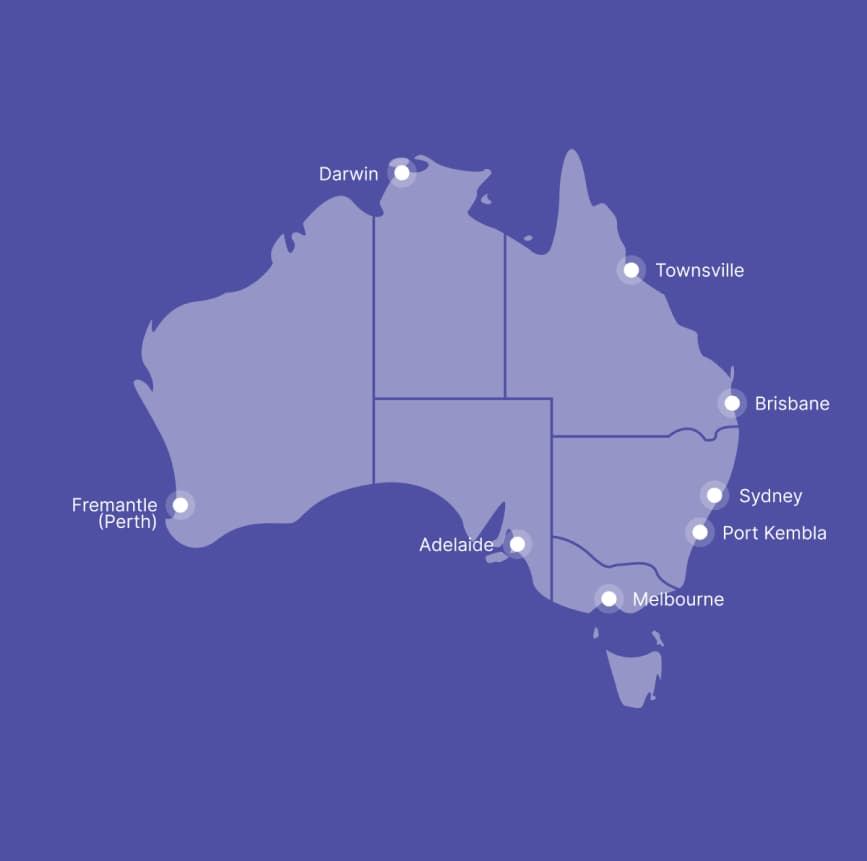
| From | To | Est. transit time |
|---|---|---|
| Sydney, Australia | Bangkok, Thailand | 15-19 days |
| Melbourne, Australia | Bangkok, Thailand | 16-20 days |
| Brisbane, Australia | Laem Chabang, Thailand | 18-22 days |
| Fremantle (Perth), Australia | Laem Chabang, Thailand | 13-17 days |
| Adelaide, Australia | Bangkok, Thailand | 17-21 days |
| Port Kembla, Australia | Bangkok, Thailand | 16-20 days |
| Darwin, Australia | Bangkok, Thailand | 11-15 days |
| Townsville, Australia | Laem Chabang, Thailand | 14-18 days |
Peak shipping months for Thailand
The route usually tightens during a few predictable windows:
- Late March to mid-April
Songkran slows offices, trucking, and some local delivery capacity in Thailand. A shipment can still land, but the last part of the move often stretches. - June to August
Australian family moves and corporate rotations push packing and vessel demand higher, especially from Sydney, Melbourne, and Brisbane. - November to December
Year-end consumer freight and holiday closures raise congestion risk. This is the wrong time to rely on optimistic timelines.
Visa requirements for Australians and other foreigners moving to Thailand
Your import file should be built around the visa or lawful stay route you will actually use in Thailand. Thai visa categories change, and the right answer depends on work, family, retirement, study, or long-stay status, so confirm the current rules on the official Thai eVisa and BOI LTR channels before you book freight.
Main visa categories
For this route, the most common long-stay decision points are:

Visitor and short-stay visas
For tourism or short stays where you are not yet building a long-term household relocation into Thailand.
Work and business visas
For employment, company-linked assignments, or business activity that leads to a real Thailand base.
Education and training visas
For approved study or training programs where your stay has a clear institutional sponsor.
Family, retirement, and long-stay visas
For marriage, retirement, family-linked residence, or selected long-term resident pathways.
Note: If you are building a real household relocation, short-stay permission is usually the wrong foundation for the shipment file.
Check the official Thai eVisa system and BOI long-term resident guidance before committing to freight dates.
Frequently asked questions
Yes, sometimes.
Thai Customs can grant duty relief for used household effects when they were owned and used before shipment, arrive in reasonable quantities, and fall within the timing and documentation rules tied to your arrival in Thailand.
Usually around two to four weeks port to port.
The exact timing depends on the Australian origin city, whether the route is direct or transshipped, and how long Thai handling, customs review, and final delivery take after arrival.
Only when speed matters more than cost.
Air freight can make sense for urgent essentials, work equipment, or a small high-value shipment, but it is rarely the cost-efficient answer for a full household move.
The inventory and your status file matter most.
A bill of lading or air waybill, passport copy, Thai visa or lawful stay evidence where relevant, address details, and a plain-language packing inventory usually do more to protect the move than generic reassurance ever will.
Usually not.
Swift Cargo is generally better suited to private freight from about a one-bedroom apartment upward. If you only have a few boxes, courier and parcel services are often cheaper and simpler.
Weak paperwork and timing mistakes cause most delays.
Common problems include vague inventories, shipments arriving before the importer's status is usable, undeclared regulated items, and unrealistic expectations around Thai port handling or local delivery.
Only after a serious cost check.
Vehicle imports into Thailand can attract approval work, duty, VAT, excise, and compliance costs that make the project uneconomic for many private movers.
It is manageable if the file is clean before departure.
The import permit, health certificate, vaccination record, and flight timing all need to line up. Problems usually come from incomplete documents, not from the existence of the rule itself.
Laem Chabang is the default for many container moves.
Bangkok-area handling can also work, and air freight usually enters through Suvarnabhumi. The best gateway depends on the shipment size, origin city in Australia, and final destination in Thailand.
In many cases, yes or at least a clear lawful-entry plan.
If the shipment is built around duty relief or a real household relocation, short-stay assumptions can create customs and timing problems. Confirm the visa route first, then align the freight dates.
Usually yes, but not in every category.
Rent, domestic services, and daily living are often cheaper, but imported goods, international schools, premium housing, and weak relocation planning can still make the first year expensive.
Sea freight is usually the best-value answer.
LCL works for smaller but still meaningful household moves, while FCL is cleaner for larger family homes. Air freight is usually for urgent essentials, not the whole house.
What matters when you land in Thailand
7–10 hrs
Typical flight time band between major Australian gateways and Thailand
2–4 wks
Common sea-freight transit window before Thai release and final delivery
7%
Thai VAT benchmark that often matters on taxable imports
What changes in the cost of living
Thailand is usually cheaper than Australia for rent, domestic services, eating out, and private daily conveniences, but imported goods and international-school lifestyles can erase part of that advantage quickly.
Bangkok carries the highest mainstream cost profile, especially for central condos, school runs, and international groceries. Chiang Mai and many secondary cities are lighter, while Phuket can feel expensive because of tourism and villa demand.
Most movers should budget for two phases, not one: the landing period, where furniture rental or setup costs are high, and the steady-state period after the household is installed.
Transport is usually cheaper than in Australia, but final costs depend heavily on whether you rely on rail and ride-hailing, or choose a car-centric lifestyle.
Thailand still offers a strong value proposition. The mistake is assuming lower daily costs automatically make the relocation cheap when the import file is weak, the housing choice is wrong, or the school strategy is decided too late.
Security and everyday risks

Security and everyday risks
Thailand is broadly comfortable for long-term residents, especially in established expat zones. The routine risks are usually petty crime, traffic exposure, and compliance mistakes, not high levels of violent crime.
For many arrivals, road safety is the more serious real-world issue. Scooters, informal driving habits, and unfamiliar local patterns create more day-to-day risk than the headlines most newcomers worry about.
Seasonal flooding, heat, and air-quality issues can also shape where people choose to live. Those are lifestyle and health decisions as much as security questions.
Salary expectations in Thailand
Most foreigners moving from Australia need to recalibrate salary expectations. Local pay can look low against Australian benchmarks, while regional packages from multinational employers can still work well.
The real question is not just salary in isolation. It is salary against rent, school costs, tax treatment, and whether your role is local-market or regional-market.
Technology and digital roles
Bangkok remains the strongest market for tech, product, and regional operations roles, with better upside in multinational or venture-backed environments than in purely local SMEs.
Finance and corporate management
Regional finance, legal, and management roles can pay well by local standards, especially when housing or schooling support is included.
Sales and business development
Commercial roles tied to regional revenue can still be attractive, but commission structures and local-market pricing need close scrutiny.
Education and training
International schools and specialised training positions are materially different from mass-market teaching roles. Do not price them as the same labour market.
Hospitality and tourism
Management-track hospitality roles exist, but Thailand is rarely the place to assume Australian-level pay just because the employer looks international.
Thai personal tax considerations
Once you spend enough time in Thailand, tax residency becomes a real planning issue, not background noise. Residency, Thai-source income, remitted foreign income, and treaty relief all matter.
This is one area where stale expat advice ages badly. Before you build a long-stay life, confirm current treatment with a qualified adviser rather than relying on forum folklore.
Finding work in Thailand as a foreigner
Thailand can work well for foreigners with a clear market fit, but it is not a place where generic enthusiasm substitutes for visa, language, and employer reality.
1. Start with credible job channels
Use Thai and regional job boards, sector recruiters, and direct company outreach rather than waiting for broad expat forums to do the work for you.
2. Focus on Bangkok first if career matters
Bangkok remains the main hub for corporate, regional, and international roles. Other cities can be excellent lifestyle choices but weaker employment markets.
3. Build the visa path into the search
A role is only real if the employer can support the right status and the file can be executed lawfully.
4. Use networks that reach decision-makers
Industry contacts, alumni circles, recruiters, and direct introductions usually outperform passive job-board behaviour.
5. Treat work-permit admin as part of the offer
In most cases, to work legally you’ll need a Non-Immigrant Visa “B” and a valid work permit arranged through your employer.
Thailand is also improving long-term options like the LTR Visa (Long-Term Resident) for highly qualified professionals and people who want to live and work in Thailand long-term.
Important update: Since October 2025, Thailand has mandated the use of the e-Work Permit platform for all new work-permit applications, renewals and cancellations. Paper permits are being phased out and employers/foreign workers must file everything through the digital system at eworkpermit.doe.go.th.
Education, healthcare, and services
Thailand attracts families partly because private healthcare is strong, international schooling is widely available in the main hubs, and service standards can feel high relative to cost.
The split between premium and ordinary provision matters. Bangkok offers a very different schooling and hospital landscape from smaller cities.
Administrative processes are manageable, but many still rely on paper, in-person attendance, or local practice rather than a smooth digital flow.
In practical terms, most newcomers do well when they choose neighbourhood, school, and hospital strategy before the shipment arrives rather than after.
Best ways to manage Thai Baht on arrival
The best currency strategy in Thailand is usually a mix: low-markup exchange for larger sums, digital spending for day-to-day convenience, and selective ATM use.
1. Licensed exchange booths
They often beat airport and bank rates, especially in Bangkok, and work well for larger conversions once you are settled.
Pros:
- Strong rates for larger amounts
- Fast access in major districts
- Useful when rent or deposits need cash support
Cons:
- You must handle physical cash
- Rates vary by operator and location
2. ATMs and local withdrawals
Convenient, but fixed withdrawal fees and home-bank charges add up quickly if you use them as your main strategy.
Pros:
- Easy access nationwide
- Works well for short-term liquidity
- Good fallback while banking is being set up
Cons:
- Repeated fee drag
- Exchange rate can be mediocre depending on your card
3. Multi-currency cards and apps
Useful for controlled spending and transparent conversion, especially in the first weeks after arrival.
Pros:
- Cleaner rate visibility
- Good for budgeting
- Safer than carrying large amounts of cash
Cons:
- Cash-heavy parts of Thailand still reduce their usefulness
- ATM and weekend-conversion rules still matter
4. Use your bank before leaving
Exchanging currency before travelling is convenient but often comes with high markups (3–10%), making it the least cost-effective option for most travellers.
Pros:
- Immediate access to Thai Baht on arrival
- Less stress at the airport
Cons:
- Poor exchange rates
- Limited flexibility
Our recommendation for foreign residents in Thailand: combine local exchange booths for larger sums with occasional ATM withdrawals or digital payments for convenience.
Climate and weather in Thailand

Climate and weather in Thailand
Thailand is warm all year, but the real adjustment for many Australians is not heat alone. It is the mix of humidity, monsoon timing, and urban flood patterns.
- Hot season (roughly March to May) with heavy daytime heat and stronger air-conditioning reliance
- Rainy season (roughly June to October) with bursts of intense rain, travel disruption, and local flooding in some districts
- Cooler season (roughly November to February) which is usually the easiest landing window for new arrivals
The climate affects storage, mould risk, furniture choice, and even what you should ship from Australia versus replace locally.
Bangkok, Phuket, Chiang Mai, and island locations do not feel the same in practice. Microclimate matters when choosing where to live.
If you plan around the weather instead of treating it as background, your first months in Thailand usually go more smoothly.
Door-to-door shipping from Australia to Thailand
We manage the route from the Australian pickup point through Thai customs and final delivery, with one file built around the real shipment rather than generic mover language.
1. Packing and file review
Before export, we align the packing plan with the customs file and the risk profile of the goods. That usually includes:
- Export-grade cartons and wrapping
For ordinary household goods that still need to survive multiple handling points. - Protection for fragile items
For glass, electronics, artwork, and anything that becomes expensive if repacked badly. - Crating where needed
For oversized, fragile, or high-value items that need better structural protection.
Full Packing Service: Don’t want to pack yourself? No problem. Your specialist can pack all types of goods, including furniture and oversized items. Just fill out the contact form, and one of our consultants will get in touch to organise your packing needs.
2. Pickup at your Australian address
Collection is scheduled against packing completion, export cut-off, and the route you are actually using, not an optimistic generic timeline.
3. International freight and Thai customs
We move the shipment by sea or air, coordinate the import file, and prepare for Thai customs review, inspection risk, and final release.
4. Delivery to your Thai address
After release, we book delivery around local access, building rules, and the actual receiving window at destination.
5. Unloading and placement
We also offer unpacking services. Your specialist places your goods where you want them so you can start using your home from day one.
What customers said
Verified reviews from customers who moved goods from Australia to Thailand with Swift Cargo:
Checklist for your Australia to Thailand move
Checklist for your Australia to Thailand move
Enter your move details.
Review the route, timing, and customs assumptions.
Choose sea freight, air freight, or a hybrid plan.
Prepare the import file before packing starts.
Confirm delivery address, access, and timing in Thailand.
Track progress while customs and handling are coordinated.
Receive the shipment and complete final delivery.